The Oud, King of Instruments at the Heart of the Maghreb
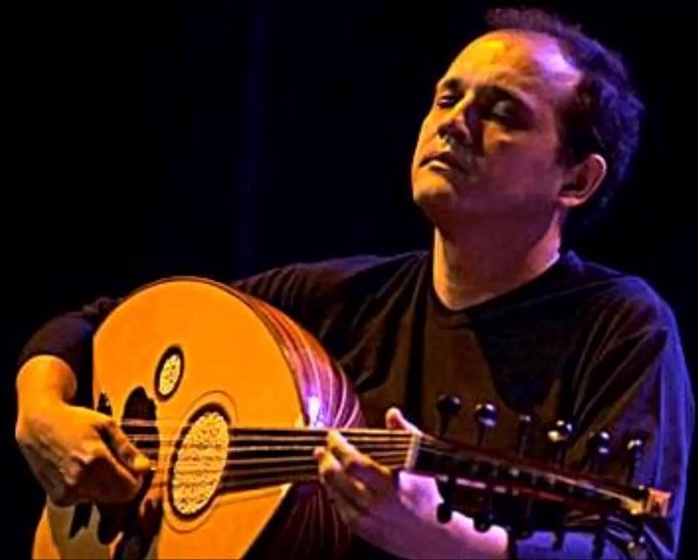
When thinking about North African music, the oud naturally stands out as the silent star. This short-necked lute, without frets and with a pear-shaped body, is the cornerstone of Algerian, Moroccan, and Tunisian musical traditions. It accompanies raï songs in Oran, Gnawa ceremonies in Essaouira, Arab-Andalusian noubas in Algiers, or the Tunisian malouf. Far from being merely a relic of the past, the oud remains at the center of a vibrant scene, supported by international festivals such as that of Tétouan1.
From Persian Origins to the Andalusian Cradle
The oud (al-ʿūd, literally “the wood” in Arabic) traces its roots back to ancient Mesopotamia and the Sassanid Empire, where the barbat — a Persian lute with a round body — was played as early as the 1st century BCE2. Arabs adopted this instrument in the 7th century, modifying the body so it was assembled from wood strips (between fifteen and twenty pieces) rather than carved from a single hollow piece3. Nicknamed “king of instruments” by 9th-century Abbasid scholars, it became the theoretical foundation of Arab music4.
It was a Persian musician, Ziryab (789–857), who made the oud a continental phenomenon. Exiled from Baghdad, he joined the caliphal court of Cordoba and added a fifth string to the instrument, expanding its harmonic range5. He founded one of Europe’s first music schools and introduced the oud into Andalusian intellectual daily life6. When Muslims in Spain were expelled in the 16th century, they sought refuge in Tunisia, Algiers, and Tétouan: the oud traveled with them7.
The Oud Arbi, a Maghrebian Variant
In the Maghreb, the oud takes on a distinct form: the oud arbi, recognizable by its longer neck and four double strings8. In Tunisia, this variant — sometimes called oud ʿarbi — is at the heart of the malouf, the Tunisian classical repertoire. It is tuned according to local maqamat modes: the strings bear names derived from the tubouʿ (Maghrebian modes) — dhil, hassin, maya and ramal9. Tunisian luthiers such as Ridha Jendoubi perpetuate ancestral craftsmanship, crafting instruments with a small but vigorous body, featuring a carved rosette and a leather footrest10.
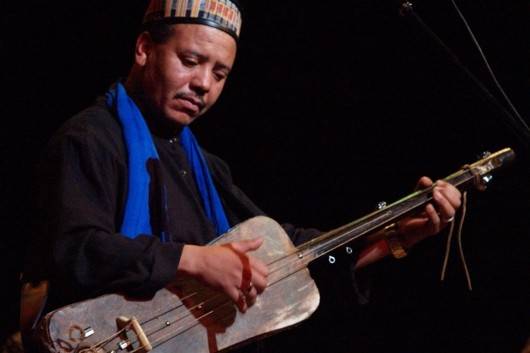
The oud arbi distinguishes itself from the Moroccan kwitra, a lute with an even longer neck and gut strings, present in Sufi ceremonies11. All these variants share a principle: the instrument is plucked with a rîsha, a traditional pick made from an eagle feather, which gives the oud its characteristic timbre12.
A Living and Contemporary Instrument
Today, the oud is not a museum relic. In Tétouan (Morocco), the International Oud Festival gathers annually Moroccan, Iraqi, and Egyptian masters. Its 26th edition in 2024 was placed under the high patronage of King Mohammed VI and offered unprecedented oud duos, illustrating intercultural dialogue through music1. Worldwide, luthiers continue to craft these instruments: in Iran and Syria, building an oud can take up to twenty-five days of work, with the main material being walnut, ebony, or ash2.
The oud also retains its pedagogical function: at the Conservatoire de musique orientale in Paris, professors transmit taqsim techniques (mode-by-mode improvisation) and the subtleties of micro-intervals enabled by the absence of frets3. Young Maghrebian generations — such as Tunisian Abir Ayadi — carry this heritage forward, proving that a millennial instrument can remain vibrant in the 21st century.
The Tunisian Malouf, Guardian of a Tradition
In Tunisia specifically, the oud is the pillar of the malouf, a classical repertoire inherited from Andalusia. Malouf concerts, called majâlis, gather singers and instrumentalists around the oud, rebab (a fiddle), and tar (a circular drum). In Tunisian malouf, the oud plays a fundamental role: it accompanies voices, responds to poetic variations, and ensures an essential rhythmic function5. The istikhbar conductor, who introduces each maqam with an improvisation, is a key moment where the oud reveals its virtuosity5.
Despite its privileged status, the Tunisian oud remains little known to the general public. “There are few specialists, recordings are rare, and there are very few books or references on this instrument,” explains Abir Ayadi5. This invisibility does not mean a lack of vitality: festivals and cultural associations regularly maintain majâlis, ensuring the oral transmission of knowledge that institutionalization has never frozen10.
Did you know? The oud is the direct ancestor of the European lute, and consequently of the modern guitar6. Its inscription on UNESCO’s Representative List of the Intangible Cultural Heritage in 2022 (“Crafting and playing the Oud”) attests that this heritage transcends borders between the Arab world, North Africa, and Europe2.
Sources
-
HIBAPRESS, « Tétouan célèbre la magie de l’oud et honore ses pionniers lors du festival international », 2024. https://es.hibapress.com/64595.html ↩︎ ↩︎
-
UNESCO, « Crafting and playing the Oud », Liste représentative du patrimoine culturel immatériel de l’UNESCO, 2022. https://ich.unesco.org/en/RL/crafting-and-playing-the-oud-01867 ↩︎ ↩︎ ↩︎
-
Michel Arkash, interview RFI, « The voice of the oud », RFI, 16 avril 2019. https://rfi.fr/en/middle-east/20190416-oud-instrument-middle-east-mideastjunction-lute-arab ↩︎ ↩︎
-
Christian Poché, « ʿŪd », Grove Music Online, Oxford University Press. https://doi.org/10.1093/gmo/9781561592630.article.28694 ↩︎
-
Rachel Beckles Willson, « The oud of Tunisia », Musicscape, août 2017. https://om.rachelbeckleswillson.com/2017/08/14/the-oud-of-tunisia ↩︎ ↩︎ ↩︎ ↩︎
-
« History of Oud: Origins, Anatomy and the Great Oud Players », Ethnic Musical. https://www.ethnicmusical.com/oud/oud-instrument ↩︎ ↩︎
-
UNESCO, « Crafting and playing the Oud », op. cit. https://ich.unesco.org/en/RL/crafting-and-playing-the-oud-01867 ↩︎
-
Britannica, « Oud | Music & Instrument ». https://britannica.com/print/article/612394 ↩︎
-
Abir Ayadi (entretien avec Rihab), « The oud of Tunisia », Musicscape, 2017. https://om.rachelbeckleswillson.com/2017/08/14/the-oud-of-tunisia ↩︎
-
Ridha Jendoubi, luthier tunisien ; entretien Musicscape, 2017. https://om.rachelbeckleswillson.com/2017/08/14/the-oud-of-tunisia ↩︎ ↩︎
-
Britannica, « Oud | Music & Instrument ». https://britannica.com/print/article/612394 ↩︎
-
RFI, « The voice of the oud », 2019. https://rfi.fr/en/middle-east/20190416-oud-instrument-middle-east-mideastjunction-lute-arab ↩︎