
Biography
Maaza Mengiste
Named a MacArthur Fellow in September 2026 — what the general public calls a “genius grant” of $625,000 — Maaza Mengiste is among the most acclaimed writers of her generation. This Ethiopian-American novelist, 52 years old, teaches creative writing at Wesleyan University in Connecticut. But it is primarily through her two novels that she made her name: Beneath the Lion’s Gaze (2010) and The Shadow King, a nominee for the Booker Prize in 2020.
An early exile, a pen that crosses borders
Maaza Mengiste was born in 1974 in Addis Ababa, the capital of Ethiopia1. Her family left the country when she was four years old, forced into exile by the revolution that overthrew Emperor Haile Selassie. She spent her childhood in Nigeria, Kenya, and the United States2. This geographical wandering, experienced from within, deeply permeates her writing: uprootedness, fragmented memory, and multiple identities will become her favorite themes.
She returned to the country in adolescence, where she finished her schooling before joining the United States for university studies. She obtained a bachelor of arts in English literature from the University of Michigan in 1993. She continued with a master of fine arts (MFA), a specialized degree in literary creation, from New York University in 2007, and benefited from a Fulbright grant that allowed her to study in Italy2.
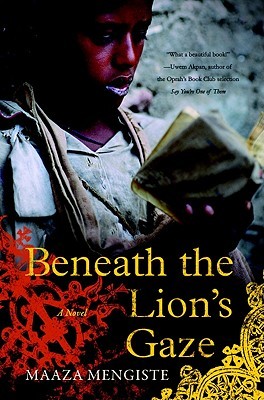
Beneath the Lion’s Gaze — Sous le regard du lion, a first novel that reveals the cracks in history
Her first novel, Beneath the Lion’s Gaze (in French: Sous le regard du lion), was published in 2010 by W. W. Norton1. The plot takes place in Addis Ababa in 1974, at the precise moment when the revolution ended three millennia of monarchy. The novel follows a doctor and his two sons, caught between family loyalty and political commitment2. The father remains faithful to his oath to observe neutrality, the eldest son realizes that apoliticism does not protect his loved ones, and the youngest sees his revolutionary zeal broken by the violence of the new military regime2.
The book was praised by international critics. The Guardian ranked it among the ten best contemporary African books1. It received a nomination for the Dayton Literary Peace Prize and became a finalist for the Flaherty-Dunnan First Novel Prize1. It was translated into French, German, Italian, Dutch, Swedish, and Portuguese1.
Did you know? Maaza Mengiste is also a photographer. On her website, she signs her photos under the name “Maaza” — her first name as it is used by her family and loved ones3.
The Shadow King, the forgotten epic of resistant Ethiopia
In 2019, Maaza Mengiste published The Shadow King, a novel that radically changes register. The plot is set between 1935 and 1941, during the Italian invasion of Ethiopia by Mussolini1. The novel highlights Ethiopian female fighters, about whom very little is said in official history4.
The novel is constructed as a polyphony: several narrative voices interweave, sometimes contradictory, to tell the story5. In the foreground: Aster, a young woman beaten by her husband who joins the resistance, and Hirut, her servant who becomes a soldier2. The book also gives voice to Ettore, an Italian photographer of Jewish origin, whose photographs become political weapons2.
“The language of war is always masculine,” explains Maaza Mengiste in an interview with the Guardian. “We automatically position history in terms of what men have done.”4 Her novel is an effort to restore this forgotten part of the narrative. It received a prestigious nomination for the Booker Prize, the most important Anglophone literary prize6. The New York Times, NPR, Time, and Elle named it the book of 20191. In January 2021, her new short story “Dust, Ash, Flight,” published in the anthology Addis Ababa Noir which she edited, won an Edgar Award for best short story3.
In an interview with Africa in Words, she explained her approach: “I wanted to write a book that reflects history as a series of voices that sometimes conflict. History itself is not linear. It has narratives that collide, cross each other, and leave gaps.”5 Her ambition: to capture what historians cannot say, because they are prisoners of data and written evidence4. The novel functions as a restoration of collective Ethiopian memory, close to the traditional songs of azmaris (singer-storytellers who perpetuate history orally).
“Women at war are both trophies and victims,” she adds. “But there is an intermediate ground where they do something unexpected.”5 This nuance, which refuses to freeze female characters in a role of passive victims, is what distinguishes her novel.
Bibliography
Novels
| Year | Work |
|---|---|
| 2010 | Beneath the Lion’s Gaze — W. W. Norton, Dayton Literary Peace Prize nomination, Flaherty-Dunnan First Novel Prize finalist (page) |
| 2019 | The Shadow King — Canongate Books / W. W. Norton, Booker Prize 2020 (page) |
Short Stories and Anthologies
| Year | Work |
|---|---|
| 2021 | Addis Ababa Noir (ed.) — Akashic Books, Edgar Award for “Dust, Ash, Flight” (page) |
| 2025 | A Brief Portrait of Small Deaths — Fourth Estate / Doubleday (page) |
What She’s Doing Today
Maaza Mengiste lives between New York and Connecticut. She has taught literary creation at Wesleyan University since 2023, following stints at Princeton and Queens College7. She sits on the board of Words Without Borders, an organization dedicated to international literary translation1.
Her next novel, A Brief Portrait of Small Deaths, will be published in October 2025 by Fourth Estate (UK) and Doubleday (US)7. It is set in Berlin during the 1920s and 1930s, amid the rise of Nazism. The novel follows Black German women — some served as models for German Expressionist painters8.
In 2016, she spent ten months in Berlin thanks to the DAAD Artists-in-Berlin Fellowship3. The stay allowed her to deepen her research on this period. « The MacArthur Fellowship gives me the freedom to take even more risks in the next work I will do », she told Wesleyan7.
« I never think of staying static, so language shouldn’t either », she writes. « As a writer, I shouldn’t stay in my comfort zone »5.
Sources
-
Wikipedia, « Maaza Mengiste », https://en.wikipedia.org/wiki/Maaza_Mengiste ↩︎ ↩︎ ↩︎ ↩︎ ↩︎ ↩︎ ↩︎ ↩︎
-
John D. and Catherine T. MacArthur Foundation, « Maaza Mengiste | 2026 », https://www.macfound.org/fellows/class-of-2026/maaza-mengiste ↩︎ ↩︎ ↩︎ ↩︎ ↩︎ ↩︎
-
Maaza Mengiste, « Biography », http://maazamengiste.com/ ↩︎ ↩︎ ↩︎
-
Alex Preston, « Maaza Mengiste : “The language of war is always masculine” », The Guardian, 18 January 2020. https://www.theguardian.com/books/2020/jan/18/maaza-mengiste-interview-shadow-king-language-war-always-masculine ↩︎ ↩︎ ↩︎
-
Korranda Harris & Birhanu Gessese, « Q&A with Maaza Mengiste, author of The Shadow King », Africa in Words, 30 April 2020. https://africainwords.com/2020/04/30/qa-with-maaza-mengiste-author-of-the-shadow-king-no-one-stays-static-so-language-should-not-be-static/ ↩︎ ↩︎ ↩︎ ↩︎
-
The Booker Prizes, « Maaza Mengiste », https://thebookerprizes.com/the-booker-library/authors/maaza-mengiste ↩︎
-
Ziba Kashef, « Maaza Mengiste Awarded MacArthur ‘Genius’ Grant », Wesleyan University, 29 September 2026. https://www.wesleyan.edu/about/news/2026/09/mengiste-award-macarthur-grant.html ↩︎ ↩︎ ↩︎
-
Brittle Paper, « Maaza Mengiste’s New Novel A Brief Portrait of Small Deaths », https://brittlepaper.com/2022/04/african-women-in-early-nazi-germany-center-in-maaza-mengistes-upcoming-novel/ ↩︎