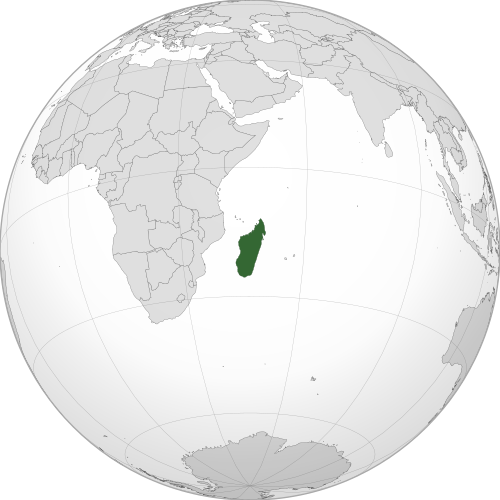
Madagascar: a literature that resists oblivion
In 1937, a young Malagasy poet poisoned himself with cyanide in front of André Gide’s house in Paris. Jean-Joseph Rabearivelo was thirty-five years old. He had just completed a work that, according to Léopold Sédar Senghor, « carries within it the germs of a Malagasy literature » 1. This suicide, a fundamental event, reveals a contradiction that remains alive: Malagasy literature has been, since its first pages, an art in exile—often written in the colonizer’s language, rarely read on the island itself, but nourished by millennial oral traditions.
How did an insular literature manage to impose itself on the French and international stages? Between hainteny—a traditional poetic form of love dialogues 2, kabary—the art of public speech 3—and a meager publishing landscape, Malagasy literature forged a singular voice, made of lyricism, violence, and memory. From Rabearivelo to contemporary authors awarded in France, it tells how a language and a people resist oblivion.
From oral polyphonies to Arabic manuscripts
Even before Latin writing, Madagascar cultivated a script. Between the seventh and tenth centuries, Arab navigators introduced sorabe—an Arabic alphabet adapted for Malagasy—to transcribe religious texts, medical treatises, and royal reports 4. This knowledge, reserved for ombiasy (diviners and scholars), circulated within a restricted circle, but it laid the foundations for an island scriptural culture, isolated in the Indian Ocean yet connected to trade routes.
Oral tradition itself was immense. The hainteny, a conversational poem between two lovers, was considered in Madagascar on par with French troubadours: Leonard Fox, who published translations of it, notes that it « offers us an incomparable vision of a society marked by exceptional refinement, a deep appreciation of beauty, and reverence for spiritual realities » 5. The Ibonia, an epic narrative transmitted over several centuries in various forms across the island, explores the mythologies and beliefs of traditional Malagasy communities 6.
The first king to institutionalize this culture was Radama I (1810-1828), who adopted the Latin alphabet to write Malagasy, relegating sorabe to a secondary role 7. With the arrival of missionaries from the London Missionary Society in Antananarivo in 1820, the Bible was translated into Malagasy in 1835, and the first Malagasy-English dictionary appeared 8. Ranavalona I (1828-1861), a queen passionate about art, launched a program to collect historical traditions and hainteny poems 9.
Rabearivelo: the architect of a modern literature
Jean-Joseph Rabearivelo (1901-1937), Merina by birth, is unanimously considered the greatest poet of Madagascar and « the first modern African poet » 10. Bilingual, he mastered Malagasy and French with equal virtuosity. His style marries surrealist forms, romanticism, and modernism with elements of traditional Malagasy oratory 11.
He maintained regular correspondence with André Gide and Paul Valéry—two giants of French literature—and published literary critiques in Du côté de chez Rakoto, a literary review founded by the colonial administration at the end of the 19th century 12. He also wrote the first Malagasy historical novels and composed Madagascar unique, a Western opera 13.
His suicide in 1937, due to accumulated debts incurred to pay for his pregnant wife, did not erase his work. In 1948, Léopold Sédar Senghor’s anthology Black Voices integrated his poems and legitimized his place among French-language black poets 14. His Œuvres complètes, edited in 2010 by CNRS and Présence Africaine, total more than 3,000 pages 15.
Meanwhile, a literary movement named Vy Vato Sakelika (« Iron, Stone, Branching »), a nationalist secret society founded in 1904, was dismantled by the colonial administration in 1915. Its members—poets and writers—were exiled to Nosy Lava and Mayotte, writing their finest texts far from their native land 16. Malagasy literature was, from its very beginnings, an art of resistance.
Post-independence and the 1980s turning point
With independence achieved in 1960, Malagasy literature entered a new phase. The Paul Minault Protestant college had formed a generation of talents—Célestin Andriamanantena (1918-2002), Emilson Daniel Andriamalala (1918-1979), Dox (1913-1978)—who published after the 1960s 17. In 1952, fifteen authors founded the Union of Malagasy Poets and Writers (U.P.E.M.), launching a poetry recital on the national radio and a review Tatamo (« Water Lily ») 18.
But the 1970s were a « decade of silence », according to Professor Liliane Ramarosoa 19. The problems of the Third World—poverty, political instability, lack of government support for the arts—paralyzed literary production. Writing was rarely a profession: an author had to either self-finance the printing of their book or distribute photocopies to friends.
The renewal came in the 1980s. An « almost urgent wave of production » renewed the landscape 20. For this generation, writing in French was « a miraculous weapon » to conquer an identity amidst the chaos of the modern world 21. The use of French also offered access to an exponentially larger number of readers than Malagasy.
The contemporary scene: awards, translations and resistance
Today, Malagasy literature is more visible than ever — but challenges persist. Madagascar is among the ten poorest countries in the world 22. Literacy hovers around 65% nationally, and drops below 30% in rural areas 23. In the capital, Antananarivo (1.3 million inhabitants), there are only about eight bookstores 24. A new printed book imported from abroad costs roughly one hundred times the price of a bus ticket 25.
Despite these obstacles, Malagasy authors have won prestigious French prizes. David Jaomanoro (1953–2014), poet and short story writer, received the RFI Short Story Prize 26. Jean-Luc Raharimanana (born 1967), winner of the Tardivat International Prize at twenty-two, has published eighteen books — novels, poems, plays — and founded in 2014 the SoaZara company to bring his texts to the stage 27. Naivo (1967–2020) published Au-delà des rizières in 2012, the first Malagasy novel translated into English (by Allison M. Charette, published by Restless Books in 2017), described as a « hainteny poem in novel form » by booksellers from Antananarivo 28.
Michèle Rakotoson (born 1948), a political exile in France during the 1980s and 1990s, received the Grand Medal of Francophonie from the Académie française in 2012 for her entire body of work 29. Upon returning to Madagascar, she founded in 2007 Opération Bokiko (pronounced as a French speaker would say bouquins), an organization that publishes, trains publishers, mentors young authors and organizes book fairs 30.
Andry Andraina (1922–2006), considered the father of Malagasy realist fiction, contributed to establishing literature as part of the national school curriculum 31. His work Mitaraina ny tany (« The Lamenting Land »), translated into French in 2023, depicts peasant life under colonial rule 32.
Did you know? No novel from Madagascar — in French or Malagasy — had ever been translated into English before 2017. Naivo’s Beyond the Rice Fields was the first 33. This means that millions of English-speaking readers had never been able to access a critical and award-winning literature, yet rich in more than a century of history.
A legacy that does not fade
Malagasy literature is not an exotic art: it is a fragile industry, a linguistic resistance, and a voice that refuses to be silenced. Between the angano — tales told by elders to children 34 — and the prizes of the Académie française, it weaves an unbroken thread. Every author — from Rabearivelo to Raharimanana, from Rakotoson to Naivo — carries the same tension: writing in a language that is not their own, to tell a story that belongs to everyone.
The future remains uncertain — lack of printing presses, dependence on French prints, the urban-rural divide — but signs are promising. Project’Îles editions, co-founded in September 2021 by Raharimanana and Nassuf Djailani, aim to publish works in French and Malagasy 35. The growing translation into English gradually expands the readership 36. And as long as there are books like Za by Raharimanana (2008) or Revenir (2018) — read from Paris to Antananarivo, from Berlin to New York — Malagasy literature will continue to resist, page after page.
Sources
-
Senghor, Léopold Sédar, Anthologie de la nouvelle poésie negro-africaine, Seghers, 1948. ↩︎
-
Fox, Leonard, Hainteny: The Traditional Poetry of Madagascar, University of California Press, 1990. ↩︎
-
Wikipedia, Literature of Madagascar, en.wikipedia.org/wiki/Literature_of_Madagascar, accessed November 7, 2026. ↩︎
-
Wikipedia, Sorabe, en.wikipedia.org/wiki/Sorabe, accessed November 7, 2026. ↩︎
-
Fox, Leonard, Hainteny: The Traditional Poetry of Madagascar, University of California Press, 1990, p. 39. ↩︎
-
Razaimiandrisoa, H., Malagasy Oral Literature, Madagascar Studies, accessed November 7, 2026. ↩︎
-
INALCO, Pour une histoire littéraire inclusive de la littérature malgache, international colloquium, August 2022, inalco.fr, accessed November 7, 2026. ↩︎
-
Auzias, Dominique and Labourdette, Jean-Paul, Petit Futé: Madagascar 2008, 2007. ↩︎
-
INALCO, Pour une histoire littéraire inclusive de la littérature malgache, international colloquium, August 2022. ↩︎
-
Killam, Donald and Rowe, Joseph, The Literature of Sub-Saharan Africa, Litwin Books, 2000. ↩︎
-
Wikipedia, Literature of Madagascar, en.wikipedia.org/wiki/Literature_of_Madagascar, accessed November 7, 2026. ↩︎
-
Charette, Allison M., Knowing the Unknowable: Writing from Madagascar, Words Without Borders, December 2015. ↩︎
-
Rabearivelo, Jean-Joseph, Œuvres complètes, CNRS-Présence Africaine, 2010. ↩︎
-
Senghor, Léopold Sédar, Black Voices, 1948. ↩︎
-
Meitinger, Serge, Ramarosoa, Liliane and Riffard, Claire (eds.), Jean-Joseph Rabearivelo, Œuvres complètes, CNRS/Présence Africaine, 2010. ↩︎
-
INALCO, Pour une histoire littéraire inclusive de la littérature malgache, international colloquium, August 2022. ↩︎
-
INALCO, Pour une histoire littéraire inclusive de la littérature malgache, international colloquium, August 2022. ↩︎
-
INALCO, Pour une histoire littéraire inclusive de la littérature malgache, international colloquium, August 2022. ↩︎
-
Ramarosoa, Liliane, Anthologie de la littérature malgache d’expression française des années 80, L’Harmattan. ↩︎
-
Charette, Allison M., Knowing the Unknowable: Writing from Madagascar, Words Without Borders, December 2015. ↩︎
-
Ramarosoa, Liliane, Anthologie de la littérature malgache d’expression française des années 80, L’Harmattan. ↩︎
-
IMF, World Economic Outlook, 2014-2015. ↩︎
-
CIA World Factbook, Madagascar — Literacy rate, accessed November 7, 2026. ↩︎
-
Charette, Allison M., Embedded with the Beating Heart of Madagascar’s Literary Life, Literary Hub, April 2019. ↩︎
-
Charette, Allison M., Embedded with the Beating Heart of Madagascar’s Literary Life, Literary Hub, April 2019. ↩︎
-
Wikipedia, Jean-Luc Raharimanana, fr.wikipedia.org/wiki/Jean-Luc_Raharimanana, accessed November 7, 2026. ↩︎
-
And Other Stories, Jean-Luc Raharimanana, andotherstories.org, accessed November 7, 2026. ↩︎
-
PEN America, Introducing the Literature of Madagascar: On Translating Naivo, pen.org, December 2015. ↩︎
-
Académie française, Michèle Rakotoson, academie-francaise.fr/michele-rakotoson, accessed November 7, 2026. ↩︎
-
Charette, Allison M., Embedded with the Beating Heart of Madagascar’s Literary Life, Literary Hub, April 2019. ↩︎
-
Words Without Borders, Andry Andraina, wordswithoutborders.org/contributors/view/andry-andraina, accessed November 7, 2026. ↩︎
-
Erostrate, Andry Andraina - Mitaraina ny tany, erostrate.org, accessed November 7, 2026. ↩︎
-
Charette, Allison M., Knowing the Unknowable: Writing from Madagascar, Words Without Borders, December 2015. ↩︎
-
GLLI, Naivo, the first Malagasy novelist translated into English, glli-us.org, December 2021. ↩︎
-
Wikipedia, Jean-Luc Raharimanana, fr.wikipedia.org/wiki/Jean-Luc_Raharimanana, accessed November 7, 2026. ↩︎
-
Restless Books, Beyond the Rice Fields by Naivo, restlessbooks.org, 2017. ↩︎