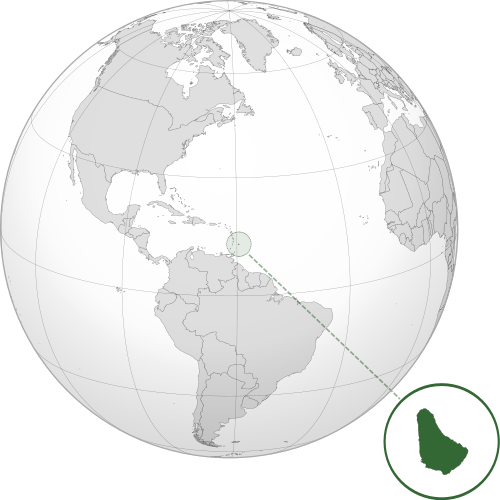
The Little Island That Made the World Dance: The Musical History of Barbados
On the 430 km² of Barbados, fewer than 290,000 inhabitants gave birth to an indigenous musical genre, the tuk — this small ensemble music of flute, bass drum, and caisson that still rhythms every Crop Over — and to a global superstar who has accumulated nine Grammy Awards. Barbadian music is a story of resistance, adaptation, and explosive creativity. How did an island lost in the Atlantic become one of the most fertile sound laboratories of the Caribbean?
From Banned Drums to Tuk: The African Root
Unlike many islands that developed their own percussion, Barbados had to invent them from scratch. In 1688, plantation owners formally banned the playing of African drums, fearing that polyrhythm would serve as a signal for revolt among slaves1. But the sound did not die: it transformed.
Barbadian slaves recovered British military instruments — iron flute, snare drum, double-headed bass drum — and loaded them with West African rhythms, essentially Akan, Igbo, and Yoruba2. Born from this syncretism, the tuk music — whose name would come from the onomatopoeia of the caisson or the Scottish expression tuck of drum — structures itself around three pillars: the kittle (snare drum), the bum-drum (bass drum) and the flute or penny-whistle3. At the colonial time, the tuk was already much more than a genre: it was the sound backbone of the Landship, a popular mutual aid society born in the 1860s where ex-slaves and workers imitated British naval structure by dancing simulated maneuvers4.
After the emancipation of 1834 (with end of apprenticeship in 1838), the tuk accompanies Crop Over ceremonies, the sugar cane harvest end festival created by plantations as early as 16875. Music becomes the thread of a memory that colonialism cannot cut.
Did you know? The tuk is today inscribed on the Barbadian national inventory of intangible heritage (reference 2023-001), alongside the spouge and steelpan music6.
Calypso and Spouge: Barbados Invents Its Own Voice
At the beginning of the 20th century, calypso arrives from Trinidad, bearer of a social satire tradition already well anchored. It meets a Barbadian public eager for this satirical language7. The first local calypsonians, Da Costa Allamby and Mighty Charmer, struggle to impose themselves in a market still dominated by Trinidadian artists8.
It is then that the figure of Jackie Opel explodes. Born Dalton Bishop in 1938 in the worker neighborhood of Bridgetown, the young man noticed by Jamaican bandleader Byron Lee spends most of the 1960s in Kingston, where he sings with the Skatalites and frequents Studio One9. Bunny Wailer will call him « the greatest of them all »10. But his decisive heritage is the spouge, a genre invented around 1968 as Barbadian response to Jamaican ska11.
The spouge fuses Trinidadian calypso, Jamaican ska and North American gospel harmonies, all carried by a rhythmic cadence to the cowbell — le cowbell — and stunning brasses12. From 1969 to 1973, the spouge dominates Barbadian waves and exports itself up to New York, where Madison Square Garden galas dedicate entire evenings to it13. The premature death of Jackie Opel in March 1970, at 31 years old, cuts short this era — but the genre survives in collective memory, and groups like Draytons Two or Blue Rhythm Combo continue to carry it14.
In 1966, Barbadian independence relaunches local calypso. The Merrymen, flagship group of the time, prints classics like « Brudda Neddy » and « Millie Gone to Brazil », still played during Independence Festival of Creative Arts ceremonies15.
Crop Over: From Rural Festival to Engine of the Music Industry
The Crop Over, born on plantations in the 17th century, withers in the 1940s with the collapse of the sugar industry16. In 1974, the National Cultural Foundation (NCF) relaunches it as national festival, with calypso competitions at Pic-O-De-Crop17.
The rebirth is not only cultural: it is economic. For the year 2007, a study by SALISES (Arthur Lewis Centre of UWI) evaluates Crop Over impact at 78 million Barbadian dollars, about 1% of national GDP18. In 2025-2026, the festival attracts more than 100,000 visitors and generates nearly 100 million dollars of economic activity19.
But Crop Over also sheds light on a deep musical mutation: in the 1980s and 1990s, soca — this fast derivative of calypso born in Trinidad in 1963 — becomes the undisputed sound there20. For the first time, a genre from outside implants better than local genres. Barbados adapts soca to its sauce, then invents its own variant.
Regional and global figures: from Krosfyah to Rihanna
Barbados has exported its sound across the continent and beyond. Krosfyah, led by Edwin Yearwood, toured throughout the Caribbean and the diaspora in the 1990s with tracks that became party anthems like Pump Me Up and Sak Passe21. Yearwood notably achieved a historic treble in 1995 by winning both the Party Monarch, the Road March and the Calypso Monarch at Crop Over22.
Alison Hinds, nicknamed the « Queen of Soca » (Queen of Soca), arrived on the scene at 17 in the group Square One before conquering the world with tracks like Roll It Gal and Bumpers. Born in London but raised in Bridgetown, Hinds was the first woman to win the Road March in 1996 and 1997, then the Calypso Monarch in 1997 — proving that a female voice could dominate a soca space long dominated by men23. Cultural ambassador of Barbados since 2018, she received an honoris causa doctorate from UWI Cave Hill in 202324.
Rupee (Rupert Clarke) crossed the ocean with the hit Tempted to Touch, a single that sold well beyond the carnival circuit and opened doors for him at Atlantic Records25. Shontelle (Shontelle Delia Layne, born in 1985) carved out her own international path with Impossible, an R&B anthem released in 2010, before opening the stage for Beyoncé on her British tour26.
And then there is Rihanna (Robyn Rihanna Fenty), born on February 20, 1988 in Saint Michael27. With Pon de Replay in 2005, a Barbadian teenager launched a career that now counts eight studio albums and nine Grammy Awards28. From Music of the Sun, her first album influenced by dancehall, to Anti in 2016, Rihanna put Barbados on the global stage — so much so that the Parliament of Bridgetown proclaimed her « Rihanna Day »29. In August 2025, she walked in the Grand Kadooment Day in spectacular feather costumes, a direct fusion between Crop Over and her own aesthetic30.
The contemporary scene: genre no longer has borders
What strikes about Barbados today is that Barbadian music is no longer limited to a single genre. The young generation mixes soca, bashment (soca-dancehall fusion), Afrobeats, R&B and hip-hop in a fluid crucible31.
Faith Callender notes this: « When I started in 2014, the boundaries between genres were much clearer. Today, young artists listen to everything — soca, bashment, Afrobeats, dancehall — and let these influences blend naturally »32.
Artists like Mole (Mole De Chief) and Lil Rick embody bashment soca, a Barbadian innovation that fuses the party rhythm with the raw energy of Jamaican dancehall33. Mikey Mercer with Like Ah Bajan and Peter Ram with Made in Barbados continue to carry patriotic anthems during Crop Over34.
For Alison Hinds, the question is not about protecting a « pure » sound, but evolving it: « As long as it is created by Bajans, it is Barbadian music »35.
This thriving scene is nourished by institutions like the Barbados Jazz Excursion, a festival that attracts international Grammy winners every year while offering a platform to local artists36. And by the NCF, which manages dozens of events each Crop Over season, from junior calypso to steelpan galas37.
A heritage in motion
Barbados has achieved a rare feat: transforming a legacy of colonial brutality — slavery, ban on drums, suppression of African cultural practices — into a reservoir of musical creation that resonates well beyond its 430 km²38. From the tuk that rhythmically guided Landship ceremonies to Jackie Opel’s spouge, from the socialist calypso of Crop Over to Mole’s bashment, Barbadian music is an active heritage that constantly reinvents itself.
As Alison Hinds reminds us, Barbados’ musical genius does not lie in a fixed style, but in the capacity of Bajans to absorb, transform and give back — a principle that has worked since the plantations of the 17th century39. Music does not just tell what Barbados was: it shows what it will become.
Sources
rbados Today, « Jeffrey Osborne headlines Barbados Jazz Excursion 10th anniversary » (27/09/2026), accessed on October 26, 2026. URL: http://barbadostoday.bb/2026/09/27/jeffrey-osborne-headlines-barbados-jazz-excursion-10th-anniversary
-
Wikipedia, “Music history of Barbados”, accessed October 26, 2026. URL: https://en.wikipedia.org/wiki/Music_history_of_Barbados ↩︎
-
Stefan Walcott, “Bajan Mummers, Have They Lost The Plot” (2011), accessed October 26, 2026. URL: https://folkplay.info/files/papers/201111/Rowley2011.pdf ↩︎
-
Sharon Meredith, Tuk Music Tradition in Barbados (SOAS Musicology), review, accessed October 26, 2026. URL: https://scholarworks.iu.edu/journals/index.php/jfrr/article/view/38477 ↩︎
-
Visit Barbados, “Explore Bajan Music of the Sun”, accessed October 26, 2026. URL: https://visitbarbados.org/bajan-music-of-the-sun ↩︎
-
Wikipedia, “Music history of Barbados”, accessed October 26, 2026. URL: https://en.wikipedia.org/wiki/Music_history_of_Barbados ↩︎
-
Barbados National Inventory of Intangible Cultural Heritage, accessed October 26, 2026. URL: https://ich.unesco.org/doc/download.php?versionID=77138 ↩︎
-
Wikipedia, “Music history of Barbados”, accessed October 26, 2026. URL: https://en.wikipedia.org/wiki/Music_history_of_Barbados ↩︎
-
Wikipedia, “Music history of Barbados”, accessed October 26, 2026. URL: https://en.wikipedia.org/wiki/Music_history_of_Barbados ↩︎
-
Barbados Today, “Jackie Opel: Forgotten Hero of Jamaica and Barbados” (26/08/2024), accessed October 26, 2026. URL: https://barbadostoday.bb/2023/08/26/jackie-opel-forgotten-hero-of-jamaica-and-barbados/ ↩︎
-
The Guardian, “Let’s spouge! Discover the funky joy of the greatest forgotten music genre” (28/02/2022), accessed October 26, 2026. URL: https://www.theguardian.com/music/2022/feb/28/spouge-forgotten-music-genre-jackie-opel-barbados ↩︎
-
Wikipedia, “Spouge”, accessed October 26, 2026. URL: https://en.wikipedia.org/wiki/Spouge ↩︎
-
The Guardian, “Let’s spouge! Discover the funky joy of the greatest forgotten music genre” (28/02/2022), accessed October 26, 2026. URL: https://www.theguardian.com/music/2022/feb/28/spouge-forgotten-music-genre-jackie-opel-barbados ↩︎
-
Afropop Worldwide, “Spouge in the Big Apple”, accessed October 26, 2026. URL: https://www.afropop.org/articles/spouge-in-the-apple ↩︎
-
Wikipedia, “Spouge”, accessed October 26, 2026. URL: https://en.wikipedia.org/wiki/Spouge ↩︎
-
Wikipedia, “Music history of Barbados”, accessed October 26, 2026. URL: https://en.wikipedia.org/wiki/Music_history_of_Barbados ↩︎
-
Britannica, “Crop Over”, accessed October 26, 2026. URL: https://www.britannica.com/topic/Crop-Over ↩︎
-
Caribbean News Global, “Building Barbados’ creative economy”, accessed October 26, 2026. URL: https://caribbeannewsglobal.com/building-barbados-creative-economy ↩︎
-
Central Bank of Barbados, “Exporting Vibes: Building Barbados’ Creative Economy”, accessed October 26, 2026. URL: https://centralbank.org.bb/news/everyday-economics/exporting-vibes-building-barbados-creative-economy ↩︎
-
Barbados Today, “Monetising the national Crop Over Festival” (15/07/2025), accessed October 26, 2026. URL: https://barbadostoday.bb/2025/07/15/monetising-the-national-crop-over-festival ↩︎
-
Billboard, “Rihanna’s Success Crosses Over Onto Cropover” (2015), accessed October 26, 2026. URL: https://billboard.com/articles/business/6640859/rihanna-cropover-festival-barbados ↩︎
-
The Caribbean Camera, “Bajan Soca Royalty Takes Over CNE Sunday”, accessed October 26, 2026. URL: https://thecaribbeancamera.com/bajan-soca-stars-cne-alison-hinds-rupee-edwin-yearwood ↩︎
-
The Caribbean Camera, “Bajan Soca Royalty Takes Over CNE Sunday”, accessed October 26, 2026. URL: https://thecaribbeancamera.com/bajan-soca-stars-cne-alison-hinds-rupee-edwin-yearwood ↩︎
-
Jamaica Gleaner, “Caribbean Flavour Series — Alison Hinds, a soca role model”, accessed October 26, 2026. URL: https://web.archive.org/web/20110812004322/http:/jamaica-gleaner.com/gleaner/20070211/ent/ent2.html ↩︎
-
Wikipedia, “Alison Hinds”, accessed October 26, 2026. URL: http://en.wikipedia.org/wiki/Alison_Hinds ↩︎
-
The Caribbean Camera, “Bajan Soca Royalty Takes Over CNE Sunday”, accessed October 26, 2026. URL: https://thecaribbeancamera.com/bajan-soca-stars-cne-alison-hinds-rupee-edwin-yearwood ↩︎
-
Wikipedia, “Shontelle”, accessed October 26, 2026. URL: https://en.wikipedia.org/wiki/Shontelle ↩︎
-
Britannica, “Rihanna”, accessed October 26, 2026. URL: https://www.britannica.com/biography/Rihanna ↩︎
-
Grammy.com, “Songbook: The Ultimate Guide To Rihanna’s Reign” (29/08/2025), accessed October 26, 2026. URL: https://www.grammy.com/news/rihanna-songs-albums-discography-music-guide-career/ ↩︎
-
Wikipedia, “Rihanna”, accessed October 26, 2026. URL: https://en.wikipedia.org/wiki/Rihanna ↩︎
-
Ynet News, “Rihanna dazzles crowds at Barbados’ annual Crop Over festival”, accessed October 26, 2026. URL: https://www.ynetnews.com/culture/article/rkfa8tguzx ↩︎
-
Barbados Today, “What does Barbados sound like today?” (08/10/2026), accessed October 26, 2026. URL: https://barbadostoday.bb/2026/10/08/what-does-barbados-sound-like-today ↩︎
-
Barbados Today, “What does Barbados sound like today?” (08/10/2026), accessed October 26, 2026. URL: https://barbadostoday.bb/2026/10/08/what-does-barbados-sound-like-today ↩︎
-
Barbados Revealed, “Bajan Soca 2026: A Deep Dive into Barbados Culture & Music”, accessed October 26, 2026. URL: https://barbadosrevealed.com/blog/culture/bajan-soca-2026-a-deep-dive-into-barbados-culture-music ↩︎
-
MASX World, “Barbados Is Heating Up: What’s Happening This Weekend as Crop Over 2026 Gets Ready to Take Over”, accessed October 26, 2026. URL: https://masxworld.com/barbados-is-heating-up-whats-happening-this-weekend-as-crop-over-2026-gets-ready-to-take-over/ ↩︎
-
Barbados Today, “What does Barbados sound like today?” (08/10/2026), accessed October 26, 2026. URL: https://barbadostoday.bb/2026/10/08/what-does-barbados-sound-like-today ↩︎
-
Ba ↩︎
-
NCF Barbados, « A Show to Savour » (10/07/2025), accessed on October 26, 2026. URL: https://ncf.bb/2025/07/10/a-show-to-savour ↩︎
-
Wikipedia, « Music history of Barbados », accessed on October 26, 2026. URL: https://en.wikipedia.org/wiki/Music_history_of_Barbados ↩︎
-
Barbados Today, « What does Barbados sound like today? » (08/10/2026), accessed on October 26, 2026. URL: https://barbadostoday.bb/2026/10/08/what-does-barbados-sound-like-today ↩︎