Biography
Fatou Guéwel
Born in the wake of the griots — these traditional storytellers and musicians who transmit history through the voice1.
In brief
| Full name | Fatou Binetou Diouf |
| Birth | June 9, 1964, Dakar, Senegal |
| Stage name | Fatou Guewel (Guewel means griot in Wolof) |
| Genre | Mbalax louangeur — traditional Senegalese music |
| Notable works | Santa Ti Cheikh Ibra Fall, Fatou, Borom Khayra |
| Group | Groupe Sope Noreyni |
| Labels | KSF Diagne Productions, Stern’s Music, Konate Studio |
Key dates
| Year | Event |
|---|---|
| 1964 | Birth in Dakar, in a Wolof griot family |
| 1992 | Integration into the Ensemble lyrique traditionnel du Théâtre national; creation of Groupe Sope Noreyni |
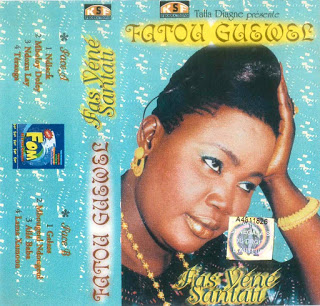
| 1994 | National television breakthrough; Santa Ti Cheikh Ibra Fall becomes a hit |
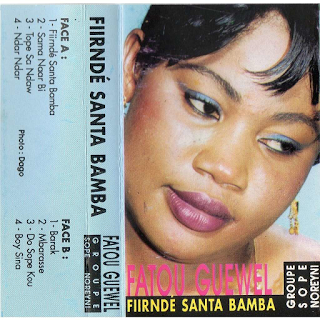
| 1995 | Departure from the Ensemble lyrique; consecration with Funde Santa Bamba |
| 1996 | First international tour (United States, Italy, France) |
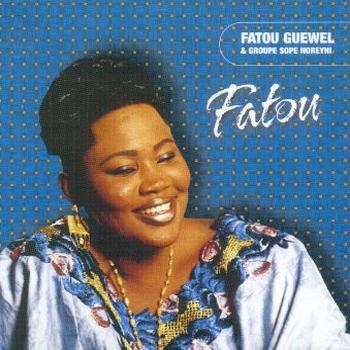
| 1998 | Album Fatou on Stern’s Music, first international record of its kind |
| 2002–2014 | Albums: Fonk Sa Waajur, Ooh c’est chaud!, Borom Khayra |
| 2025 | Forty years of career |
Origins and training
Fatou Guéwel Diouf grew up in an environment where sung speech served as a vector of collective memory. Descended from a line of Wolof griots, she began singing very early at baptisms and traditional ceremonies. She sang within a theatrical dance troupe before joining in 1992 the Ensemble lyrique traditionnel du Théâtre national de Dakar and founding the Groupe Sope Noreyni2.
Revelation and international success
A television performance in 1994 secured an unprecedented platform and opened a tour across the country. Santa Ti Cheikh Ibra Fall (1994) became a popular hit, then Funde Santa Bamba (1995) confirmed the success. Her style is a more rooted mbalax than that of Youssou N’Dour. The lyrics cover praises to figures of Mouridism, portraits of daily life, and reflections on family3.
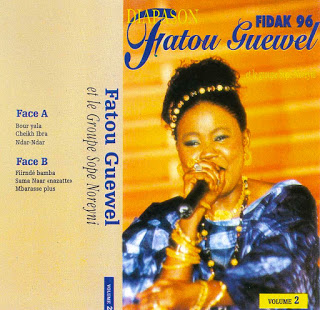
This national consecration opened the international stage in 1996 with concerts in the United States, Italy, and France. Her album Fatou, published by Stern’s Music in 1998, compiles her first cassettes. For the Passport to Paradise exhibition at UCLA, which preserves a stage robe gifted by Fatou Guewel adorned with motifs of Cheikh Ahmadou Bamba, she embodies Mouride music carried by a female voice. The return of Serigne Modou Moustapha on social media approaching Magal 2026 proves the longevity of her repertoire4.
Legacy
She built her legacy on three pillars: showing that a woman could dominate the mbalax louangeur in a historically male genre, proving that music rooted in Mouride tradition could conquer an international audience, and illustrating the transformation of Senegalese music from cassette to digital. In 2025, she celebrated forty years of career. Today, when an excerpt of Mbarass resurfaces on a mobile phone, it is the present that discovers it already had a memory3.
Major works
| Work | Year | Why it is essential |
|---|---|---|
| Santa Ti Cheikh Ibra Fall | 1994 | Founding cassette; praise to the son of the founder of Mouridism |
| Funde Santa Bamba | 1995 | Confirmation of success and reach throughout Senegal |
| Fatou | 1998 | First international album by a Senegalese singer of her kind |
| Borom Khayra | 2014 | Late double album, testimony of a career never stopped |
Sources and references
-
AllMusic, Fatou Guewel biography, accessed November 2, 2026 ↩︎
-
Wikipedia, Fatou Guewël, Wikipédia, accessed November 2, 2026 ↩︎
-
Amadou Kébé, La voix qui a traversé les générations, Le Soleil (Dakar), September 15, 2026, accessed November 2, 2026 ↩︎ ↩︎
-
Musiques d’Afrique, Frank Bessem, Fatou Guewel Senegal, 1998, accessed November 2, 2026 ↩︎