Biography
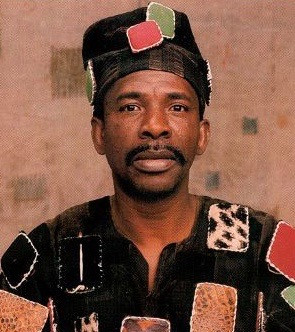
Mustapha Tettey Addy
In 1974, at the Cheltenham Music Festival in England, a handful of Ghanaian drummers took to the stage. The audience, mainly middle-aged English people accustomed to classical music, found themselves a few minutes later in the wings and parking lot, overcome by an impossible-to-contain rhythmic frenzy. The musicians did not just play: they loaded all their drums into a packed minibus and continued drumming on the way to Cologne for their next concert. That night, Mustapha Tettey Addy introduced Europe to the raw power of traditional Ghanaian percussion, long before the term world music became a commercial label.
In brief
| Full name | Mustapha Tettey Addy |
| Birth | 1942, Avenor (Ga village near Accra), Ghana |
| Field | Traditional percussion, ethnomusicology, ritual dance |
| Notable works | Master Drummer from Ghana, The Royal Drums of Ghana |
| Honours | Titled dadefoiakye (master drummer) by his extended family |
Key dates
| Year | Event |
|---|---|
| 1942 | Birth in a Ga village, Avenor, near Accra |
| 1963 | Appointment as dadefoiakye (master drummer) after his father’s death |
| 1963 | First tour in West Germany with the Obonu Drummers |
| 1964 | New York World Festival, with dance group led by Mistress Adesika Adu |
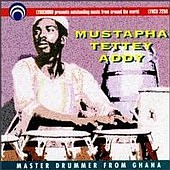
| 1972 | Release of first album, Master Drummer from Ghana (Tangent Records) |
| 1974 | Cheltenham Music Festival – performance that made a lasting impression |
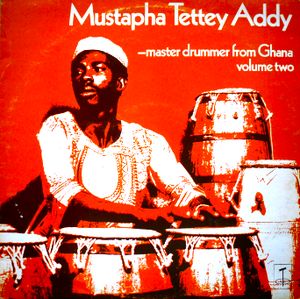
| 1980 | Master Drummer from Ghana, Vol. 2 (Tangent Records) |
| 1990s-2005 | Regular European tours; Smart Boys (WeltWunder Records) |
Origins and training: the drum in the blood
Mustapha Tettey Addy was born in 1942 in a small Ga village called Avenor, on the outskirts of Accra. He grew up in a family where music was not a leisure activity but an institutional vocation. His father, Kpani Kofi Addy (also known as Okonfo Akoto Addy in some sources), was a respected Akan priest who initiated him very early into drumming. As AllMusic reports, Mustapha Tettey Addy comes from a family of drummers. He was initiated into ritual percussion and dance by a father who was also a fetish priest.
This initiation went beyond instrumental technique. The young man learned traditional Ga songs and ritual dances — Kpele, Akon, Otu — as well as the meaning and healing properties of medicinal herbs. In Ghana, music and disease care are intimately linked: to understand one is to understand the other.
Revelation and international recognition
In 1963, his father’s death marked a turning point. For his deep knowledge of Ga drumming, dance and rituals, members of his family designated him dadefoiakye — a title that recognized him as chief master drummer. At the time, he was already working at the University of Ghana as a drummer and dancer, a post that opened unexpected doors. There he met specialists from various regions of Ghana who came to study at the Institute of African Studies, thus expanding his repertoire beyond just the Ga heritage.
That same year, 1963, he embarked on his first foreign tour in West Germany with the Obonu Drummers. Two years later, he represented Ghana at the New York World Festival in 1964, alongside the dance group led by Mistress Adesika Adu. These early international appearances laid the foundations for a career that would span decades.
From Ghana to Europe: a pioneer of African percussion
In the 1970s, Mustapha Tettey Addy became one of the first strictly traditional African musicians to perform in Europe. His performance at the Cheltenham Music Festival in 1974 remains a reference: “one of the first strictly traditional African musicians to perform in Europe,” wrote critic John Ryle for The Guardian. On the day of that festival, he “induced an audience of English, middle-class, middle-aged classical music lovers to take to the stage in a conga line, servants to the rhythm of Ashanti and Ga” — the audience found themselves in rhythmic disarray, led out of the auditorium, down the corridors, to the parking lot, and finally into the minibus speeding towards Cologne, drums still in hand.
This episode is not anecdotal: it predates by a decade the creation of the term world music as a marketing category by the industry. Peter Gabriel had not even yet imagined Womad. Tettey Addy sold this uncompromising tradition on a European stage that was still closed to such performances.
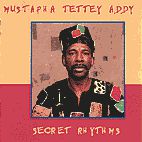
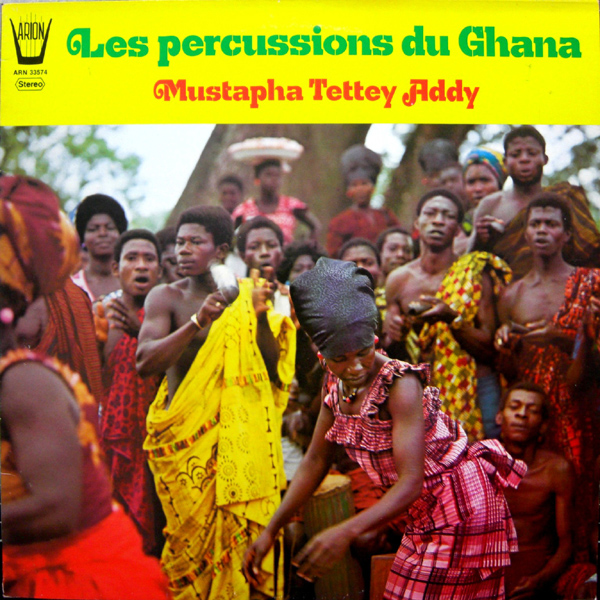
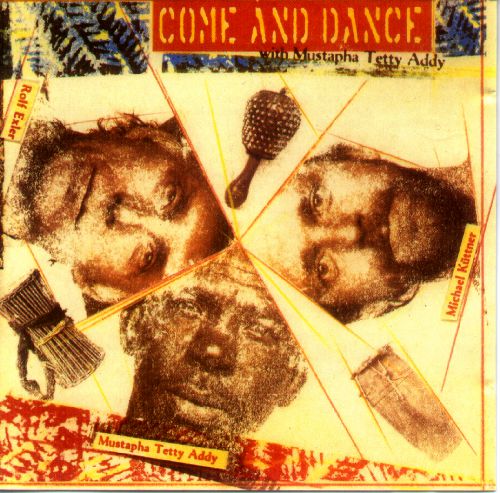
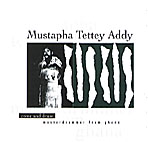
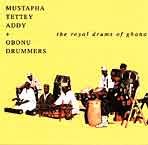
His first recording, Master Drummer from Ghana, appeared in 1972 with Tangent Records (London), followed a few years later by a second volume. These records served as an introduction for listeners discovering that the African drum is a complete language, not an exotic accessory. He then recorded The Royal Drums of Ghana (WeltWunder Records, 1991) and Smart Boys (2005), always with the German label WeltWunder, which played a crucial role in spreading traditional African music in Europe.
Major works
| Work | Year | Why it is essential |
|---|---|---|
| Master Drummer from Ghana | 1972 | First international recording, brings Ga percussion to a Western audience |
| Master Drummer from Ghana, Vol. 2 | 1980 | Continuation of dialogue with the European public, deepening of ritual styles |
| The Royal Drums of Ghana | 1991 | Return to Ga royal roots, recorded with WeltWunder Records in Germany |
| Smart Boys | 2005 | Turning towards younger generations, a bridge between tradition and modernity |
Heritage and influence
Mustapha Tettey Addy paved the way for an entire generation of Ghanaian musicians who followed him onto international stages. John Collins, ethnomusicologist researcher, cites him as a central figure in Ghana’s response to the world music boom. His work influenced the development of professional Ghanaian cultural groups that, from the late 1980s onward, served dual functions: performance troupes and teaching units for foreign visitors.
His legacy is also ethnological: as an ethnomusicologist, he contributed to documenting and preserving Ga rhythmic traditions in the context of Accra’s rapid modernization. The styles he championed — Kpele, Akon, Otu — continue to be practiced in Ga communities and serve as a foundation for contemporary Ghanaian percussion.
Sources and references
- « Mustapha Tettey Addy », Wikipedia, https://en.wikipedia.org/wiki/Mustapha_Tettey_Addy, accessed November 17, 2026.
- « Mustapha Tettey Addy: Biography », Weltwunder, http://www.weltwunder.com/mta.en.html, accessed November 17, 2026.
- « Mustapha Tettey Addy », AllMusic, https://www.allmusic.com/artist/mustapha-tettey-addy-mn0000621183, accessed November 17, 2026.
- John Ryle, « The power of the drum », The Guardian / City of Words, December 1996, https://johnryle.com/?article=the-power-of-the-drum, accessed November 17, 2026.
- William Ray Matczynski, Staging Heritage, Sounding Ga Kusum: The Festival Politics of Music, Sound, and Performance in Accra, Ghana, doctoral thesis, UCLA, 2022, https://escholarship.org/content/qt3cq7f733/qt3cq7f733.pdf, accessed November 17, 2026.
- John Collins, « Ghana and the World Music Boom », African Studies Review, https://helda.helsinki.fi/bitstreams/9eb7acdc-85af-4532-ac04-8351f4a3/download, accessed November 17, 2026.