
Biography
Vasco Martins
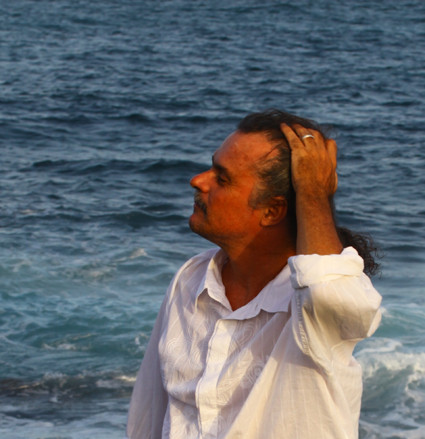
Vasco Martins settled far from the crowds, in a valley of the Ribeira do Calhau on the island of São Vicente. Nicknamed “hermit of sound” by the island’s inhabitants, he lived just steps from the Atlantic and composed symphonies using sounds of the shoreline as his sole raw material. Died on November 27, 2025 at the age of 69, Vasco Jorge Coelho de Oliveira Martins leaves behind an unprecedented work in Cape Verde: symphonic composer, musicologist, poet and electronic musician.
In brief
| Full name | Vasco Jorge Coelho de Oliveira Martins |
| Birth | May 14, 1956, Queluz (Portugal) |
| Death | November 27, 2025, Mindelo (Cape Verde) |
| Fields | Classical music, new age, ambient, traditional Cape Verdean music |
| Instruments | Piano, guitar, synthesizer |
| Notable works | Quinto Mundo, 4 Sinfonias, opera Crioulo |
Key dates
| Year | Event |
|---|---|
| 1956 | Birth in Queluz, of Cape Verdean father and Portuguese mother |
| 1965 | Arrival in São Vicente; the island becomes his music school |
| 1976 | Founding member of the group Colá; Cape Verdean jazz expeditions |
| 1977-1978 | Studies in harmony and analysis in Portugal with Fernando Lopes Graça |
| 1978-1979 | Training at the Conservatoire de Noisy-le-Sec (France) with Henri-Claude Fantapié |
| 1979 | First LP, Vibrações (Vibrations) — introduction of new sounds to Cape Verde |
| 1984 | Co-founding of the Festival de la Baía das Gatas, Cape Verde’s first music festival |
| 1987 | First symphony inspired by the Mars Equinox — he becomes Cape Verde’s first symphonist |
| 1989 | Quinto Mundo — affirmation of a unique electronic style |
| 2001 | Fourth symphony, Buda Dharma; Dôs with musician Voginha |
| 2009 | Opera Crioulo at Centro Cultural de Belém (Lisbon); cycle of 4 Sinfonias |
| 2014 | Last album, Twelve Moons; he never stopped composing until the end |
A refusal of labels, a life of compositions
Son of a Cape Verdean father and a Portuguese mother, Vasco Martins was born in Queluz in 1956 and arrived in São Vicente with his family nine years later. There, the sound of waves on the cliffs of Calhau and the wind rising from the ocean would become the raw material for a work that refused all labeling. Self-taught on piano and then guitar, he joined in 1976 the group Colá which experimented with Cape Verdean jazz breaking away from the official consensus of the time. In 1977, he left to study harmony and analysis in Portugal with Fernando Lopes Graça — a tutelary figure of Portuguese classical music — then joined the Municipal Conservatoire de Noisy-le-Sec in France under the direction of Henri-Claude Fantapié.
Back in Cape Verde in 1978, Vasco recorded his first LP, Vibrações, in 1979. The album introduced airy melodies and tense harmonies that resembled nothing heard until then in the archipelago. He returned to symphonic composition in 1987 with his first symphony, linked to the Mars Equinox, followed by Erupção (1998-2002), inspired by the last eruption of Fogo volcano, and Buda Dharma (2001). He composed a total of nine symphonies, the fifth being dedicated to Monte Verde.
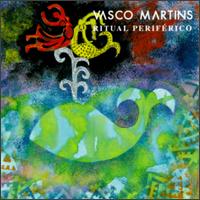
Parallel to orchestral writing, Vasco Martins explored electronic music and the synthesizer. Quinto Mundo (1989), Ritual Periférico (1995) and Memórias Atlânticas (1997-1998) embody this duality between new age ambience and synth explorations. In March 2022, he told RFI: “Music for me is oxygen. I made thirty-something records. Each album is a step in my life.” An displayed simplicity — the poet Manuel Brito-Semedo highlighted it in his funeral chronicle — that must not deceive regarding the complexity of the result.
The hermit and his musical legacy
In the 2010s, Vasco Martins settled as a hermit in Calhau and continued to compose: Lua água clara (Paris, 2008), Li Sin, Azuris, and Twelve Moons (Spring 2014), his last album. He wrote poetry, published an essay on morna (Música Tradicional Cabo-verdiana), orchestrated for piano and cellos, and composed stage pieces. His symphonies were performed by the Prague-Moravia Philharmonic Orchestra, the Gulbenkian Orchestra and international soloists. In 2022, his score was engraved on the facade of the new CNAD in Mindelo.
Vasco Martins died on November 27, 2025 at Dr. Baptista de Sousa Hospital in Mindelo, after a prolonged illness. According to his brother Rodrigo Martins, the last days had been very difficult: he had been evacuated for care in Portugal but returned precipitously. His funeral took place at the CNAD, where his body was then buried in the cemetery of North Baía das Gatas, in accordance with his wish.
The Cape Verde Ministry of Culture qualifies the musician as a “rare figure” who built a vast and innovative work. The Presidency elevated him to the rank of “highest figure of contemporary Cape Verdean culture.” The Baía das Gatas festival, which he co-founded in 1984, could dedicate an edition to him in 2026.
Major works
| Work | Year | Why it’s essential |
|---|---|---|
| Vibrações (Vibrations) | 1979 | First LP — introduction of new sounds to Cape Verde |
| Quinto Mundo | 1989 | Pioneering album of Cape Verdean electronic music |
| Memórias Atlânticas (Atlantic Memories) | 1997-1998 | Culmination of the new age period; recorded in France and Cape Verde |
| 4 Sinfonias (Four Symphonies) | 2007 | First integrated symphonic cycle; synthesis of his classical and insular heritage |
| Opera Crioulo | 2009 | Creation at Centro Cultural de Belém (Lisbon); peak of musical theater |
Heritage and influence
Vasco Martins paved the way for an entire generation of Cape Verdean composers who no longer feared blending the classical and the local. His symphonies resonate in European halls as much as in the collective memory of the archipelago. He proved that music born on the edge of a small, isolated bay in São Vicente could be universal — and he made inspired honesty his sole creative creed throughout his life.
Sources and references
- RFI — “Morreu o músico e compositor cabo-verdiano Vasco Martins”, by Carina Branco, 27 November 2025. URL: https://www.rfi.fr/pt/%C3%A1frica-lus%C3%B3fona/20251127-morreu-o-m%C3%BAsico-e-compositor-cabo-verdiano-vasco-martins
- Expresso das Ilhas — “Silêncio… Morreu o Maestro Vasco Martins”, by Manuel Brito-Semedo, 27 November 2025. URL: https://expressodasilhas.cv/blogs/esquina-do-tempo/2025/11/27/silencio-morreu-o-maestro-vasco-martins/140
- CNN Portugal — “Morreu o músico Vasco Martins”, Lusa Agency, 27 November 2025. URL: https://cnnportugal.iol.pt/vasco-martins/cabo-verde/morreu-o-musico-vasco-martins/20251127/69286d36d34e3caad84bc77d
- Wikipedia EN — “Vasco Martins”, encyclopedia article, accessed 14 May 2026. URL: https://en.wikipedia.org/wiki/Vasco_Martins
- Expresso das Ilhas / Rádio Morabeza — “Morreu Vasco Martins, ícone da música cabo-verdiana”, by Fretson Rocha, 27 November 2025. URL: https://www.expressodasilhas.cv/cultura/2025/11/27/morreu-vasco-martins-icone-da-musica-cabo-verdiana/100136
- Ministry of Culture of Cape Verde — Official statement on the death of Vasco Martins, 27 November 2025
- Presidency of the Republic of Cape Verde — Official note on the death, 27 November 2025
- Discogs — Vasco Martins profile. URL: https://www.discogs.com/artist/387268-Vasco-Martins
- Caboverde-amusica.online — “Festival da Baía das Gatas”. URL: https://www.caboverdeamusica.online/festival-da-baia-das-gatas/
- Mindel Insite — “Faleceu no HBS o exímio músico Vasco Martins”, 27 November 2025. URL: https://mindelinsite.com/cultura/faleceu-no-hbs-o-eximio-musico-vasco-martins-vitima-de-doenca/