
Biography
Biography of Ngũgĩ wa Thiong’o
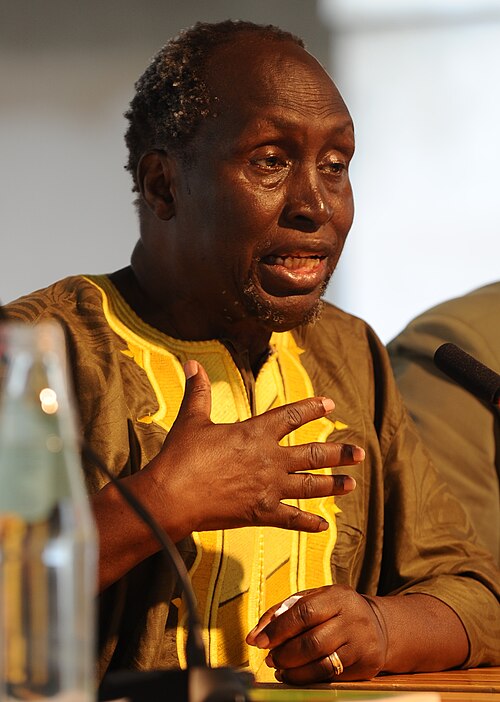
In 1977, in Limuru, Kenya, workers performed a play they had built themselves, denouncing the betrayals of independence. Six weeks later, the theatre was razed and the author, Ngũgĩ wa Thiong’o, was imprisoned. A year in solitary confinement followed by a decade of exile forged the portrait of a writer who made his pen a political weapon.
In Brief
| Full Name | James Ngugi → Ngũgĩ wa Thiong’o (since 1970) |
|---|---|
| Birth | January 5, 1938, Kamiriithu, British Kenya |
| Death | May 28, 2025 (aged 87), Buford, Georgia, United States |
| Field | Novel, theatre, essay — African postcolonial literature |
| Languages | English → Gikuyu (from 1978) |
| Emblematic Works | Weep Not, Child, A Grain of Wheat, Decolonising the Mind, Matigari |
| Awards | PEN/Nabokov Award (2022), Nonino Prize (2001), Park Kyong-ni Prize (2016) |
Key Dates
| Year | Event |
|---|---|
| 1938 | Birth in a Kikuyu village, within a family of farmers dispossessed by colonizers |
| 1952-1960 | Mau Mau Insurrection: his half-brother dies in combat, his mother is tortured |
| 1964 | Weep Not, Child, first major novel in English by an East African author |
| 1967 | A Grain of Wheat, pivotal work; Marxist turning point for the author |
| 1977 | Arrest following the play I Will Marry When I Want |
| 1986 | Decolonising the Mind, manifesto on language policy |
| 1982-2004 | Exile in the United Kingdom and then the United States |
| 2025 | Death at age 87, in Buford (Georgia) |
Ngũgĩ was born in 1938 under the first name James Ngugi, baptized by missionaries—a colonial name he abandoned in 1970 for Ngũgĩ wa Thiong’o. Land dispossession struck his family as early as 1915; the Mau Mau rebellion, during the 1950s, struck even closer: his half-brother was killed, his mother tortured. These traumas shaped all of his work.
He studied at Makerere, in Kampala, where he submitted his manuscripts to Chinua Achebe in 1962. Weep Not, Child (1964), the first novel in English by an East African author, follows a young Kikuyu aspiring priest swept up in the rebellion. A Grain of Wheat (1967), a polyphonic masterpiece on the betrayals of independence, marks his Marxist turning point.
Theatre became his main popular instrument. In 1977, with Ngũgĩ wa Mirii, he co-wrote I Will Marry When I Want, a play performed in Gikuyu by villagers in Limuru. The theatre was razed, the author thrown into prison. At Kamiti, he wrote Devil on the Cross on toilet paper. Adopted as a political prisoner by Amnesty International, he was released in 1978, banned from Kenyan universities, and went into exile in the United Kingdom and then the United States, where he taught at the University of California, Irvine.
Decolonising the Mind (1986) asserts that one does not liberate one’s mind with the language of the oppressor. This turn toward Gikuyu—abandoning English—is a political as well as aesthetic act. Upon returning to Kenya in 2004, he and his wife were assaulted. He published three memoirs (2010, 2012, 2016) and The Right-Hand Revolution was translated into more than a hundred languages. A favorite of the Nobel Prize in Literature, he died on May 28, 2025, in Buford (Georgia), at the age of 87.
Major Works
| Year | Title | Genre |
|---|---|---|
| 1964 | Weep Not, Child — View Profile | First novel · African Writers Series |
| 1965 | The River Between — View Profile | African novel · African Writers Series |
| 1967 | A Grain of Wheat — View Profile | Masterpiece · African Writers Series |
| 1975 | Secret Lives and Other Stories — View Profile | Short story collection |
| 1977 | Petals of Blood — View Profile | Post-independence novel |
| 1982 | Devil on the Cross — View Profile | Prison novel |
| 1986 | Decolonising the Mind — View Profile | Essay · linguistic manifesto |
| 1986 | Matigari — View Profile | Satirical novel |
| 2006 | Wizard of the Crow — View Profile | Fantasy epic |
Detailed Bibliography
All major works by Ngũgĩ wa Thiong’o with ISBNs and publishers:
- Weep Not, Child (1964) — Heinemann (African Writers Series), ISBN: 0435902687
- The River Between (1965) — Heinemann (African Writers Series), ISBN: 0435905872
- A Grain of Wheat (1967) — Heinemann (African Writers Series), ISBN: 0435909871
- Secret Lives and Other Stories (1975) — Heinemann (African Writers Series), ISBN: 0435908421
- Petals of Blood (1977) — Heinemann / Penguin Classics, ISBN: 0143039174
- Devil on the Cross (1982) — Heinemann (African Writers Series), ISBN: 0435908448
- Decolonising the Mind (1986) — James Currey, ISBN: 0435080162
- Matigari (1986) — Heinemann (African Writers Series), ISBN: 0435905465
- Wizard of the Crow (2006) — Harvill Secker, ISBN: 1846550343
Heritage and influence
Ngũgĩ wa Thiong’o shaped a significant part of world literature. His conviction that African languages are the only authentic voices for the African experience has inspired generations of writers and linguists. His works are studied in universities around the world, and his linguistic theories lie at the heart of postcolonial debates. His son Mũkoma and daughter Wanjikũ are themselves authors. While the Francophone world has known him less than the Anglophone world, his texts, translated into more than thirty languages, continue to resonate as calls for resistance and cultural dignity.
Sources and references
- « Ngũgĩ wa Thiong’o », Encyclopædia Britannica, https://www.britannica.com/biography/Ngugi-wa-Thiongo, accessed 18 October 2026.
- « Ngugi wa Thiong’o » (Wikipedia article), Wikipedia, https://en.wikipedia.org/wiki/Ng%C5%A9g%C4%AB_wa_Thiong%27o, accessed 18 October 2026.
- « Acclaimed Kenyan writer and dissident, Ngugi wa Thiong’o, dies at 87 », Al Jazeera, 29 May 2025.
- « Biography Ngugi wa Thiong’o », Howard University — Center for African Studies.
- ISBN data verified via WorldCat, Penguin Random House and Goodreads (November 2026).