Biography
Alemu Aga: the enchanting voice of the King David’s Harp
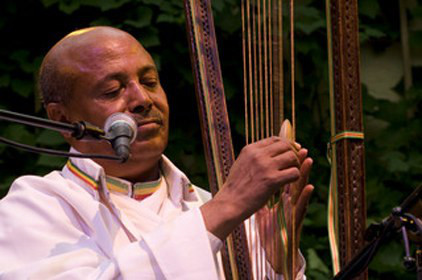
In October 2021, a hall fell silent. Alemu Aga placed his hands on the begena, this ten-stringed lyre with a deep, rumbling sound that has traversed the centuries since the 13th century. « The listeners, no matter if they are old, young or foreigners, even if they don’t understand the language, the sound that comes out has the power to make them very quiet », he confides to RFI. The instrument, often called King David’s Harp (translation of Davidsharfe in German), is considered in Orthodox Ethiopia as a mediator between the world of the living and the divine. Alemu Aga is its greatest living custodian.
In brief
| Full name | Alemu Aga |
| Birth | 1950, Entotto (Shewa), Ethiopian Empire |
| Field | Begena — a ten-stringed gut lyre, sacred Amhara Orthodox Christian instrument — and traditional singing |
| Notable works | Bägänna of Ethiopia, Ende Jerusalem (1995), The Begenna of Elders (2009) |
| Honors | UNESCO recording in 1972, international tours since the 1990s |
Key dates
| Year | Event |
|---|---|
| 1950 | Birth in Entotto, near Addis Ababa, in the Ethiopian Empire |
| 1962 | Beginning of begena training with Aleqa Tessema Welde-Emmanuel, aged twelve |
| 1970s | Geography studies at Addis Ababa University, then engagement as a begena teacher at Yared Music School |
| 1972 | First recording by Cynthia Tse Kimberlin for a major UNESCO collection |
| 1974 | Seizure of power by the Derg regime; the instrument is banned from radio waves |
| 1980 | Resignation from teaching post and opening of a shop in the Piazza district, Addis Ababa |
| 1991 | Fall of the Derg; resumption of teaching and public practice of the begena |
| 1995 | Release of the album Ende Jerusalem with krar player Asnaketch Worku |
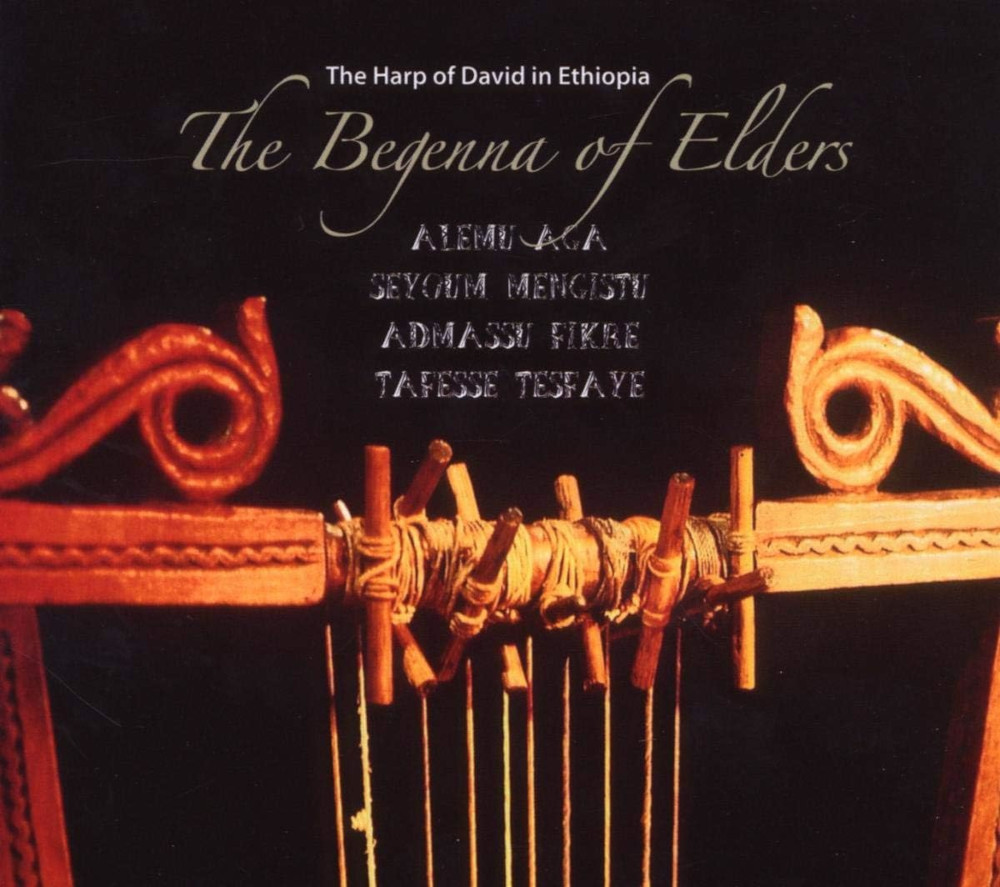
| 2009 | Release of The Begenna of Elders, a sound documentary gathering four masters of the begena |
Origins, ban and rebirth
Alemu Aga enters the world of the begena at twelve years old, by chance and grace. His neighbor Aleqa Tessema Welde-Emmanuel is a master of the instrument from northern Ethiopia. An oral history reported by Alemu recounts that Emperor Haïlé Sélassié had heard him play during a ceremony and asked him to settle in Addis Ababa to transmit this traditional and ancient instrument, which is passed down from generation to generation1. Aleqa taught at Ras Desta School, where Alemu was a student. He took it upon himself to carry the master’s instrument back and forth between school, thus extending lessons between classroom doors and home.
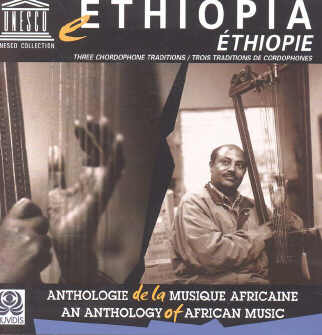
After geography studies at Addis Ababa University, he obtained a teaching post at Yared Music School — the country’s national music school — where he taught the begena for seven years. In 1972, Cynthia Tse Kimberlin recorded him for a UNESCO collection: his begena resonated for the first time across borders. It is a moment of glory for an instrument whose existence has been attested since at least the thirteenth century2.
In 1974, the Derg military junta took power in Ethiopia. Its atheist program included banning the begena from radio waves and closing its teaching at Yared School3. In 1980, Alemu Aga resigned from his post and opened a shop in the Piazza district of Addis Ababa4. In the following years, he played only privately. The sacred instrument, which is accompanied by no other instrument5, sank into clandestinity.
After the fall of the Derg in 1991, the begena gradually regained public spaces. Alemu resumed teaching and traveled the world to present an instrument that Europeans were then discovering. From the early 1990s, he embarked on multiple international tours. His lyrics translate an art where songs, poems or prayers are almost whispered and often contain hidden meanings. « You want to say one thing but you don’t want to say it directly so you use words that have double meanings », he explains: the texts also serve to express grievances towards God or the powerful1.
Major works
| Work | Year | Why it is essential |
|---|---|---|
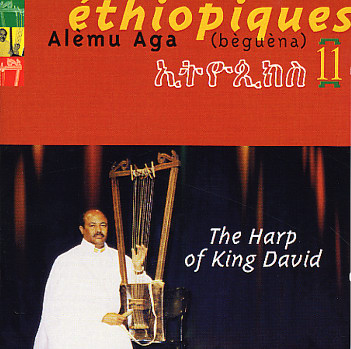
| Bägänna of Ethiopia | 1995 | First major solo album; traditional Christian hymns sung in Amharic, reissued in the Éthiopiques series by Buda Musique |
| Ende Jerusalem (with Asnaketch Worku) | 1995 | First collaborative record, released by the German label Acoustic Music; meeting between begena and krar |
| The Begenna of Elders | 2009 | Sound monument gathering four masters of the begena (Alemu Aga, Seyoum Mengistu, Admassu Fikre, Tafesse Tesfaye); a collective tribute to tradition |
Legacy and influence
Alemu Aga has never stopped transmitting. After the closure of Yared School, he welcomed for decades students and young musicians in his Piazza shop6. Today, he is recognized as the most eminent interpreter of the begena in Ethiopia7. His work contributed to renewing a tradition nearly erased by the Derg, making the begena an instrument rediscovered by young Ethiopian generations and admired worldwide.
His repertoire — prayers, double-meaning poems and meditations on the vanity of the world — fits into a deep spiritual line. The begena is not strictly a liturgical instrument, but it is closely associated with Amhara Orthodox faith, and particularly listened to during Lent (the tsom). It protects against the devil, according to traditional belief: he retreats before it8.
Every note played by Alemu Aga is a thread woven between ancestral past and global modernity.
Sources and references
-
« A meeting with Ethiopian musician Alemu Aga and his mesmerising begena lyre », RFI, 21/10/2021, accessed on 18 November 2026. ↩︎ ↩︎
-
Cynthia Tse Kimberlin (ed.), Ethiopia: Three Cordophone Traditions (Anthology of African music, UNESCO Vol. 14), Bärenreiter Musicaphon BM 30 SL 2314, recording from 1972. ↩︎
-
« Alemu Aga », English Wikipedia, accessed on 18 November 2026. ↩︎
-
Music in Africa, « Alemu Aga », accessed on 18 November 2026. ↩︎
-
Pit Budde, notes for The Begenna of Elders, Laika-Records, 2009. ↩︎
-
« Chant de la lyre bagana - Éthiopie », Maison des Cultures du Monde, 2021, accessed on 18 November 2026. ↩︎
-
« Alemu Aga », Laika-Records, accessed on 18 November 2026. ↩︎
-
Stéphanie Weisser, Chants de Bagana / Ethiopia: Bagana Songs (International Archives of Popular Music), VDE-Dialog, 2006. ↩︎