Biography
Dimi Mint Abba, the Desert Diva who Revealed Mauritania to the World
In 1990, in a London studio, a woman sitting on a rug plays a fourteen-stringed harp and lets rise a deep voice that crosses continents1. No one in the West had ever heard this music. Dimi Mint Abba had just revealed Mauritania to the world.
Did you know? Ali Farka Touré, the legendary Malian guitarist, nicknamed her « the greatest singer in Africa »2.
In Brief
| Full Name | Loula Bint Sidati Ould Abba |
| Birth | December 25, 1958, Tidjikdja, Mauritania |
| Death | June 4, 2011, Rabat, Morocco |
| Field | Singer, ardinist (Mauritanian harp) — griot tradition |
| Notable Works | Moorish Music from Mauritania, Musique et chants de Mauritanie |
| Awards | Gold Medal, Festival d’Oum Kulthum (Tunis, 1977) |
Key Dates
| Year | Event |
|---|---|
| 1958 | Birth in Tidjikdja, in a family of griots (iggawin) |
| 1968 | Debut on Mauritanian radio at age sixteen |
| 1977 | Gold Medal at the Festival d’Oum Kulthum (Tunis) |
| 1977-1986 | Representation of Mauritania at festivals in Iraq, Algeria, and Morocco |
| 1989 | First European tour; recording in England |
| 1990 | Release of Moorish Music from Mauritania (World Circuit) |
| 1992 | Album Musique et chants de Mauritanie (Auvidis Ethnic) |
| 1993 | First tour of the United States |
| 2006 | WOMAD (UK) and BBC Proms (Royal Albert Hall, London) |
| 2009 | WOMADelaide in Australia |
| 2011 | Death in Rabat, Morocco |
A Griot by Birth, a Child of the Desert
Dimi Mint Abba was born on December 25, 1958, in Tidjikdja, at the heart of Mauritania3. She is the daughter of Sidati Ould Abba, a singer and composer who originated the Mauritanian national anthem, and Feu Mounina Mint Eida, a percussionist and master of the ardin4. Her birth name, Loula Bint Sidati Ould Abba, is often shortened to Dimi5.
She grew up in the caste of iggawin, the hereditary griots of Mauritania6. Their role goes beyond music: they are oral historians, poets, social commentators, and diviners serving chiefs, merchants, and ceremonies7. Education is done through oral tradition, from parent to child8. Dimi began singing at a very young age, accompanying her parents; then around ten years old, her mother taught her the ardin — a fourteen-stringed harp mounted on a gourd covered with goat skin — an instrument traditionally associated with women9. She also learned the t’bol (large drum) and the tidinit, a four-stringed lute normally associated with men10.
« I have been singing since I can remember », she confessed in 198911. « Since childhood, I accompanied my family. »
Revelation and International Consecration
In 1976, Dimi won a national vocal contest that qualified her for the prestigious Festival d’Oum Kulthum in Tunis12. The following year, she represented Mauritania there with “Sawt Elfan” (The Feather of Art), whose chorus affirms that « the feather of Art is a balm, a weapon, and a guide that illuminates the minds of men »13. She won the gold medal14.
This success opened the door to a series of international performances: Iraq (1977), Algeria (1978), Morocco (1986)15. But Mauritania remained a largely unknown musical country16.
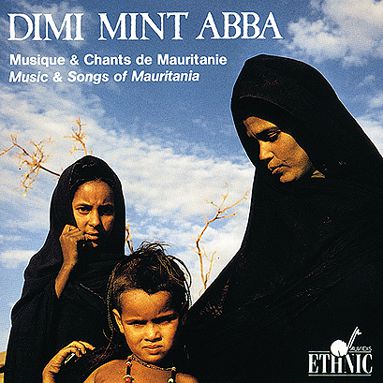
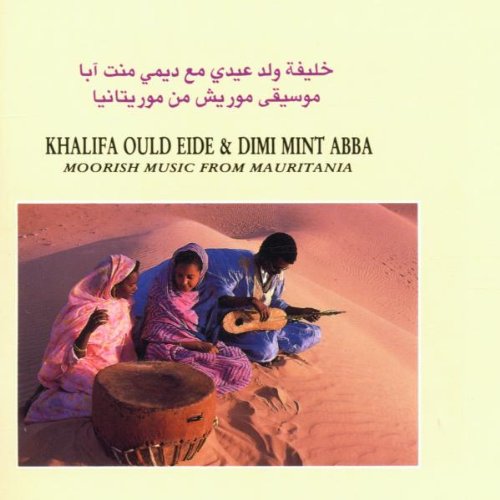
The breakthrough came from West Africa. Ali Farka Touré, the legendary Malian guitarist, was impressed by Dimi and recommended her name to World Circuit, the British label17. Nick Gold, head of the label, invited her to England in 198918. She recorded Moorish Music from Mauritania (1990) with her husband Khalifa Ould Eide — guitarist and tidinitist — accompanied by his two daughters on percussion and backing vocals19. The album was the first studio recording of Mauritanian music20. Followed in 1992 by Musique et chants de Mauritanie on Auvidis Ethnic21.
Dimi continued touring: United States (1993), West Africa, Australia (2009)22. In 2006, she performed at WOMAD in England and, a historic moment, at the BBC Proms of the Royal Albert Hall — the first time a Mauritanian artist performed on that stage23. « Wrapped in a red shawl », wrote the Evening Standard, « she played her harp accompanying her dramatic voice »24.
Legacy
Dimi Mint Abba died on June 4, 2011, in Rabat, Morocco, from a cerebral hemorrhage25. An accident that occurred during a performance in Aïoun ten days earlier hastened her end26. The Mauritanian president Mohamed Ould Abdel Aziz described her death as « a national loss »27.
Her daughter Noura Mint Seymali, who toured with her in her final years, perpetuates the legacy of the « Desert Diva »28. Khalifa Ould Eide, her husband and lifelong collaborator, had died in 200129.
But it was Dimi Mint Abba who opened the door. A desert voice, coming from a caste long despised, crossed the oceans and changed the world’s view of Mauritania30.
Major Works
| Work | Year | Why It Is Essential |
|---|---|---|
| Moorish Music from Mauritania | 1990 | First studio album of Mauritanian music; revealed to the world by World Circuit20 |
| Musique et chants de Mauritanie | 1992 | More traditional version, recorded during the third European tour21 |
| “Sawt Elfan” | 1977 | Winning song at the Festival d’Oum Kulthum; manifesto on the role of the artist13 |
| “Hailala” | Unknown | Popular title among the Mauritanian public31 |
| “Koumba bay bay” | Unknown | Emblematic composition of Dimi’s repertoire31 |
Sources and references
-
World Circuit Records, Dimi Mint Abba — Biography, accessed 27 October 2026. ↩︎
-
The Independent, Dimi Mint Abba: la diva du désert, 17 June 2011, accessed 27 October 2026. ↩︎
-
Wikipedia, Dimi Mint Abba, English version, accessed 27 October 2026. ↩︎
-
The Guardian, Dimi Mint Abba obituary, 9 June 2011, accessed 27 October 2026. ↩︎
-
Wikipedia, Dimi Mint Abba, French version, accessed 27 October 2026. ↩︎
-
Gale, Abba, Dimi Mint Benaissi (1958–), accessed 27 October 2026. ↩︎
-
BBC Press Office, Dimi Mint Abba and Radio Tarifa at BBC Proms, 12 July 2006, accessed 27 October 2026. ↩︎
-
AllMusic, Dimi Mint Abba — Biography, accessed 27 October 2026. ↩︎
-
Encyclopædia Universalis, Biographie de DIMI MINT ABBA (1958-2011), accessed 27 October 2026. ↩︎
-
Discogs, Dimi Mint Abba Discography, accessed 27 October 2026. ↩︎
-
The Guardian, Dimi Mint Abba obituary, 9 June 2011, accessed 27 October 2026. ↩︎
-
Wikipedia, Dimi Mint Abba, English version, accessed 27 October 2026. ↩︎
-
Gale, Abba, Dimi Mint Benaissi (1958–), accessed 27 October 2026. ↩︎ ↩︎
-
Encyclopædia Universalis, Biographie de DIMI MINT ABBA (1958-2011), accessed 27 October 2026. ↩︎
-
Gale, Abba, Dimi Mint Benaissi (1958–), accessed 27 October 2026. ↩︎
-
BBC Press Office, Dimi Mint Abba and Radio Tarifa at BBC Proms, 12 July 2006, accessed 27 October 2026. ↩︎
-
The Guardian, Dimi Mint Abba obituary, 9 June 2011, accessed 27 October 2026. ↩︎
-
World Circuit Records, Dimi Mint Abba — Biography, accessed 27 October 2026. ↩︎
-
The Guardian, Dimi Mint Abba obituary, 9 June 2011, accessed 27 October 2026. ↩︎
-
Wikipedia, Dimi Mint Abba, English version, accessed 27 October 2026. ↩︎ ↩︎
-
Wikipedia, Dimi Mint Abba, English version, accessed 27 October 2026. ↩︎ ↩︎
-
Wikipedia, Dimi Mint Abba, English version, accessed 27 October 2026. ↩︎
-
BBC Press Office, Dimi Mint Abba and Radio Tarifa at BBC Proms, 12 July 2006, accessed 27 October 2026. ↩︎
-
World Circuit Records, Dimi Mint Abba — Biography, accessed 27 October 2026. ↩︎
-
Wikipedia, Dimi Mint Abba, English version, accessed 27 October 2026. ↩︎
-
The Independent, Dimi Mint Abba: la diva du désert, 17 June 2011, accessed 27 October 2026. ↩︎
-
Wikipedia, Dimi Mint Abba, English version, accessed 27 October 2026. ↩︎
-
World Circuit Records, Dimi Mint Abba — Biography, accessed 27 October 2026. ↩︎
-
The Guardian, Dimi Mint Abba obituary, 9 June 2011, accessed 27 October 2026. ↩︎
-
The Independent, Dimi Mint Abba: la diva du désert, 17 June 2011, accessed 27 October 2026. ↩︎
-
Wikipedia, Dimi Mint Abba, English version, accessed 27 October 2026. ↩︎ ↩︎