Biography
Firmin Viry: the cane cutter who saved maloya
In the scorching heat of the sugar fields between Saint-Pierre and Le Tampon, a man cuts cane by day and crafts instruments by night. This worker branded by the sun’s burns becomes the absolute guardian of a sound that will defy an entire French State1.
In brief
| Name | Firmin Viry |
| Birth | 11 March 1935, Saint-Pierre, La Réunion |
| Genre | Maloya — traditional music of La Réunion, born from the songs of slaves and indentured laborers coming from Africa and Madagascar |
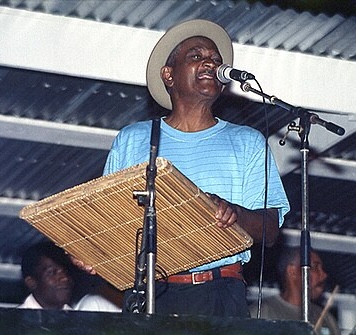
| Instruments | Kayamb, roulèr, bobre, piker, triangle, chant |
| Engagements | Réunion Communist Party (PCR), defense of cane cutters |
Key dates
| Year | Event |
|---|---|
| 1935 | Birth at La Ligne Paradis, Saint-Pierre |
| 1958 | Learning instrument making with Gustin Miza |
| 1959 | First maloya sung in public at the Rio cinema, Saint-Denis |
| 1959 | Proximity with the PCR at its founding |
| 1972 | Official ban on maloya |
| 1977 | Maloya de la Réunion — first official recording (Disques Jackman) |
| 1981 | Lifting of the ban under François Mitterrand |
| 1998 | National Order of Merit |
| 2014 | Knight of the Legion of Honour |
The sugar fields: cradle of maloya
Born on 11 March 1935 in the La Ligne Paradis neighborhood of Saint-Pierre, Firmin Viry spent his childhood amidst vast plantations. He practiced the trade of cane cutter all his life, between Saint-Pierre and Le Tampon. It was there, amidst the sweat and work songs, that he absorbed the rhythms of maloya — a sound from Africa and Madagascar, adapted by people enslaved since the 17th century2.
At 23, Viry learned from Gustin Miza, a Mozambican elder, how to craft traditional instruments: the bobre (musical bow), the roulèr (large drum), the kayamb (bamboo rake), the piker (perforated bamboo) and the triangle. Every piece carved from local wood, every string tightened by hand3.
Resistance and ban
Close to the Réunion Communist Party (PCR) since its founding in 1959, Viry actively participated in the island’s political life. In 1959, he proposed to the Rio cinema of Saint-Denis the first maloya sung and danced in public. According to political scientist Françoise Vergès, this performance marked a break with local authorities who considered this genre subversive4.
The ban arrived in 1972. Maloya was judged a threat to public order by the French government. Instruments were broken, concerts dispersed. Viry persisted by organizing disguised shows as village festivals, performances in private homes, and constant changes of venue5.
Protector of traditional maloya
After the lifting of the ban in 1981 by François Mitterrand, Viry no longer needed to hide. A new mission imposed itself: to transmit. His courtyard became an informal school where young people came to learn the rhythms and Creole language6.
Major works
| Work | Year | Why it is essential |
|---|---|---|
| A nous même danser Maloya | 1972 | First single by the singer, popular anthem |
| Peuple de la Réunion, peuple du maloya | 1976 | PCR recording: music in service of struggle |
| Maloya de la Réunion (with Yvrin Lagarrigue) | 1977 | One of the first official recordings, Disques Jackman |
| Cent An Boner | 1989 | Notable album of the post-ban period |
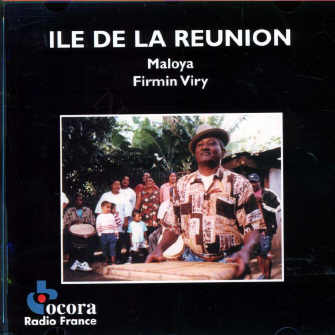
| Île de la Réunion: Maloya (Ocora) | 1999 | International recognition by the Radio France label |
Legacy
Firmin Viry allowed maloya to be reborn. His name is associated with the birth of a cultural heritage inscribed on the UNESCO register in 2009. Maloya, which nearly disappeared under repression, owes its survival to figures like his. Danyèl Waro cites Firmin Viry as a mentor. Viry’s legacy is not only musical: it is political, identity-based, cultural. In 2014, France finally recognized him — Knight of the Legion of Honour at age 79. The machete is put away, but the kayamb does not fall silent.
Sources and references
-
Wikipedia (EN), “Firmin Viry”, accessed 28 October 2026, https://en.wikipedia.org/wiki/Firmin_Viry ↩︎
-
BBC News, “Maloya: The protest music banned as a threat to France” by Robin Denselow, 5 October 2013, accessed 28 October 2026, https://www.bbc.com/news/magazine-24300017 ↩︎
-
Afrisson, “Firmin Viry” by Nago Seck, updated 23 November 2025, accessed 28 October 2026, https://afrisson.com/firmin-viry-467/ ↩︎
-
Wikipedia (FR), article “Firmin Viry”, biography section, accessed 28 October 2026, https://fr.wikipedia.org/wiki/Firmin_Viry ↩︎
-
BBC News, “Maloya: The protest music banned as a threat to France” by Robin Denselow, 5 October 2013, accessed 28 October 2026, https://www.bbc.com/news/magazine-24300017 ↩︎
-
Imaz Press, “Firmin Viry celebrates his 80th at the Téat plein air de Saint-Gilles”, 12 December 2015, accessed 28 October 2026, https://www.ipreunion.com/culture/reportage/2015/12/12/firmin-viry-fete-ses-80-ans-au-teat-plein-air-de-saint-gilles-ote-raw-firmin-larg-out-maloya,36726.html ↩︎