Biography
Fulgence Compaoré
Hands in motion, the djembé pierces the sky of the 4th August stadium on January 14, 2003, during the closing ceremony of the Junior African Nations Cup. Fulgence Compaoré unleashes salvos of rhythms that carry Burkina Faso to the ears of thousands of spectators. Beside him, the drums of Nong-Taaba Percussions resonate like a language: that of the griot, which is not just music but an act of transmission. “The djembé is part of my life,” he says simply. To understand this phrase, one must go back to 1982, when a seven-year-old boy learned the gourd in his grandmother’s hands, and to the echo that today traverses stages across Africa and Europe.
In brief
| Full name | Fulgence Compaoré |
| Birth | September 2, 1975, Adjamé (Côte d’Ivoire) |
| Domain | percussion — djembé, gourd — afro-reggae, Burkinabè traditions |
| Group | Nong-Taaba Percussions |
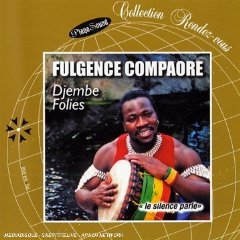
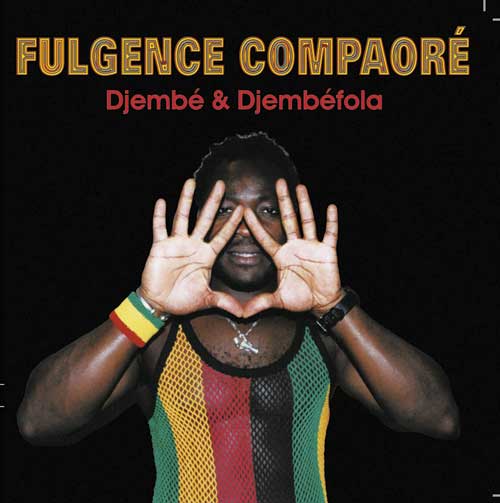
| Signature works | Djembé et Djembéfola, Que la vérité !, Le silence parle |
| Honors | Gold Kunde of the diaspora (2011) |
Key dates
| Year | Event |
|---|---|
| 1975 | Birth in Adjamé (Côte d’Ivoire) to Mossi parents |
| 1982 | Initiation into the gourd by his grandmother Korogo Ado, musician of the Larlé Naaba royal court |
| 1995 | Creation of Nong-Taaba Percussions in Ouagadougou |
| 1999 | Tour of France: Arènes de Nîmes, Festival de la Roque d’Anthéron |
| 2001 | Release of Djembé et Djembéfola in Burkina Faso and Mali |
| 2004 | Djembé teaching in Saint-Mandé and Paris |
| 2007 | Reggae concert at FESPACO; release of Le silence parle |
| 2011 | Gold Kunde of the diaspora at the Kundé awards (Ouagadougou) |
| 2013 | Release of Welcome to the World, a reggae album with colors |
From a seven-year-old griot to European stages
Fulgence Compaoré was born on September 2, 1975, in Adjamé, a suburb of Abidjan in Côte d’Ivoire, to a family of Mossi parents originally from Burkina Faso. In 1982, his grandmother Korogo Ado, musician of the Larlé Naaba royal court, initiated him into the gourd, a hollow wooden instrument that resonates through friction, an ancestral gesture of Burkinabè music. Two years later, at nine, he joined the Djembéfola troupe, specialists of the djembé — the large Peul drum with goat skin, emblem of Manding griots — and participated in his first public debuts. In 1995, he founded Nong-Taaba Percussions, which means “to love one another” in Mooré, the majority language of Burkina Faso. The group spread rapidly across Burkina Faso, Mali, and Niger, then to France as early as 1999, at the Arènes de Nîmes and the Festival de la Roque d’Anthéron. In 2000, the Amiens International Film Festival invited him to animate openings and closings, notably for the screening of Kirikou et la Sorcière. Every performance was acclaimed.
Major works
| Work | Year | Why it is essential |
|---|---|---|
| Djembé et Djembéfola | 2001 | Founding album that launched Fulgence on the Burkinabè and Malian stage; key tracks: Boolayamba, Dounia Nongayamba |
| Que la vérité ! | 2002 | First bilingual reggae album (Mooré/French), collaboration with confirmed African artists |
| Le silence parle | 2007/2008 | Percussion masterpiece: the ethnomusicology journal cites him as griot Fulgence Compaoré |
Percussion memory and modernity
Fulgence Compaoré’s career revolves around two engines: ancestral percussion and reggae, a style he uses as his ground for experimentation. In 2001, Djembé et Djembéfola was released with tracks like Boolayamba and Dounia Nongayamba. Que la vérité ! (2002) marries reggae and percussion in Mooré and French, produced by Playasound. The French edition of Djembé et Djembéfola was released in 2005 under the labels Playasound and Nocturne. In 2007, he gave a reggae concert at FESPACO and released Le silence parle, published in France by Playasound and Nocturne in 2008. Welcome to the World (2013) is a reggae album with colors that welcomes Cameroonian singer Queen Eteme in a feature.
Parallel to his career, Fulgence has taught the djembé since 2004 in Saint-Mandé (Val-de-Marne) and at the SMOM center in Paris (20th arrondissement). In 2006, he founded the Nong-Taaba association, of which he is president, which assists two villages and the Home Kisito orphanage in Burkina Faso. Settled in the Paris region, he hosts evenings, directs African percussion workshops, and develops a tradi-coupé style, a fusion between traditional Burkinabè music and coupé décalé, an Ivorian trend born in the early 2000s.
Legacy
Fulgence Compaoré embodies the figure of the contemporary griot: he carries the memory of Burkinabè percussion while opening a conversation with modern styles. His European tours, his teachings in France, and his national diaspora award testify to the influence of a musician who does not merely repeat tradition but reinvents it constantly. The Nong-Taaba association and his tradi-coupé style, which crosses borders between Burkina Faso and Côte d’Ivoire, reveal the vision of an artist for whom percussion is a dialogue between generations.
Sources and references
- “Fulgence Compaoré”, Music In Africa, https://musicinafrica.net/fr/directory/fulgence-compaore, accessed October 22, 2026.
- “Fulgence Compaoré”, Afrisson, https://www.afrisson.com/fulgence-compaore/, accessed October 22, 2026.
- “Djembé Folies: le silence parle”, AllMusic, https://www.allmusic.com/album/djembe-folies-le-silence-parle-mw0000580656, accessed October 22, 2026.
- “Fulgence Compaoré”, Ethnomusicology journal, Current Discography, Vol. 52, No. 1 (Winter 2008), accessed October 22, 2026.
- “Palmarès 2011 – Kundé”, Kundé (Burkinabè music award), https://www.kunde.bf/palmares-2011/, accessed October 22, 2026.
- « Fulgence Compaoré en direct sur Africa 1 pour la sortie de son nouvel album », leFaso.net, https://lefaso.net/spip.php?article34119, accessed 22 October 2026.
- « Fulgence Compaoré », Kundé (music awards) — Wikipedia, https://en.wikipedia.org/wiki/Kundé_(music_awards), accessed 22 October 2026.
- « Fulgence Compaoré », Bruits d’Afrique (burkinafaso.over-blog.net), https://burkinafaso.over-blog.net/article-fulgence-compaore-37422543.html, accessed 22 October 2026.