Biography
Maréchal Papillon
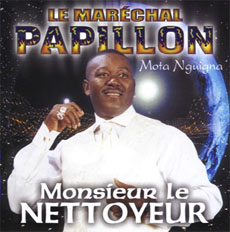
Douala, mid-1980s. At the docks of the port, where Congolese rumba and Douala rhythms are exchanged, a young man submits his demos to Guy Lobe. It is Din Din Ferdinand, known as “Maréchal” Papillon. He becomes one of the most iconic faces of Cameroonian makossa, with a distinct style—the sakissa—that crosses borders to reach Paris.
In brief
| Full name | Din Din Ferdinand, known as “Maréchal” Papillon |
| Nationality | Cameroonian |
| Place of birth | Douala, Cameroon (Littoral) |
| Field | Cameroonian makossa, sakissa, zouk, African reggae |
| Iconic works | “Femme sans ambition”, “L’amour et la misère”, Homme fort… je suis sérieux |
| Distinctions | Medal of the Force Publique (2025), international recognition of the sakissa |
Key dates
| Year | Event |
|---|---|
| ~1964–1968 | Born in Douala, Cameroon. Studies in electricity and construction before music |
| 1984 | Discovered by Guy Lobe; start of professional musical activity |
| 1990 | Release of first album, “Femme sans ambition”, an immediate hit in Cameroon |
| 1993 | “L’amour et la misère” released by Air B. Mas Production in Paris; breakthrough in Europe |
| 1995 | Recording of Homme fort… je suis sérieux at Studio de la Madeleine, Paris |
| 2005 | Double album Porc-épic on the occasion of the fifteenth anniversary of his career |
| 2009 | Album Kamerun; collaboration with Manu Dibango; Douala Bercy show |
| 2018–2024 | Persistent recognition in Europe (Soundway Records); political engagement |
| 2025 | Candidacy in the Cameroonian presidential election under the banner Les Partisans |
Douala, Paris and the sakissa
Din Din Ferdinand grew up in Douala. After studies in electricity and construction, his passion for music took over around 1984: he submitted his demos to Guy Lobe, a tutelary figure of Cameroonian makossa. Lobe opened the doors of the industry for him, and in 1990 “Femme sans ambition” made a splash on the Cameroonian stage. The title caught Paris’s attention; the label Air B. Mas Production released “L’amour et la misère” (Soukous Makossa Love) in 1993, marking his European breakthrough. Papillon then recorded at Studio de la Madeleine, frequented by Cesaria Evora and Daddy Yod, where he invited Cameroonian veterans and Congolese guitarists. His signature, the sakissa—a driving tempo blending Congolese rumba, zouk, and African reggae—is claimed as a personal invention:
“I believe I had a lot of luck. I brought my personal touch to the makossa rhythm by integrating the sakissa.”
Between 1990 and 2005, Papillon published an album every eighteen months on average. He founded the Orchestre Pizza Dance International, produced young artists, and organized major shows such as the 2009 Douala Bercy. Controversial—accused several times of plagiarism, involved in legal cases—he also presents himself as an independent entrepreneur: president of the Anti-Piracy Committee (2003), he ran for the Cameroonian presidential election in 2004 and again in 2025 under the colors of the Partisans.
Major works
| Work | Year | Why it is essential |
|---|---|---|
| “Femme sans ambition” | 1990 | First album, a Cameroonian hit that launched the career |
| “L’amour et la misère” (Soukous Makossa Love) | 1993 | Breakthrough in Paris on the Air B. Mas label; flagship title of the sakissa |
| Homme fort… je suis sérieux | 1995 | Recorded at Studio de la Madeleine; classic “Moulongo” of the genre |
| Porc-épic (double album) | 2005 | Peak of the fifteenth anniversary, with Jacky Kingue and Meiway |
| Kamerun | 2009 | Posthumous collaboration with Manu Dibango; hymn to the nation |
Legacy and influence
Papillon’s sakissa occupies a singular place in the diversity of Cameroonian makossa: a genre where the dance drive crosses Congolese guitar lines and zouk and reggae chords. Recent reissues, particularly by Soundway Records, have brought titles like “Moulongo” back to the forefront of the international stage, proving that his music crosses generations. Papillon remains a controversial but indispensable figure—prolific producer, artist promoter, and multi-faceted political figure. The strong man of the sakissa is not done making people dance.
Sources and references
- “Maréchal Papillon”, makossaoriginal (blog), https://makossaoriginal.blogspot.com/2021/02/marechal-papillon.html, accessed November 2, 2026.
- “Papillon - Moulongo”, Soundway Records, https://soundwayrecords.com/release/454113-papillon-moulongo, accessed November 2, 2026.
- “The musician artist Papillon celebrates 20 years of career”, CAMERFEELING, https://camerfeeling.fr.fo/fr/3205/, accessed November 2, 2026.
- Profile “Maréchal Papillon”, Discogs, https://www.discogs.com/fr/artist/12382015-Mar%C3%A9chal-Papillon, accessed November 2, 2026.
- “Douala: More Candidates Postulate”, Cameroon Tribune, https://cameroon-tribune.cm/article.html/71641/fr.html/details_2, accessed November 2, 2026.
- “Maréchal Papillon”, Africultures, https://africultures.com/personnes/?no=3045, accessed November 2, 2026.
- “Cameroon - After 2004, artist Papillon will be a candidate for the 2025 presidential election”, Cameroon.be, https://camer.be/actualites/politique/cameroun-apres-2004-lartiste-papillon-sera-candidat-a-la-presidentielle-2025-cameroon.html, accessed November 2, 2026.
- “Maréchal Papillon: I believe I had a lot of luck”, CT (Cameroon Tribune), June 11, 2009, https://camerfeeling.fr.fo/fr/3205/, accessed November 2, 2026.