Equatorial Guinea: when the music of a small nation dictates its own rules
Equatorial Guinea produces about 65% of Central Africa’s oil. We know its reserves, but little about its music. Yet, from the forests of Kie-Ntem to the rap festivals in Malabo, a soundscape is taking shape, made of mèndzáng (Fang xylophone) and digital drums, Bubi chants, and rap in pichi (Guinean pidgin). A return to a heritage fragmented by colonization, ravaged by dictatorship, and today carried forward by a new generation that refuses to remain invisible.
From the forests of Río Muni to the islands: a heritage shaped by geographies
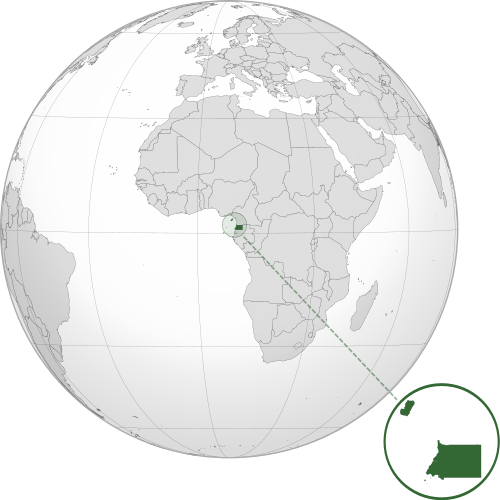
Equatorial Guinea is not one country, but several. The continental territory (Río Muni), Bioko Island, and Annobón Island form three distinct musical universes, united and separated at once by the sea and languages. The country is the only sub-Saharan African state whose official language is Spanish, a legacy of colonization that truly began only in 1843 — well after most of its French and British neighbors.
The Fang, the majority (85% of the population according to the 1994 census), carry on the continental tradition of the mvet, an eight-string harp-lute accompanied by three gourd resonators. The mvet player (the mbòm mvét) is far more than a musician: he is a storyteller, an actor, and an archivist who narrates the Fang people’s epics for entire nights, recounting the exploits of Èkáng and the Immortals. This tradition is part of the bwiti initiation rite. The instrument itself is protected by the bebom mvét society, whose initiation alone allows one to learn its notation1.
On Bioko Island, the Bubi — an indigenous people with a matrilineal society — perpetuate their chants, talking drum, and ceremonies. The Ndowe of the coast, the Bisio of the interior, and the Annobonais of Annobón each carry their own universe. The cumbé, a square frame drum of the Annobonais, is part of a fascinating transatlantic cycle: an instrument born in West Africa, taken to the Americas with slaves, returned by retournés from America, and taking root once again2. The bonkó, among the Fernandinos of Bioko, descends from the Ekpe rites of the Efik people who came via Cuba and the secret society Abakuá3.
All these peoples share common instruments: idiophone drums (nkúú), woven maracas (ñas), gourd xylophones (mèndzáng), ritualized bells, and leather bellows used to send signals through the forest4.
Did you know? The mvet tree, a harp-lute instrument first mentioned in European engravings from 1619 (Praetorius), is one of the few African instruments documented so early. Today, the last identified traditional player in Ebebiyin, Oscar Zue Ella, 68 years old, still traverses the Kie-Ntem with his mvet Oyeng4.
| Artist | Era | Style | Contribution |
|---|---|---|---|
| Maelé (Martiniano Abaga) | 1958–2017 | Machacando | Invented the style in Kie-Ntem (1978), founding king |
| Le Grand Bessoso (Baltasar Nsue) | 1970s–80s | Makossa/Pop | Recorded in Paris, collaborated with Cameroonian musicians |
| Desmali Tamtam | 1980s–2000s | Annobon/Acoustic | Annobonese guitar tradition, Luga Da Ambo |
| Barón Ya Búk-Lu | 1988– | Rap/Fusion | “urban troubadour”, Madrid diaspora, Akamayong |
| Las Hijas del Sol | 1992–2006 | Bubi/Afropop | Sibèba (1995), “¡Ay! Corazón” #1 in Spain |
| Ngal Madunga | 2000s– | Rumba/Pop | “Mundo complicado” with Papa Wemba (2011) |
| Patrima | 2005– | Machacando | Guardian of machacando, feminist themes |
| El Chojín | 1990s– | Rap/Diaspora | Guinness record for rap speed, social critique |
The precursor: Maelé, king of machacando
When Equatoguinean popular music crossed the threshold of commercial recording, it was a man who opened the door: Martiniano Abaga Ele Ndoho, known as Maelé. Born on July 5, 1958, in Bata, in the Kie-Ntem region, he spent his childhood rocked by traditional Fang chants5.
In the 1970s, facing the crushing competition from Cameroonian makossa and Congolese rumba, Maelé invented a style of his own: the machacando. The term comes from machacar (Spanish crush), referring to the percussive rhythm that characterizes the form. Maelé fused Fang polyrhythms with makossa structures (Cuban-Cameroonian palm-wine), incorporating acoustic guitar, balafon, and tuned drums6. The style was born in 1978, and forty years later, Maelé remains its founding name.
Beyond music, Maelé also engaged in the young country’s political life. He died in Madrid on December 1, 2017, leaving a legacy that artists like Patrima continue today7. Active since 2005, Patrima sees herself as the guardian of machacando: her two albums, recorded before 2015, address social themes — women’s rights, critique of polygamy — in a country where censorship remains a threat8.
Other precursors accompany this first wave: Le Grand Bessoso (Baltasar Nsue), who recorded in Paris with Cameroonian musicians in the 1980s9; Desmali Tamtam y Su Grupo Dambo de la Costa, who carries the Annobonese tradition through guitar chords inspired by Spain10; and Ngal Madunga, a composer influenced by Congolese rumba, who collaborated in 2011 with Papa Wemba on the track “Mundo complicado”11.
Exile and diaspora: artists between Malabo and Madrid
The dictatorship of Francisco Macías Nguema (1968-1979) upended the musical destiny of the country. Nicknamed “Macías the Mysterious,” this first president banned private education, outlawed European names, persecuted non-Fang people — and, implicitly, any free artistic creation12. Artists fled. Some went to Cameroon, others to Gabon, and the luckiest reached Spain.
This migration gave birth to two major figures of the diaspora.
Barón Ya Búk-Lu (stage name of Juan María Ngomo Eyui) grew up in Micomeseng, at the heart of the Fang region. He first played in Obóo Kura, a band of mèndzáng that toured celebrations13. In 1988, the socio-political situation forced him into exile: he settled in Madrid, created his own label Ngomo Line, and self-produced about fifteen albums14. Nicknamed the “urban troubadour,” he fused Fang rhythms (olong, mokom, ozila) with hip-hop, funk, and reggae — a genre he named rock’n búk-lu15. His tracks “Malabo Law” and “KÓRÓYÓ! Vete Ya!!” gave a voice to exile while speaking to Malabo16.
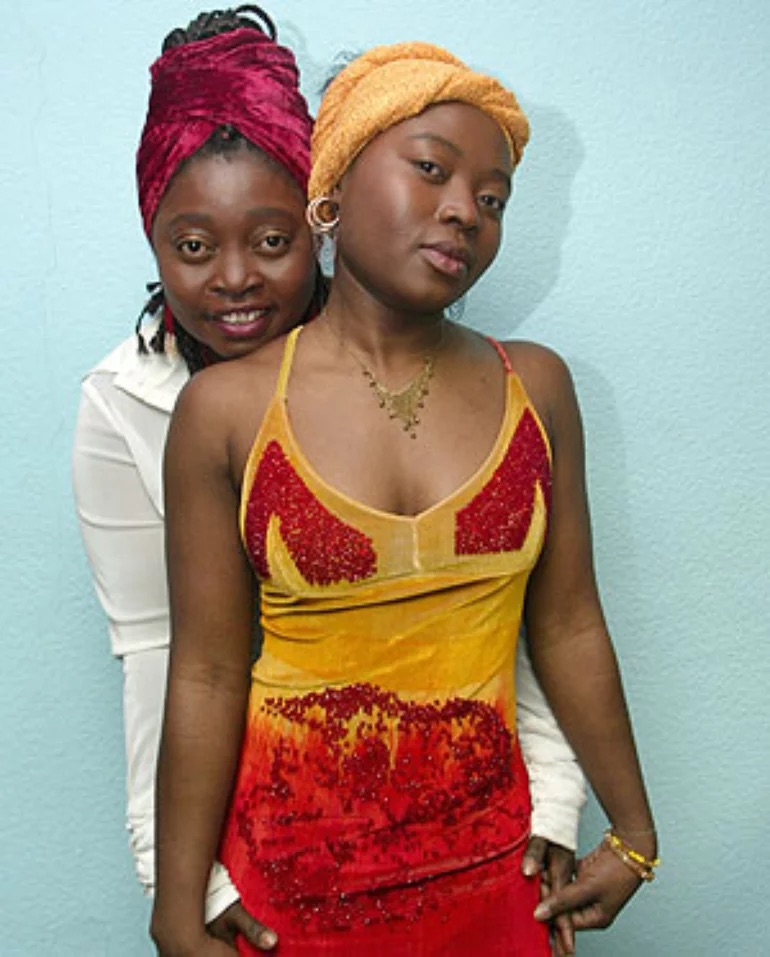
Las Hijas del Sol — Piruchi Apo Botupá and his niece Paloma Loribo Apo, two Bubi women from Bioko — formed a duo in 1992 that changed the game17. After performing at Expo ‘92 in Seville, they settled in Madrid and signed with the Nubenegra label of Manuel Domínguez. Their first album, Sibèba (1995), sang Bubi traditions in the Bubi language, after which their style hybridized: funk, rock, Afrobeat. In 2001, “¡Ay! Corazón” reached number one on the Spanish chart Los 40 Principales18. It was the first Equatorial Guinean single to reach this summit. The duo split in 2006, but Piruchi (now Piruchi Apo, solo) and Paloma (Paloma del Sol, solo) continued recording — each on their own19.
The present: rap, machacando, and emerging scenes
Equatorial Guinea has fewer than 1.7 million inhabitants and a virtually non-existent music industry — no major label, no established commercial scene, no broadcasting infrastructure20. Yet music lives there.
Rap is probably the most dynamically active genre. Barón Ya Búk-Lu paved the way in the 1990s. On the island, a genuine underground circuit developed: around 2015, an international hip-hop festival in Malabo attracted artists like Verso Roto, 2dados trucados, and Negrobey21. In 2025, the Malabo rap festival brought together Sugar Boy, Mr. Game Mba, Aisha Xuxes, and Zesar Last King22.
Mefe, an emerging artist, releases singles in Spanish with an urban tone — “Toka madera”, “Asómate” — and signs accessible pop that does without ethnic labels23. Nanda Nfá, active in 2025-2026, strings together singles (“FILI”, “Emowom”, “Y’onssofaha”) that show a new generation no longer waiting for an album to exist24.
Equatorial Guinean music also lives in transit. El Chojín (Domingo Antonio Edjang Moreno), a rapper born in Equatorial Guinea but raised in Spain, built a career against racism in Europe — he holds the Guinness World Record for rap speed (921 syllables in one minute, 2008)25. Negro Bey, for his part, publishes from Malabo: his lyrics directly criticize local power26. Equatorial Guinean rap is a bridge between the two shores of the Mediterranean, between Malabo and Madrid, with a language that shifts from Spanish to Fang as verses progress27.
Finally, the institutional context is beginning to shift: the government has moved its capital from Malabo to Ciudad de la Paz, a new town in the middle of the forest (January 2026)28. Malabo remains the cultural and media hub — and, above all, the musical center29. The Centro Cultural de España and the Centro Cultural Ecuatoguineano program rap, singers, dance groups, and regional artists on the same evening30. A distribution network exists; it only awaits investment.
Music does not wait: a future in streaming
Equatorial Guinea does not produce music because it chooses to — it produces music because it has no other choice. Mèndzáng resonates in Fang ceremonies, cumbé beats on Annobón, and rap rises from the neighborhoods of Malabo and Madrid. A small country fragmented by geography and dictatorship, yet whose music today weaves an audible thread across generations.
Machacando, born from the hands of Maelé almost fifty years ago, is not a relic. It is in permanent conversation with streaming, hip-hop, and social media. Equatorial Guinean artists lack neither the structures of Nigeria’s Nollywood nor the capital of Luanda’s Sampa31. They have something else: an inheritance no one stole from them, and voices that refuse to stay silent.
Sources and references
-
Isabela de Aranzadi, « Equatorial Guinea: History, Culture, and Geography of Music », SAGE International Encyclopedia of Music and Culture, 2019. ↩︎
-
Isabela de Aranzadi, « A drum’s trans-Atlantic journey from Africa to the Americas and back after the end of slavery: Annobonese and Fernandino musical cultures », African Music 11(1), 2014. ↩︎
-
Ibid. — The bonkó descends from the Ekpe rites of Éfik, transformed in Cuba by the Abakuá society. ↩︎
-
Luis Mallart Guimerà, Cara o creu, imatges i paraules d’un joc d’atzar africà, ICRPC Girona, December 2010. ↩︎ ↩︎
-
Ronnie Graham, Stern’s Guide to Contemporary African Music, Zwan Publications, 1988, p. 226-227 (Ch. 21, Equatorial Guinea). ↩︎
-
Timeline.music — « Equatorial Guinea Music History », accessed 2025. ↩︎
-
« Martiniano Abaga Ele Ndoho (Maelé) », Ask-Oracle.com. Maelé died on December 1, 2017 in Madrid. ↩︎
-
Grokipedia, « Patrima » — active machacando singer since 2005, two albums before 2015. ↩︎
-
Graham, Stern’s Guide, Ch. 21 — Grand Bessoso records in Cameroonian studios of the 1980s. ↩︎
-
Wikipedia, « Music of Equatorial Guinea » — Desmali and Dambo de la Costa as national acoustic stars. ↩︎
-
Blue Tree Audio — « Desmali, Karr and Beyond », 2025. ↩︎
-
BlackPast.org — « Francisco Macias Nguema (1924-1979) »; International Commission of Jurists, « The Trial of Macias in Equatorial Guinea », 1979. ↩︎
-
Ekottomagazine, « September25 » — Baron Ya Buk-Lu with Obóo Kura, bands of mèndzáng. ↩︎
-
UCLA Ethnomusicology Review — « Producing Culture from Afar: Equatoguinean Musicians in Spain », 2015. ↩︎
-
Ekottomagazine, loc. cit. — « rock’n búk-lu », fusion with hip-hop and funk. ↩︎
-
Blue Tree Audio — « Equatorial Guinea Music History: Archives, Dictatorship and Exile », 2025. ↩︎
-
Timeline.music — « Equatorial Guinea », Hijas del Sol, 1992-2006; Grokipedia, « Hijas del Sol ». ↩︎
-
Timeline.music — “¡Ay! Corazón” climbs to first place on the Spanish chart Los 40 Principales, 2001. ↩︎
-
Blue Tree Audio — Piruchi Apo solo since 2010 (Remembre Africa), Paloma del Sol solo since 2016 (Atrévete a ser Feliz). ↩︎
-
Blue Tree Audio — « Equatorial Guinea Music History: Archives, Dictatorship and Exile », 2025. ↩︎
-
Vice (Spanish edition), « Fotos de hiphoperos en Bata, Guinea Ecuatorial », 2015 — mention of the Malabo International Hip-Hop Festival, 7th edition. ↩︎
-
Blue Tree Audio, 2025 — Malabo rap festival 2025, Sugar Boy, Mr. Game Mba, Aisha Xuxes, Famo 69, Young Bigui, Zesar Last King. ↩︎
-
Blue Tree Audio, 2025 — Mefe, “Toka madera”, “Asómate”, “Píllalo al vuelo”. ↩︎
-
Blue Tree Audio, 2025-2026 — Nanda Nfá, “FILI”, “Emowom”, “Y’onssofaha”, “Mene Mina”, “Minaye Mayi”. ↩︎
-
AhoraEG.com — « El Chojín : Guinea Ecuatorial es mi pueblo », 2025; Guinness speed rap record in 2008. ↩︎
-
Timeline.music — « Equatoguinean Hip-Hop », Negro Bey and his rap from Malabo. ↩︎
-
Blue Tree Audio, 2025 — language, Pichi, Fang and Spanish as artistic tools. ↩︎
-
Le Figaro — « La Guinée équatoriale change de capitale et opte pour une ville en pleine forêt », 2026. ↩︎
-
Blue Tree Audio, 2025 — Malabo, Centro Cultural de España, Centro Cultural Ecuatoguineano. ↩︎
-
Blue Tree Audio, 2025 — programs combining rap, chansonnier, dance and regional artists. ↩︎
-
Nollywood (Nigeria) = >1 500 films/year; Sampa (Angola) = national film industry structured since the 2000s. ↩︎