
Biography
Kotto Bass: the virtuoso who fused makossa and soukous
On November 20, 1996, in Douala, a massive crowd traversed the city to Bonaberi cemetery to accompany a 33-year-old young man to his last resting place. The “studio shark,” as the elders nicknamed him, had just passed away. Voices mingled with those of loved ones: Edith ndol’a ngo, Concours de patience, Yes Bamenda. These titles, born of only a two-year career, would remain etched in the musical memory of Cameroon.
In brief
| Full name | Nyamsi Théodore Auger |
| Birth | February 6, 1963, Douala (Cameroon) |
| Death | November 20, 1996, Douala (Cameroon) |
| Genre | Makossa, Congolese rumba, world music |
| Instruments | Bass guitar (main), vocals |
| Signature works | Soukous Fusion, C’est Comme ça, “Edith ndol’a ngo” |
| Awards | Gold record for Soukous Fusion, nicknamed “Tonton Vieux” by his family |
Key dates
| Year | Event |
|---|---|
| 1963 | Born in Douala on February 6; diagnosed with polio at age two |
| Around 1980 | At 17, an excellent bassist; participated in school orchestras at Camp Berteau |
| Late 1980s | Joined Sam Fan Thomas’s Makassi Studio, became bandleader of MBC (Makassi Band Corporation) |
| 1993 | Famous rehearsal of “Ponce Pilate” (cover) on the project L’âge d’or – Hommage à Nelle Eyoum |
| 1995–1996 | Release of first album Soukous Fusion, makossa-soukous fusion |
| 1996 | Gold record for Edith ndol’a ngo; release of second album C’est Comme ça |
| November 20, 1996 | Death at age 33; massive crowd at Bonaberi cemetery, Douala |
A bass prodigy against polio
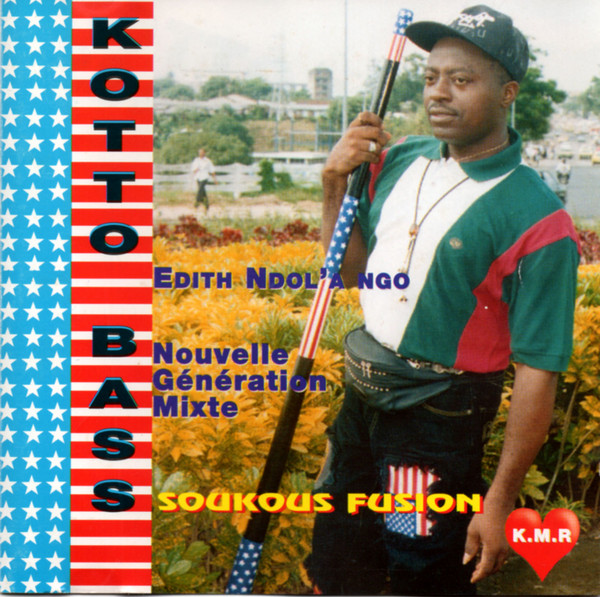
Nyamsi Théodore Auger was born on February 6, 1963, in Douala. At age two, polio paralyzed one of his legs. He moved using a cane painted with the colors of the American flag, but this disability did not diminish his patience or enthusiasm for music. By age six, he could sing the entire repertoire of the Duala Choir, Makôm m’Eses’a Yehova — a religious repertoire with an oral tradition. At Camp Berteau primary school, he joined the school orchestras and showed very early on a natural predisposition for bass. By 17, he was already an accomplished bassist.
In the late 80s, Kotto Bass joined Sam Fan Thomas’s Makassi Studio — a tutelary figure of Cameroonian makossa. There, he became the bandleader of MBC (Makassi Band Corporation) and laid his riffs on the hits that made Douala dance in the early 90s. The elders also remember him as a regular at the Mermoz cabaret: before his public fame, he was already a respected name among musicians. Young Richard Bona, who arrived in Douala at 13, cited him as a reference among the city’s greatest bassists.
The fusion that shook Cameroonian makossa
His moment of truth arrived in 1993. Sam Fan Thomas and other artists recorded the album L’âge d’or – Hommage à Nelle Eyoum, a co-production by Aladji Touré and Moïse Kouogueng. In this collective project, Kotto Bass slipped in his own interpretation of a Congolese classic: “Ponce Pilate” by Tabu Ley Rochereau (1977). His idea: give a “makossa sauce” to Congolese rumba. Instead of the usual melancholic motif, Kotto Bass imposed walking bass lines — these arpeggios that descend and ascend like a breath — rhythms that make feet move. The Cameroonian public was won over, and the title became a surprise.
This success launched a broader artistic project: Soukous Fusion, his first solo album, published between 1995 and 1996. He mixed covers of Congolese standards (“Nouvel Génération” by Lipua Lipua, “Infidélité Mado” by Franco) with his original compositions. Edith ndol’a ngo became the flagship track — a poetic dedication to all Ediths of Cameroon, sung with an angelic voice. The album earned a gold record and achieved national success. The second album, C’est Comme ça (also released as Bass 1), opens with Yes Bamenda, an anthem to Cameroon’s second city, and Concours de patience, a title that became popular. Kotto Bass was about to embark on a national tour when everything stopped.
A legacy that remains alive
The sudden death of Kotto Bass, at only 33 years old, caused a shock in Cameroon. The circumstances of his death remain vague: some sources mention a short illness, while others suggest poisoning. On the day of his funeral, a massive crowd accompanied his body to Bonaberi cemetery, where a corner of the cemetery has since been nicknamed “Kotto Bass cemetery” by fans.
His name remains in Cameroonian musical consciousness: Edith ndol’a ngo is still cited as a reference in bass and arrangement. The Kotto Bass Foundation, created in 2015 by his niece Danielle Eyango, helps disabled children — in the spirit of the artist who overcame his own. In 2025, his son Auger Kotto announced the release of a tribute documentary, L’ombre d’une légende, and released his own 10-track album titled Héritage.
Kotto Bass left us with less than a decade of career, but in that span, he changed the sound of Cameroonian makossa by infusing it with Congolese breath.
Major works
| Work | Year | Why it’s essential |
|---|---|---|
| Soukous Fusion (C’est Comme ça) | 1995–1996 | First successful large-scale makossa-soukous fusion; gold record for Edith ndol’a ngo |
| Bass 1 (My last songs) | 1996 | Final album; cult title Yes Bamenda became an anthem to Cameroon’s second city |
| “Edith ndol’a ngo” | 1996 | Flagship track: poetic dedication to all Ediths of Cameroon, angelic voice and walking bass |
| “Ponce Pilate” (on L’âge d’or – Hommage à Nelle Eyoum) | 1993 | The Tabu Ley Rochereau cover that revealed Kotto Bass to the general public |
Heritage and influence
Kotto Bass proved that an artist with little press coverage internationally can remain an indispensable figure on their local scene. His approach—blending makossa and soukous while letting the bass drive change rather than the melody—influenced an entire generation of Cameroonian bassists. His songs continue to get people dancing on dance floors in Cameroon and the diaspora, rediscovered by each new generation.
Sources and references
- « Kotto Bass », Wikipedia, https://fr.wikipedia.org/wiki/Kotto_Bass, accessed 12 November 2026.
- « Kotto Bass — Biography, Discography », AllMusic, https://www.allmusic.com/artist/kotto-bass-mn0001218013, accessed 12 November 2026.
- « Kotto Bass », Discogs, https://www.discogs.com/artist/3928699-Kotto-Bass, accessed 12 November 2026.
- « The incredible story of Kotto Bass’s artistry », PoiseSocial, https://poisesocial.com/2022/05/08/the-incredible-story-of-kotto-basss-artistry/, accessed 12 November 2026.
- Sylvie Clerfeuille, « Kotto Bass », Afrisson, https://www.afrisson.com/kotto-bass, accessed 12 November 2026.
- « Kotto Bass: 29 years later, the legacy of a makossa giant continues to inspire », Les Enfants du Terroir, https://lesenfantsduterroir.com/2025/11/20/kotto-bass-29-ans-apres-lheritage-dun-geant-du-makossa-continue-dinspirer/, accessed 12 November 2026.
- « It was 20 years ago that Kotto Bass passed away », Camerounweb, https://www.camerounweb.com/CameroonHomePage/entertainment/Il-y-a-20-ans-disparaissait-Kotto-Bass-395373, accessed 12 November 2026.
- « Kotto Bass », Apple Music, https://music.apple.com/gh/artist/kotto-bass/916296052, accessed 12 November 2026.
- Danielle Eyango, Kotto Bass: Like a bird in full flight, Éditions du Protocole, 2012.