Biography
Orchestre Baobab: from Cuban sound to the nights of Dakar
In 1970, in the heart of Dakar’s Médina, a young Togolese guitarist, Barthélémy Attisso, gave evening lessons to pay for his law studies. The owner of Club Baobab, a chic nightclub frequented by the Senegalese elite, hired him to found a resident orchestra. Six musicians from four different regions joined forces and invented, in a few years, the most distinctive sound of African popular music—a fusion so accomplished that it spans decades and time.
In brief
| Group name | Orchestra Baobab, also known as Gouye-Guy de Dakar |
| Origin | Dakar, Senegal |
| Genres | Afro-Cuban son/pachanga, Wolof griot, Manding traditions, jazz |
| Founding members | Baro N’Diaye (saxophone), Balla Sidibé (timbales, vocals), Rudy Gomis (percussion, vocals), Laye M’Boup (Wolof griot vocals), Barthélémy Attisso (guitar) |
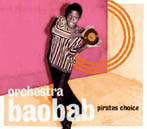
| Iconic works | Pirate’s Choice, “Autorail”, Specialist in All Styles |
| Distinctions | BBC Radio 3 World Music Awards: best African artist and critics’ choice (2003) |
Key dates
| Year | Event |
|---|---|
| 1970 | Formation at Club Baobab, recruited from the Star Band |
| 1972-1976 | Series of Buur albums; the Afro-Cuban × Wolof sound takes hold in Dakar |
| 1978 | Paris sessions On verra ça and Africa 78, acclaimed by critics |
| 1982 | Ken Dou Werente, pan-African hit and posthumous classic |
| 1987 | Separation, drowned out by the rise of Youssou N’Dour’s mbalax |
| 1989/2001 | Reissue of Pirate’s Choice by World Circuit → European renaissance |
| 2002 | Specialist in All Styles, first new album in 20 years, prod. Youssou N’Dour |
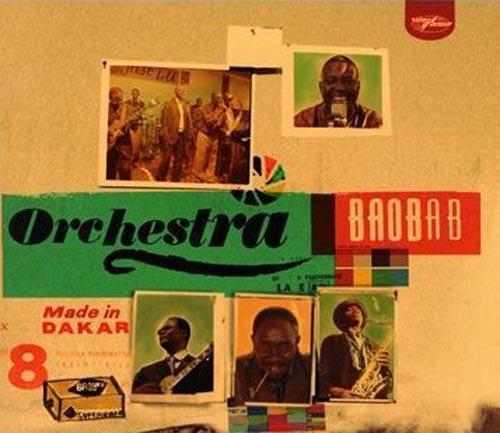
| 2007/2017 | Made in Dakar (Grammy nomination), then Tribute to Ndiouga Dieng |
The origins and invention of a sound (1970-2001)
The story begins in the euphoria of independent Senegal. In 1970, Adrien Senghor (nephew of President Léopold Sédar Senghor) opened Club Baobab. He recruited Barthélémy Attisso—a self-taught guitarist and brilliant arranger—and a few musicians from the Star Band. The musical formula was immediate: Attisso immersed Latin rhythms in harmonies from Casamance carried by Balla Sidibé and Rudy Gomis (southern vocals), while the Wolof griot Laye M’Boup gave the group words and soul. Baro N’Diaye’s saxophone, followed by Issa Cissoko (from the Mandinka griot family of Mali), traced the dance melodies.
Between 1972 and 1976, the Buur label published a series of albums (Guy Gu Rey Gi, Aduna jarul naawo) that made Baobab the first nighttime attraction in Dakar. Their music was a transnational mix—northern Wolof, Casamance and southern Manding traditions, Congolese rumba, Cuban son. In 1974, Thione Seck (18 years old) joined the group on M’Boup’s recommendation.
The break came at the end of the 1970s: Club Baobab closed, and Youssou N’Dour dominated the airwaves with his revolutionary mbalax. Pirate’s Choice, a compilation of the 1982 sessions renamed thus by Nick Gold of the World Circuit label in 1989, became a classic for European music lovers. In 2001, World Circuit and Youssou N’Dour persuaded the group to be reborn. Specialist in All Styles (2002), co-produced by N’Dour and Nick Gold, invited Ibrahim Ferrer (star of the Buena Vista Social Club) as a guest. In 2003, the album won two BBC Radio 3 World Music Awards. Made in Dakar (2007) earned a Grammy nomination; Tribute to Ndiouga Dieng (2017) pays homage to the founder who passed away in 2016.
Major works
| Work | Year | Why it’s essential |
|---|---|---|
| Pirate’s Choice (Ken Dou Werente) | 1982/1989 | 1982 sessions; reissued in Europe, the absolute classic |
| On verra ça (Paris sessions 1978) | 1978/1992 | Careful production, Casamance and Wolof harmonies at their peak |
| Specialist in All Styles | 2002 | Comeback produced by Youssou N’Dour, Ibrahim Ferrer as guest |
| Made in Dakar | 2007 | Grammy nomination; return to Dakar roots |
Legacy and influence
Orchestre Baobab ranks among the African ensembles that fused Cuban influences and Senegalese traditions with the greatest virtuosity. Their legacy is not reduced to twenty albums: they paved the way for West African musical hybridations by proving that a truly African sound can be born from transatlantic dialogues. The group remains, beyond successive departures (Cissoko in 2019, Sidibé in 2020, Attisso and Gomis in 2021/2022), proof that a world-renowned orchestra can be cultivated in the hot nights of a popular neighborhood—where Cuban sound and griot vocals have answered each other for over fifty years. Their music, carried by younger voices (Papino Koité, Korka Dieng), crosses the barrier of age with astonishing ease.
Sources and references
- « Orchestra Baobab », Wikipedia, https://en.wikipedia.org/wiki/Orchestra_Baobab, accessed November 11, 2026.
- « Orchestra Baobab: Always Made in Senegal », Afropop Worldwide, https://afropop.org/articles/orchestra-baobab-always-made-in-senegal, accessed November 11, 2026.
- « Orchestre Baobab: History and discography », Official Orchestra Baobab Site, https://orchestrabaobab.com/, accessed November 11, 2026.
- « Orchestra Baobab: Specialist in All Styles », The Guardian (Robin Denselow), https://www.theguardian.com/music/2002/sep/06/worldmusic.artsfeatures, September 6, 2002.