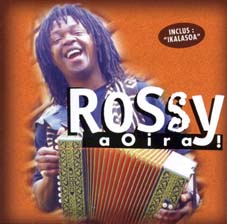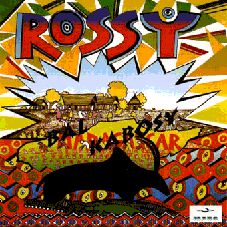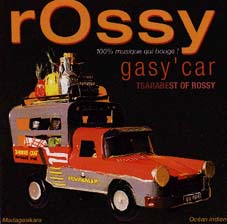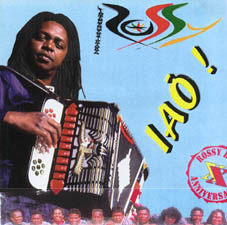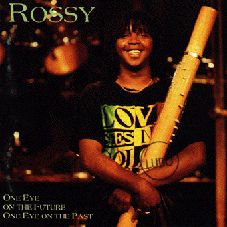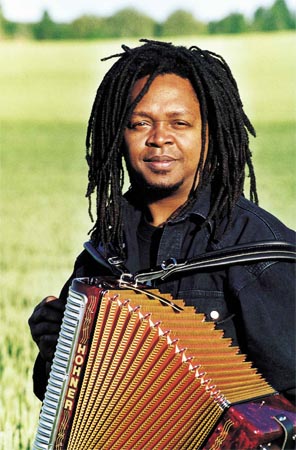
Biography
Rossy: the master of the Malagasy accordion
On May 25, 2008, in Antsonjombe, 35,000 people paid to enter a stadium in Antananarivo1. Six years of exile changed nothing about the legend of Rossy, whose real name is Paul Bert Rahasimanana, who set up in front of his diatonic accordion while the crowd cheered him on.
In brief
| Full name | Paul Bert Rahasimanana, aka Rossy |
| Birth | September 20, 1960, Antananarivo |
| Field | Malagasy music — hira gasy, vakisôva, tapolaka |
| Instruments | Accordion, kabosy, valiha, sodina flute |
| Signature works | Island of Ghosts, Bal kabosy, Lera, Mitapolaka |
| Awards | RFI Trophy |
Key dates
| Year | Event |
|---|---|
| 1960 | Born in Antananarivo in a working-class family |
| 1970s | Debut with the a cappella group Hazo Midoroboka |
| 1981 | First group with African percussion |
| 1983 | First public performance at Ecole Sainte Famille |
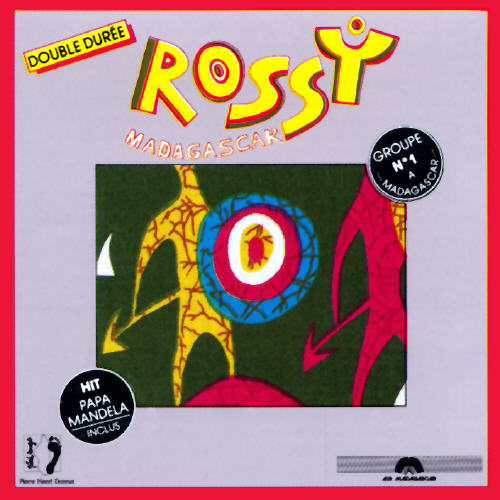
| 1988 | First album: Madagascar (Celluloid) |
| 1991 | Island of Ghosts at Peter Gabriel’s Real World Studios |
| 1994 | Success of Bal kabosy; RFI trophy |
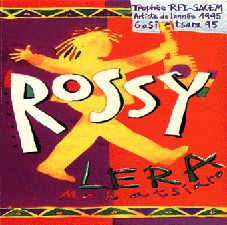
| 1995 | Lera, political anthem taken up by hira gasy troops |
| 2001 | Cultural advisor to President Ratsiraka |
| 2002 | Exile in France |
| 2008 | Return; 35,000 spectators at Mahamasina stadium |
| 2011 | Release of Mitapolaka |
From origins to France
Paul Bert Rahasimanana grew up in the Ampamarinana neighborhood in Mahamasina2. At seven, he was given an accordion, which he taught himself.
In the 1970s, he formed an a cappella group Hazo Midoroboka (“falling tree”) and performed at wakes, where he sang mamonjy jaobany2.
In 1983, Rossy caught the attention of presenter Tsilavina Ralaindimby3.
Madagascar (1988) was released on Celluloid4.
Bal kabosy (1994) earned Rossy a trophy from Radio France International5.
In 2001, Rossy was appointed cultural advisor by Ratsiraka2.
For six years, he lived in the Berry, recorded Ino Vaovao? (2007), and participated in educational shows6.
Major works
| Work | Year | Why it’s essential |
|---|---|---|
| Island of Ghosts | 1991 | Recorded at Peter Gabriel’s Real World Studios, introduced Rossy to the world |
| Bal kabosy | 1994 | Established Rossy as “best ambassador of Malagasy music” |
| Lera | 1995 | Became a political anthem, taken up by hira gasy troops |
| Mitapolaka | 2011 | Return after exile; the title means “to act crazy” |
Legacy
Rossy remains a central figure in Malagasy music4. His journey from the popular neighborhood to the top of the national stage makes him a symbol of social mobility. His style, influenced by tapolaka, fuses traditional rhythms with funk and rock.
“Whatever people say, whatever they think, Rossy is a living legend in every respect”3.
Sources and references
-
Ramambazafy, Jeannot (August 6, 2008). Le phénomène Rossy, Madagate. Accessed November 2, 2026. ↩︎
-
Rossy (musician), Wikipedia (English version), September 9, 2026. ↩︎ ↩︎ ↩︎
-
Lavaine, Bertrand (March 21, 2008). Les ressorts de Rossy, RFI Musique. ↩︎ ↩︎
-
Pourtier, Grégoire (May 27, 2008). Rossy de retour à Madagascar, RFI Musique. ↩︎
-
Rossy, Africultures. ↩︎