
Biography
Solorazaf: The Malagasy Guitar in Solitude
In 1995, at the L’Air du temps festival in Boston, the guitarist from Madagascar was hailed by the world guitar press as a “revelation.” Solo Razafindrakoto, known as Solorazaf, performed alone on stage—no accompanist, no keyboard—producing rhythmic cascades that sounded like an entire island: deep basses, catchy melodies, and foot percussion. He was a man who had carried the music of a continent on his shoulders, doing so without apparent effort.
In Brief
| Full Name | Solo Razafindrakoto |
| Stage Name | Solorazaf (pronounced “Soulrazaf”) |
| Birth | 1956, Montpellier, France |
| Genre | Guitar — world jazz, world music, traditional Malagasy music |
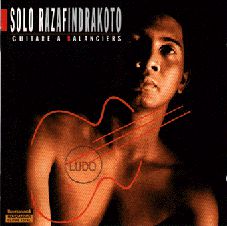
| Notable Works | Guitare à balanciers (1993), Solonaïves/Sculptures with GAD (2012) |
| Awards | Ranked among the ten best guitarists in France (2000), Opus Prize Montréal (2011) |
Key Dates
| Year | Event |
|---|---|
| 1956 | Birth in Montpellier; childhood in Madagascar in his grandparents’ village |
| 1973 | At 17, first studio musician in Antananarivo (Discomad studio) |
| 1978 | Move to France; accompaniment of Graeme Allwright (until 1983) |
| 1979 | Move to Paris; sessions with Francophone and African artists |
| 1986–2000 | Lead guitarist for Miriam Makeba; world tours (15 years) |
| 1998 | Creation of the quartet Worlds of Guitar with Fareed Haque, Romero Lubambo, and Aquiles Baez |
| 2000 | Ranked among the ten best guitarists in France |
| 2011 | Opus Prize for the Montréal Guitar Trio for “Dans les cordes” |
| 2015 | Covered With Love named “Guitar Album of the Year” by Folker (Germany) |
From Village to World Stages
Solo Razafindrakoto was born in the spring of 1956 in Montpellier and returned to Madagascar shortly after, to his grandparents’ village. He grew up immersed in the tsensigat—the folk music of the high plateaus—and the rhythms of the ba gasy, a popular dance whose picking bass waves mark the music of the region. Discovering the guitar at age twelve, he was immediately fascinated by Jimi Hendrix and Elek Baczik, a Hungarian jazz guitarist. “This jazz madman captivated me with his melodic sense and lightness,” he would later confess. “I find that the valiha resembles certain harp games,” he added, “I wanted to develop it harmonically through improvisation music like jazz. I developed a style blending jazz, Malagasy styles, and Brazilian music.” At seventeen, he joined Discomad, the only recording studio in Antananarivo, where he played guitar, bass, and drums for artists from all regions of Madagascar, forging a style nourished by the traditions of the Great Island.
In 1978, he settled in Paris and embarked on a double career. He first accompanied Graeme Allwright until 1983, then joined Dizzy Gillespie and, above all, Miriam Makeba, the legendary “Mama Africa.” From November 1986 to August 2000, Solorazaf was Makeba’s lead guitarist and toured the world with her—“The Three Divas Tour” with Nina Simone and Odetta, tours in the United States, and shows in Europe. Upon his return, he multiplied collaborations: “Autour de la guitare” by Jean-Félix Lalanne at the Olympia (2000, 2003), sessions with Maxime Le Forestier, Georges Moustaki, Rakoto Frah, Erick Manana, Ray Lema, and Franco. His label, Musikela, was born from this desire to make Oceanian artists known.
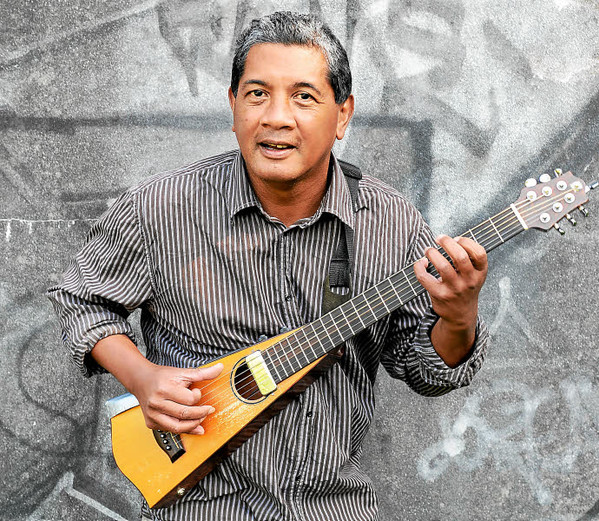
From 2001 onward, Solorazaf dedicated himself to “solo guitar performance,” a format he invented: seven-string guitar (an additional low E string for basses), small open C guitar for the ba gasy, an instrument he calls “bigbee,” and “footoy,” a drum played with the feet. With his voice, feet, and guitar, he produced dense and complete music. Télérama described his playing as “solo guitar illuminated by cascading traditional Malagasy rhythms,” while the New York Times called it “highly recommended.” In 2011, he received the Opus Prize in Canada with the Montréal Guitar Trio for the show “Dans les cordes.” In 2015, Folker named Covered With Love “Guitar Album of the Year,” and Madagascar made him an Officer of Arts and Culture. In parallel, he founded the “Guitares Alliées” school with the Alliance française d’Antsirabe.
Major Works
| Work | Year | Why It’s Essential |
|---|---|---|
| Guitare à balanciers | 1993 | Fusion of Malagasy music, folk blues, and French chanson |
| Solonaïves/Sculptures with GAD | 2012 | Double album: tribute to Rakotozafy (valiha) and Freddy Ranarison, sound collaboration with Georges-Alain Duriot |
| The Moon and the Banana Tree | 1997 | Shanachie album; portraits of Malagasy guitars for a Western audience |
| Covered With Love – Reprises par amour | 2015 | Named “Guitar Album of the Year” by the German magazine Folker |
Legacy and Influence
Solorazaf carries a music that has never separated from its roots, while engaging in dialogue with American jazz and French chanson. He showed that the Malagasy guitar—the sound of the valiha and kabosy transposed onto steel strings—could count among the most singular voices of world music. Guitarists like Dama and D’Gary opened the door; Solorazaf widened it, making the “solo guitar performance” a complete universe where the rhythms of Madagascar resonate like a mother tongue heard for the first time, yet instantly recognized.
Sources and References
- “Solo Razafindrakoto”, Afrisson, https://www.afrisson.com/solorazaf-388/, accessed November 8, 2026.
- “Solorazaf”, Wikipedia, https://fr.wikipedia.org/wiki/Solorazaf, accessed November 8, 2026.
- « Solorazaf », Wikipedia EN, https://en.wikipedia.org/wiki/Solorazaf, accessed 8 November 2026.
- Danny Carnahan, « Guitar Masters of Madagascar: A player’s guide to an amazing world of music », Acoustic Guitar Magazine, November 1997, https://dannycarnahan.com/writing/guitar-masters-of-madagascar-a-players-guide-to-an-amazing-world-of-music/, accessed 8 November 2026.
- « Concert. A guitar show with Solorazaf », Le Télégramme, 1 March 2016, https://www.letelegramme.fr/cotes-d-armor/erquy-22430/spanconcertspan-un-show-de-guitare-avec-solorazaf-2651376.php, accessed 8 November 2026.
- « This artist, among the best guitarists in France, in concert in the Cotentin », La Presse de la Manche, 18 Sept. 2024, https://actu.fr/normandie/valognes_50615/cet-artiste-parmi-les-meilleurs-guitaristes-de-france-en-concert-dans-le-cotentin_61617993.html, accessed 8 November 2026.
- Martin Sinnock, « Solonaïves/Sculptures with GAD », Songlines, Jan/Feb 2013, https://www.songlines.co.uk/reviews/solonaives-sculptures-with-gad, accessed 8 November 2026.
- Martin Taylor, page « Solorazaf », https://martintaylor.com/tag/solorazaf/, accessed 8 November 2026.
- « Solorazaf », Discogs, https://www.discogs.com/artist/3924555-Solorazaf, accessed 8 November 2026.