
Biography
Afrigo Band: five decades of Ugandan rhythm and resilience
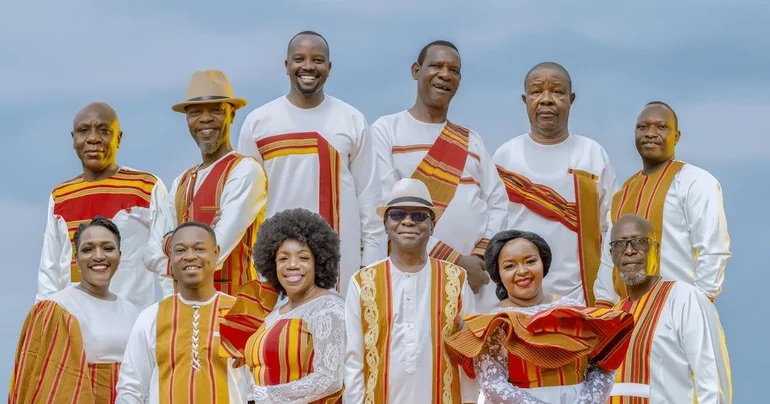
In August 1975, eight young musicians from Kampala refused to let the dissolution of Cranes Band end their careers.
With no instruments and no means, but driven by the conviction that music belongs to them, they founded a formation that would survive dictatorships, civil wars, and technological upheavals. Afrigo Band, a contraction of “Africa go” in the musical sense, became Uganda’s oldest music institution1.
In brief
| Name | Afrigo Band |
| Origin | Kampala, Uganda |
| Genres | African Rumba, Kidandali, Jazz |
| Active Period | 1975 – present |
| Founder | Moses Matovu (1949–2026) |
| Founding Members | Moses Matovu, Charles Ssekyanzi, Jef Sewava, Paddy Nsubuga, Paulo Serumagga, Fred Luyombya, Anthony Kyeyune, Geoffrey Kizito |
| Signature Songs | ““Afrigo Batuuse””, ““Jim””, ““Obangaina””, ““Teri Mubi”” |
| Distinctions | PAM Awards Lifetime Achievement Award (2022) |
Key Dates
| Year | Event |
|---|---|
| 1969 | Moses Matovu joins Cranes Band |
| 1975 | Founding of Afrigo Band in Kampala |
| 1976 | First recording in Nairobi with Phonogram (K) Ltd |
| 1979 | Rebuilding after theft of equipment during the liberation war |
| 1989 | Arrival of Joanita Kawalya and Rachael Magoola |
| 1999 | Release of album Obangaina, recorded in London |
| 2015 | 40th anniversary, weekly concerts at Club Silk |
| 2022 | Lifetime Achievement Award from PAM Awards |
| 2025 | Celebration of the 50th anniversary |
| 2026 | Death of Moses Matovu (September 24) |
Origins: from Cranes Band to Afrigo Band2
Born on June 19, 1949, in Kawempe, Kampala, Moses Matovu Bukenya — affectionately nicknamed “Papa Moi” — discovered music early on, singing in the choir of Namirembe Cathedral at around four years old. Passionate about football during his youth, he played for several Kampala clubs, but music emerged as his vocation. In 1967, he joined the Thunderbirds Band, then the Police Band, and finally Cranes Band in 1969. With this last group, he recorded his first original composition in 1970, ““Jimmy Saasira””, about a woman abandoned by her husband3.
When the Cranes Band management announced the group’s dissolution in 1975, Matovu refused to abandon music. Six fellow musicians decided to stay together. There were no instruments at that time, as the expulsion of Asians by Idi Amin had disrupted the Ugandan music market. The eight founders negotiated with Leonard Mugwanya, manager of Bat Valley Bar, who agreed to finance the purchase of instruments. The name Afrigo, a contraction of “Africa go,” was chosen to express their ambition.
Maturity: resilience, innovation, and recognition3
The 1980s constituted the most turbulent decade in Uganda’s history. From Amin’s regime to the civil war that led to Yoweri Museveni’s rise to power in 1986, Afrigo Band transformed into comfort for an exhausted population, playing at Nsambya Railway Club and Bat Valley Theatre. Their tracks ““Afrigo Batuuse””, ““Speed””, and ““Olulimi Lwange”” became popular anthems4.
The group’s sound fusion rests on Congolese rhythm and blues, jazz, funk, and traditional Ugandan rhythms, all wrapped in lyrics in Luganda, the language predominantly spoken in Kampala. This rooted identity ensures exceptional longevity. The group also produced in Denmark, recorded the album Volume 9, and became the first Ugandan band to release a CD2. The 1990s marked a turning point with the arrival of Joanita Kawalya and Rachael Magoola in 1989. Their arrival brought a new dimension. The group embarked on tours in the United States and the United Kingdom for the Ugandan diaspora.
Moses Matovu understood the importance of organizational discipline as much as music. “You cannot be, let’s say, 40 years old, and you are still playing. It is not possible, except when you become a coach,” he declared to justify his life choice5. This pragmatic vision made him the undisputed engine. In 2015, Afrigo celebrated its 40th anniversary at Kampala’s Club Silk, and in 2022, it received the Lifetime Achievement Award from PAM Awards.
Major Works
| Work | Year | Why It Is Essential |
|---|---|---|
| ““Afrigo Batuuse”” | Around 1980 | First major hit; anthem of Kampala nights |
| ““Jim”” | 1990s | Joanita Kawalya’s masterpiece; national hit |
| ““Obangaina”” | 1999 | Album recorded in London; group’s first CD |
| ““Teri Mubi”” | 2019 | Matovu’s last major album; old/new fusion |
Legacy2
Afrigo Band established itself as a full-fledged cultural institution. Their fidelity to the live format — saxophones, brass, guitars, percussion, vocals — kept a musical performance model alive at a time when Ugandan music was shifting toward programmed electronic production. The group trained and inspired generations of musicians who integrated the rigor of their arrangement approach.
The death of Moses Matovu on September 24, 2026, at the age of 77, plunged Uganda into mourning. Attacked in the Kibuli neighborhood, the founder never stopped directing or composing. Before disappearing, he summarized Afrigo’s longevity in three words: interest, commitment, and discipline. This treasure of experience remains, with more than 20 albums and 200 songs that constitute a musical heritage that all of Uganda continues to listen to and pass on.
Sources and references
-
Nilepost, 50 Years of the Beat: How Afrigo Band Shaped Uganda’s Soundtrack, accessed October 28, 2026 ↩︎
-
Jabulani Radio, Afrigo Band, biographical article, accessed October 28, 2026 ↩︎ ↩︎ ↩︎
-
GovInfoHub UPPC, Afrigo Band at 50: Five Decades of Rhythm, Resilience, and Relevance, August 14, 2025, accessed October 28, 2026 ↩︎ ↩︎
-
The Observer, Moses Matovu’s saxophone has fallen but the music of a nation will not, accessed October 28, 2026 ↩︎
-
East African Vanguard, Moses Matovu the footballer who built Afrigo Band, September 25, 2026, accessed October 28, 2026 ↩︎


