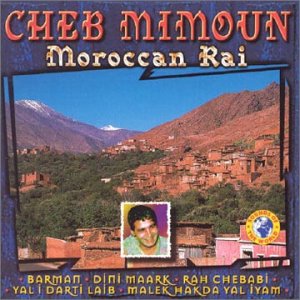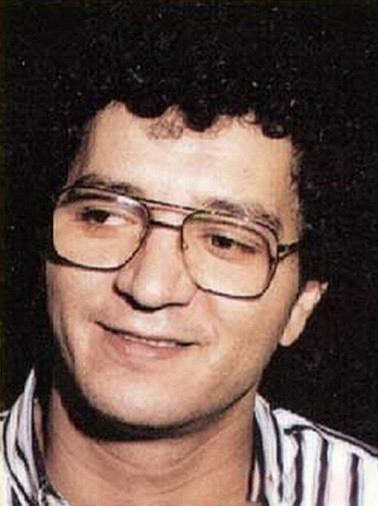
Biography
Cheb Mimoun El Oujdi
Oujda, a border town fifteen kilometers from Algeria. In the mid-1980s, a warm voice traversed the airwaves: that of a man who drew from the music of his region to offer Moroccan raï a unique sound. Mimoun El Oujdi, known by the nickname « Cheb » — this Maghrebi term meaning « young » and distinguishing young artists of the generation — made Oujda, perched on the edge of the eastern desert, a cultural crossroads where Algerian raï meets the chaâbi rhythms of eastern Morocco.
In brief
| Full name | Mimoun Bekkouch (stage name: Cheb Mimoun El Oujdi) |
| Birth | 1950 (or February 1953), Oujda, Morocco |
| Death | 3 November 2018, Casablanca, Morocco |
| Field | Moroccan raï (eastern chaâbi) — violin, electric guitar |
| Notable works | Barmān (1985), Alamāne (1995), Soulouh (2008) |
| Honors | Iconic figure of Moroccan raï, International Raï Festival of Oujda (2013) |
Key dates
| Year | Event |
|---|---|
| 1950 or 1953 | Birth of Mimoun Bekkouch in Oujda, eastern Morocco |
| 1982 | First album: En-nar kedāt, at around 32 years old, marked by the sounds of eastern raï |
| 1984 | Third explosive year: three releases (Ash-shidda ma tdoum, Ana ma nawlish, Raha djaia mehnati) |
| 1985 | Barmān, first major record that took him beyond eastern Morocco |
| 1986 | Ya moul taksi, a title that marked the Moroccan popular imagination |
| 1995 | Alamāne, confirmation of his status as maestro of eastern raï |
| 2008 | Soulouh, a noted comeback proving he never stopped |
| 2013 | Performed at the International Raï Festival of Oujda |
| 2018 | Death on 3 November, in Casablanca, following cancer |
Origins and first sound: the music of a border city
Mimoun Bekkouch was born in Oujda, a city perched on the eastern steppe, almost touching the Algerian border. The city lives to the rhythm of cross-border exchanges and its Kabyle, Chaoui, and Arab populations. It was in this crossroads that young Mimoun discovered the raï music coming from neighboring Algeria while growing up with the endemic chaâbi rhythms of Oriental Morocco. He learned the violin and then the electric guitar, instruments that very few raï singers mastered at the time — a practice that gave his recordings from the start a unique texture, between strings and machines.
Like other young Maghrebi singers of his generation, he signed himself under the title « Cheb », an honorific accolade that the raï public reserves for promising young men. « Cheb Mimoun El Oujdi » — the Oujdi, that of Oujda — became in a few years the name of the city itself.
Revelation and consecration: from eastern raï to the general public
It was in 1982 that Cheb Mimoun put his first voice on a record, with En-nar kedāt. The eastern raï he sang was not to be confused with that of Oran or Constantine: it bore local sounds, phrases in eastern Darija, and the rhythms that have made people dance in Oujda for decades. The year 1984 marked a rupture: three albums were released almost simultaneously (Ash-shidda ma tdoum, Ana ma nawlish, Raha djaia mehnati), an unusual surge that placed the artist at the forefront of the Maghrebi raï scene.
In 1985, Barmān exploded his notoriety beyond the borders of eastern Morocco. The album, signed by an influential producer from Casablanca, introduced more elaborate arrangements — bowed strings over an electronic rhythm — without betraying the singer’s chaâbi roots. The entire Moroccan public discovered an artist capable of singing the pain of love with rare frankness.
He continued throughout his life to publish one or two albums every fortnight, accumulating a total of eighteen records between 1982 and 2012. Among the titles that marked his career: Ya moul taksi (1986), Alkay fat-talafun (1990), the very popular Az-zin wma darte fia (1992), then Alamāne in 1995, a title that sealed his status as maestro of eastern raï. Ghorba bla wniss (2004, song of exile without friends) and Marjāna (2000) attest to a constant: the obsession with themes that touch directly those who cross the Mediterranean to seek work in Europe.
Legacy: a Moroccan raï that stands tall
Cheb Mimoun El Oujdi was one of the main craftsmen of the recognition of Moroccan raï, long eclipsed by his Algerian cousins. His prolonged career — thirty years of records — makes him an indispensable reference for eastern singers who succeeded him. He proved that eastern raï, that of Oujda and its border region, deserved to be listened to well beyond the city markets. He also left a son, Kamal El Oujdi, who took up the torch as a singer.
The festivities of the International Raï Festival of Oujda see him every year in 2013 on the stage of the festival that bears his name. Even today, his recordings circulate on streaming networks and continue to inspire a new generation of Moroccan raï enthusiasts.
Major works
| Work | Year | Why it is essential |
|---|---|---|
| Barmān | 1985 | First record to cross the borders of eastern Morocco, with arrangements that stand the test of time |
| Alamāne | 1995 | Mature masterpiece that confirms the artist at the peak of his art |
| Ghorba bla wniss | 2004 | Exile song that speaks to Moroccan workers in Europe |
| Soulouh | 2008 | Brilliant comeback proving he lost none of his flame |
Sources and references
- « Mimoun El Oujdi », French Wikipedia, https://fr.wikipedia.org/wiki/Mimoun_El_Oujdi, accessed 2 November 2025.
- « Mimoun El Oujdi », Wikipedia in English, https://en.wikipedia.org/wiki/Mimoun_El_Oujdi, accessed 2 November 2025.
- « Cheb Mimoun El Oujdi — Biography », Last.fm, https://www.last.fm/music/Cheb+Mimoun+El+Oujdi/+wiki, accessed on November 2, 2025.
- « Cheb Mimoun », AllMusic, https://allmusic.com/artist/cheb-mimoun-mn0000613112, accessed on November 2, 2025.
- « Morocco: the famous raï singer Mimoun El Oujdi has passed away », Atlas Info Maroc, November 3, 2018, https://atlasinfo.fr/maroc-le-celebre-chanteur-de-rai-mimoun-el-oujdi-decede_a95152.html, accessed on November 2, 2025.
- « Death of the famous Mimoun El Oujdi », L’Economiste, November 3, 2018, http://www.leconomiste.com/flash-infos/deces-du-celebre-mimoun-el-oujdi, accessed on November 2, 2025.
- « Mimoun el Oujdi Biography », MusicMe, https://www.musicme.com/Mimoun-el-Oujdi/biographie/, accessed on November 2, 2025.