Biography
Grace Decca: the voice of makossa
Douala, 1993. On a stage across the continent and Europe, Grace Decca’s timbre cuts through the air — pure, clear, incandescent. Behind her, the soundtrack weaves its makossa chords between dance and prayer. This voice born into a family of artists, forged in the choir of her brother Ben and then with Jean-Jacques Goldman, has since the 1990s reached a rare summit: the one who became “the Diva” of makossa does not merely sing her people, she reinvents them with every album.
In brief
| Full name | Ndom’a Deccah Grace, known as Grace Decca |
| Birth | 23 September 1966 — Douala, Cameroon |
| Genre | Makossa, gospel |
| Signature works | Besoin d’amour, Doï La Mulema, Appelle-moi Princesse, Mouna |
| Awards | Best female album, best female sales, Bertrand Folon prize for artistic maturity |
| Nickname | The Diva |
Key dates
| Year | Event |
|---|---|
| 1966 | Born in Douala, sixth of eleven siblings |
| 1983 | First appearance on “Na sengui bobe” by Ben Decca |
| 1987 | Choir on “À nos actes manqués” by Jean-Jacques Goldman |
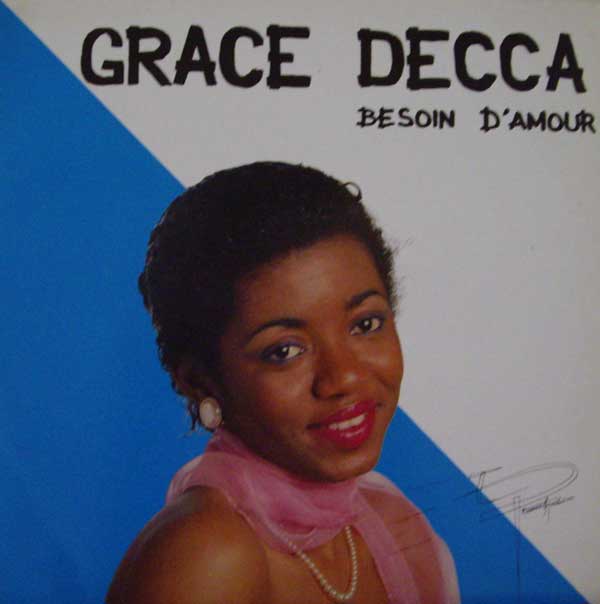
| 1989 | First solo album, Besoin d’amour — over 150,000 copies sold |
| 1993 | Doï La Mulema, true international consecration |
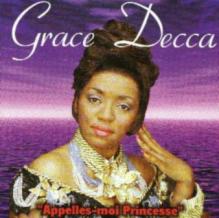
| 1998 | Appelle-moi Princesse: triple award, Bertrand Folon prize |
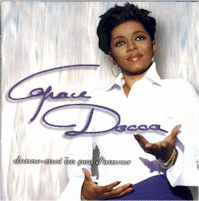
| 2001 | Last makossa album, Donne-moi un peu d’amour |
| 2014 | Return to gospel with Mouna, produced by George Duke |
| 2018 | SACEM prize for cultural contributions |
A family music, an imposed vocation?
Born on 23 September 1966 in Douala, Grace Decca grew up in a household where music was not a profession, but a mother tongue. Her father was an automobile expert and her mother a pedagogue; in the same house lived four artists — her older brother Ben, his sister Dora, and Isaac. She is also the niece of Eboa Lotin and the great-granddaughter of Lobe Lobe Rameau, a pioneer of makossa. Talent bloomed there as a matter of course: one is born a musician, then chooses to remain one.
From 1983, Ben Decca invited her on “Na sengui bobe”, a title that became a hit. Grace entered the arena gently, placing her voice on the choir of her brother and other prestigious artists. In 1987, Jean-Jacques Goldman entrusted her with the choir on the track “À nos actes manqués” — a sign that her timbre resonated beyond borders. Between 1984 and 1989, she rubbed shoulders with the greatest of the Cameroonian scene while pursuing her studies in France, where she obtained a DEA in communication (1998).
The break came in 1989: she sang for herself. Besoin d’amour, her first album, features five tracks and sold over 150,000 copies in Cameroon. The public discovered an interpreter as much as a promising songwriter-composer.
Three years later, Doï La Mulema (1993) imposed her voice on the world. Richard Bona signed the choir, Toto Guillaume orchestrated the arrangements. Planetary success. Appelle-moi Princesse (1998) earned her best female album of the year, best female sales, and the Bertrand Folon prize for artistic maturity. Donne-moi un peu d’amour (2001) closed this prosperous period of five albums dedicated to makossa.
Then, silence. Thirteen years of absence that suggested retirement. Grace founded GNS Productions and raised her family.
The renaissance arrived in 2014 with Mouna — “burden” in douala. Gospel album produced in the United States by George Duke (1946-2013), who contributed two compositions. Thirteen tracks in English, French, and douala, sung alongside Sheila E., Jeffrey Osborne, and Jonathan Butler. Grace no longer sought the makossa of the dance floor; she sought transcendence in it.
In 2022, “Challenge” announced her return to the news, reminding everyone that she had never stopped writing or questioning herself.
Major works
| Work | Year | Why it is essential |
|---|---|---|
| Besoin d’amour | 1989 | First release that exploded sales and launched the solo career |
| Doï La Mulema | 1993 | The album that established her on the international stage |
| Appelle-moi Princesse | 1998 | Critical triumph, triple award winner |
| Mouna | 2014 | Spiritual turning point produced by George Duke: makossa transforms into gospel |
Legacy and influence
Grace Decca paved the way for female voices in makossa. By proving that a woman could compose, produce, and reinvent herself — from popular makossa to international gospel — she traced a path that Charlotte Dipanda and Sally Nyolo continue to follow. Her label GNS Productions trains the new generation, and her story remains one of the most beautiful examples of African art uniting tradition, spirituality, and modernity.
Sources and references
- « Grace Decca », Wikipedia (French version), https://fr.wikipedia.org/wiki/Grace_Decca, accessed 2 November 2025.
- « Grace Decca », Wikipedia (English), https://en.wikipedia.org/wiki/Grace_Decca, accessed 2 November 2025.
- « Portrait: discovering Grace Decca », Camerounweb, https://www.camerounweb.com/CameroonHomePage/entertainment/Portrait-la-d-couverte-de-Grace-Decca-419383, accessed 2 November 2025.
- « Grace Decca (Cameroon) Biography », Frank Bessem’s Musiques d’Afrique, https://www.musiques-afrique.net/cameroon/art-decca-grace.html, accessed 2 November 2025.
- « Music: the new “Challenge” by Grace Decca », Cameroun Tribune, https://www.cameroon-tribune.cm/article.html/53428/fr.html, accessed 2 November 2025.
- « Grace Decca – Challenge MP3 », citimuzik, https://citimuzik.com/2026/05/grace-decca-challenge-mp3-download.html, accessed 2 November 2025.
- « YAOUNDE: GRACE DECCA EMBRASE LE CARROSSEL », AfricaZine, http://africazine.com/yaounde-grace-decca-embrase-le-carrosselvideo, accessed 2 November 2025.
- « Grace Decca », Qobuz, https://www.qobuz.com/us-en/interpreter/grace-decca/600881, consulted on 2 November 2025.