Musical History of Tunisia
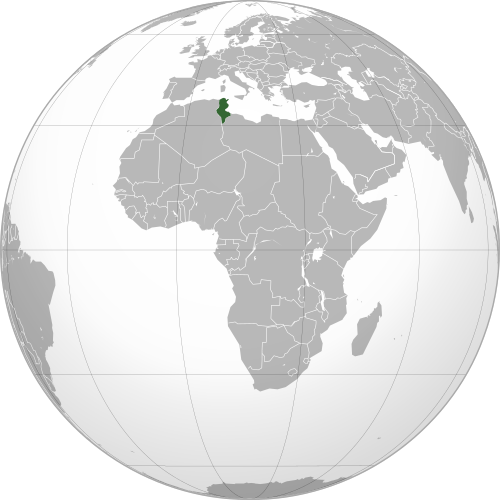
Tunisia, a small Maghrebian country at the crossroads of the Mediterranean, harbors one of the most layered and surprising musical scenes in the Arab world. From noubas — vocal suites inherited from Al-Andalus — to Tunisian prog-metal, passing through the revolutionary singing of Emel Mathlouthi and the experimental electro of Deena Abdelwahed, Tunisian music ceaselessly recomposes its identity. How did a territory of 1.3 million km² become an unsuspected crucible?
An Andalusian Heritage Preserved by Science
Malouf, a term meaning familiar in Tunisian Arabic, is the cornerstone of classical Tunisian music. This musical art arrived on North African shores in the 12th century, when Andalusian communities expelled from the Iberian Peninsula made Tunis their refuge 1. After four centuries in the white city of Tunis, these traditions absorbed Ottoman influences from Istanbul in the 18th century, creating a repertoire whose very name — al-musiqa al-andalusiyya — recalls Hispano-Muslim origins 2.
Until the beginning of the 20th century, malouf survived in reduced popular ensembles, playing at weddings and circumcisions with instruments such as the Tunisian oud, rabab, and bendir. But the arrival of French colonization in 1881 dealt a heavy blow to indigenous cultural expressions 3.
It was then that an extraordinary figure intervened: Baron Rodolphe d’Erlanger (1872-1932), a German musicologist naturalized French, who settled in Tunis in 1910 and dedicated the rest of his life to saving malouf from oblivion. In collaboration with Ali al-Darwish from Aleppo, he wrote a monumental treatise in six volumes that laid the theoretical foundations of the genre 4. In 1934, he co-founded with Tunisian intellectuals the association La Rachidia, a true popular conservatory that standardized the repertoire and trained the first generation of certified musicians 5.
Did you know? The first Arab Music Congress was held in Cairo in 1932, bringing together the musical elites of the Arab world. D’Erlanger, too ill to attend, nevertheless played a central role in the organization, and his work influenced Arab music worldwide 6.
1938-1970: Radio, Pioneers and Legendary Voices
The creation of Radio Tunis in 1938 changed everything. For the first time, Tunisian voices reached listeners who did not frequent the refined circles of the medina. Radio offered a salary, recognition, and an African-wide audience to artists who instantly became icons 7.
Cheikh El Afrit (1880-1939), from the Tunisian Jewish community, is one of the first stars recorded: between 1928 and 1938, he left a catalog of songs in Tunisian Arabic that remains a reference 8. Saliha (1914-1958), born in the Kef, took to the stage of the Municipal Theatre of Tunis upon the inauguration of radio, and became one of the greatest voices of the Tunisian repertoire 9. Ali Riahi (1900-1967), a singer and composer of Turkish origin, shaped a personal style blending malouf and Egyptian Oriental influences, and recorded dozens of discs for Columbia and Pathé.
Hédi Jouini (1909-1990) extended the movement. A prolific composer author of more than 1,070 songs and 56 operettas, he transposed Tunisian melodies into Latin harmonies and modern orchestral arrangements, creating a bridge between traditional malouf and light song 10.
On the popular side, mezwed — literally added in Tunisian Arabic, named after the reed instrument that dominates it (a kind of goat-skin bagpipe) — established itself as the music of the countryside and working classes. Played at village festivals, it is often associated with trance dances. Singers like Heddi Habbouba and Salah Farzit made it, in the 1960s-70s, a respected and recorded genre 11.
Malouf itself, however in decline during the protectorate, survived thanks to state support that made it, after independence in 1956, an emblem of national identity.
Post-independence: effervescence and pan-Arab stars
The Tunisian independence (1956) opens a decade of cultural renaissance. The Rachidia nurtures new talents, including Khemaïs Tarnane, poet and singer who composes on texts by Mahmoud Bourguiba and Jalaleddine Naccache 12. Lotfi Bouchnak (born 1954), from the popular Halfaouine neighborhood in Tunis, joins the institution in 1969 and studies oud under Ali Sriti. His tenor voice, compared by the press to Pavarotti, propels him onto Arab stages: he performs regularly at the Cairo Opera starting in 1992 and becomes the UN ambassador for peace in 2004 13. Curiously, his career intersects with modern metal: in 2019, he lends his voice to the group Myrath on the track Mersal, fusing tarab with distorted guitars 14.
Saber Rebaï (born 1967), for his part, fuses the rhythms of malouf with contemporary Arab pop production. In 2000, his track Sidi Mansour becomes a pan-Arab cultural phenomenon and is ranked as the 8th best Arab pop song of the 21st century by Rolling Stone 15.
Tunisia also exports exceptional female voices. Thekra (1966-2003), born in La Marsa, takes the stage at the Carthage Festival in 1983 and becomes, within a few years, the « princess of tarab » — this style of Arab singing that transports the listener through emotional intensity — with tracks like Wehyati Andak and Al Asami 16. She is assassinated in Cairo in November 2003, a tragedy that mourns the Arab music scene.
Tunisia also pushes artists internationally: F.R. David (Elli Robert Fitoussi, 1955-2017) lives in Paris and conquers the whole world in 1982 with Words (Don’t Come Easy), a global hit that remains the biggest international success of an artist born in Tunisia 17.
Jazz, oud and fusion: Tunisia in the global conversation
In the 1990s, two Tunisians place their country on the map of international jazz. Anouar Brahem (born 1957), oud player trained at the Tunis Conservatory, signs with the German label ECM Records in 1986. His first album, Maqam, blends Arab-Andalusian modes with the sobriety of Scandinavian jazz. Dave Holland, bassist for Miles Davis, records with him on Thimar (1999) 18. Brahem is hailed as an oud magician, capable of extracting sounds from the old lute that resemble nothing else.
Dhafer Youssef (born 1967 in Téboulba, a coastal village), from a lineage of muezzins, goes to Europe in 1990 and builds his universe between jazz, electro and Sufism. His album Electric Sufi (2001) combines oud, voice and electronic rhythms with Will Calhoun of the Sugar Hill Gang. Diwan of Beauty and Odd (2016), recorded at the Sear Sound Studio in New York, is acclaimed by critics for its use of asymmetrical measures 19. He tours regularly with figures like Zakir Hussain, Nguyên Lê and Marcus Miller.
On the orchestral side, El Azifet, founded in 1992 by violinist and leader Amina Srarfi, remains one of the rare all-female ensembles in the world entirely composed of musicians. It performs malouf and the mouachah — classical Arabic poems from the 12th century — on stages in Paris, New York and Cairo 20.
Revolution, rap and experimentation: the new wave
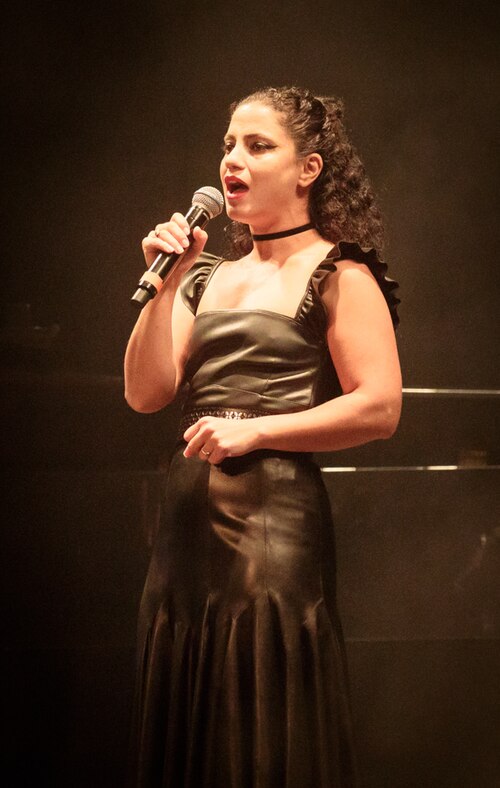
The Tunisian revolution of 2011 marks a turning point. Emel Mathlouthi (born 1982) sings Kelmti Horra (« My word is free ») with Habib Bourguiba in the middle of a demonstration. The video goes viral. The eponymous album (2012), released by Harmonia Mundi, is acclaimed internationally; Ensen (2017) receives a nomination for Best New Track from Pitchfork 21. She becomes the muse of the revolution, and her last album, Mra (2024), explores the links between the female body and nature.
Tunisian hip-hop, with artists like Balti, JenJoon, Samara and Tchiggy, exploits the same themes of rebellion and identity. Deena Abdelwahed (born in Qatar, raised in Tunis) creates the EP Klabb (which means rage in Tunisian Arabic) in 2017, blending North African rhythms and dark electronic sounds. Based in Toulouse, she is programmed at Sónar, CTM Festival and the Transmusicales de Rennes, and her headlining act has become the icon of contemporary Maghrebi electro 22.
Metal also progresses: Myrath, formed in 2001 by Malek Ben Arbia, fuses progressive metal riffs and Tunisian melodies. The album Shehili (2019), with its collaboration with Lotfi Bouchnak, illustrates this improbable dialogue between a classical tenor and a distorted amplifier 23.
And malouf revives? The answer is yes. Dorsaf Hamdani (born 1971), musicology doctor from the Sorbonne and former singer at the Cairo Opera, returned to settle in Tunis in 2020 after fifteen years in France. She performs Arab divas — Oum Kalthoum, Fairuz, Asmahan — with a purist repertoire that she constantly renews 24. Even younger, Dhiaeddine Maknine (born 2005) performs at the Brussels festival in 2021 and received the award for best show at the Testour festival in 2026. At 21, he masters the oud, rabab, kammanja and darbouka, embodying a generation that refuses to reduce heritage to a museum showcase 25.
Tunisian music, long presented as a frozen heritage, is today a living ecosystem: tradition does not suffocate it, it stimulates it.
Sources
-
Davis, Ruth, « Ma’luf and Tunisian Identity », in Music in Tunisia: Contemplating musical life under the French protectorate, 2019. URL : https://doi.org/10.4135/9781483317731.n744 ↩︎
-
AllMusic, « Music of Tunisia », 2024. URL : https://en.wikipedia.org/wiki/Music_of_Tunisia ↩︎
-
« Contemplating musical life in Tunisia under the French protectorate», in Musical Life in North Africa, transcript-open.de, 2023. URL : https://www.transcript-open.de/pdf_chapter/9783839446676/9783839446676-007/9783839446676-007.pdf ↩︎
-
Pasler, Jann, « Baron Rodolphe d’Erlanger and the transcription of Tunisian music », Revue de musicologie, vol. 84, no 2, 1998. ↩︎
-
« La musique tunisienne », Wikipédia fr, last modified September 2026. URL : https://fr.wikipedia.org/wiki/Musique_tunisienne ↩︎
-
Poché, Jean-Michel, « Le premier Congrès de musique araise du Caire (1932) », in Music in Tunis: History, Culture, and Geography, SAGE International Encyclopedia of Music and Culture, 2019. URL : https://doi.org/10.4135/9781483317731.n744 ↩︎
-
Pasler, Jann, « Tunisian Music and Musicians on Radio-Tunis P.T.T. », Ethnomusicology, vol. 53, no 2, 2009. URL : https://escholarship.org/uc/item/84g2w0sz ↩︎
-
« History of Arabic Song: The Best of Cheikh El Afrit », Apple Music. URL : https://music.apple.com/us/album/history-of-arabic-song-the-best-of-cheikh/384774989 ↩︎
-
Wikipédia, « Saliha (chanteuse) », last modified. URL : https://en.wikipedia.org/wiki/Saliha_(singer) ↩︎
-
Wikipédia, « Hédi Jouini », last modified. URL : https://en.wikipedia.org/wiki/Hédi_Jouini ↩︎
-
Wikipedia, « Mezwed », last modified. URL : https://en.wikipedia.org/wiki/Mezwed ↩︎
-
« Évolution de la musique tunisienne », Scribd, 2024. URL : https://fr.scribd.com/document/715583969/Patrimoine-Musical-Tunisien ↩︎
-
« The artist is a witness of his time – Lotfi Bouchnak », Arab America, 2019. URL : https://arabamerica.com/the-artist-is-a-witness-of-his-time-lotfi-bouchnak ↩︎
-
Myrath, album Shehili (2019), Saphir Records. ↩︎
-
Rolling Stone, « The 50 Best Arabic Pop Songs of the 21st Century », 2024. ↩︎
-
« Zekra – 20th anniversary of her passing », MusiFlo, November 28, 2023. URL : https://musiflo.com/2023/11/28/zekra-20th-anniversary-of-her-passing/ ↩︎
-
« F.R. David », Wikipédia, last modified. URL : https://en.wikipedia.org/wiki/F.R._David ↩︎
-
« Anouar Brahem and the Art of the Oud », NPR Studio 4A, November 17, 2002. URL : https://www.npr.org/2002/11/17/845031/anouar-brahem-and-the-art-of-the-oud ↩︎
-
Chrysler, Ivan, « BBC Awards for World Music 2006 », BBC Radio 3, 2006. URL : https://www.bbc.co.uk/radio3/worldmusic/a4wm2006/a4wm_dhaffer.shtml ↩︎
-
Britannica, « El-Azifet », last updated. URL : https://www.britannica.com/topic/El-Azifet ↩︎
-
Pitchfork, « Review: Emel Mathlouthi – Ensen », 2017. ↩︎
-
« Bidoun Mix 2: Deena Abdelwahed », Bidoun, 2017. URL : https://next.bidoun.org/articles/bidoun-mix-2-deena-abdelwahed ↩︎
-
« Tunisian Progressive Metal Band Myrath Announce Shehili », AtomSplitter PR, 2019. URL : https://atomsplitterpr.com/tunisian-progressive-metal-band-myrath-announce-shehili-release-date/ ↩︎
-
« Dorsaf Hamdani : une voix jeune au service du malouf », LaPresse.tn, October 24, 2026. URL : https://lapresse.tn/2026/10/24/dhiaeddine-maknine-une-voix-jeune-au-service-du-malouf ↩︎
-
« Dhiaeddine Maknine : une voix jeune au service du malouf », LaPresse.tn, October 24, 2026. URL : https://lapresse.tn/2026/10/24/dhiaeddine-maknine-une-voix-jeune-au-service-du-malouf ↩︎