Zambian music: from copper mines to global fame
In 2025, the group WITCH makes history by performing at Glastonbury Festival, the world’s largest music festival. Thirty-five years after their last album, the heirs of Zamrock — Zambian psychedelic rock from the 1970s — have conquered Europe and America. Rappers like Tyler, The Creator1, labels like Third Man Records2 and icons like Jack White2 have rediscovered these forgotten recordings. But what makes this renaissance extraordinary is that it rests on an entire Zambian music scene that died out in the 1980s, before being reborn. How did a landlocked country in southern Africa create one of the continent’s most original styles, then almost entirely lose it?
From copper mine rhythms to kalindula beats
The story of Zambian music begins with that of copper. The exploitation of the Copperbelt deposit, in the north of the country, began in the 1920s and shaped for seventy years the economy, society and culture of the country. Mining companies attracted workers from all over the country and neighboring regions, gathering them in urban settlements where new traditions emerged3.
Before independence, music served specific ritual functions — teaching, healing, ancestor celebration — but social clubs built for miners on weekends became the first venues for disseminating popular music. It was there that young Zambians discovered imported records from the United States and the United Kingdom for the first time: The Stones, Jimi Hendrix, Deep Purple4. Their rhythms, their gestures, their sounds would remain etched.
Kalindula music — the most emblematically Zambian form — finds its roots in the rural north of the country, among the Bemba. Originally, it is festive music played during beer parties, with acoustic guitar, two-string bass, drums and a long wooden stick that rubs against stretched skin, acting as a vinyl deck5. Kalindula is a tradition that constantly reinvents itself, moving between countryside and city, and will become the musical DNA of an entire country.
The pioneers: the voice of radio
Alick Nkhata is the first major figure in recorded Zambian music. Born in 1916 in Northern Rhodesia, this blind teacher was spotted in 1940 as a sergeant in the British army during World War II. His musical talents earned him a scholarship, and he became the leader of a quartet that would record thousands of discs, broadcasting humorous and moral songs6. He later directed the Lusaka Radio Band, then climbed the ranks to become Director of Cultural Services for Zambia. His destiny broke on November 16, 1978, killed in a Rhodesian paratrooper raid on a suspected Zambian combatants camp7.
For years, CABS radio — the Central African Broadcasting Station — played a driving role in musical development. It broadcast local recordings as well as American and South African ones, stimulating creation and record sales8. The listeners of kitchen radios — these Saucepan Specials made with an Eveready battery and a cooking pot — broadcast music into the huts of all across the Copperbelt9.
Thus a generation grew up with The Stones, The Beatles and Jimi Hendrix in their ears — and decided that when independence arrived in 1964, they would make music for themselves too.
The Golden Age: Zamrock and Kalindula
The 1964 independence marks a decisive turning point. President Kenneth Kaunda, himself an ex-musician, promoted a policy of Zambian First: 95% of music broadcast on the radio had to be of Zambian origin10. Young groups were only waiting for a chance to perform. And they took it.
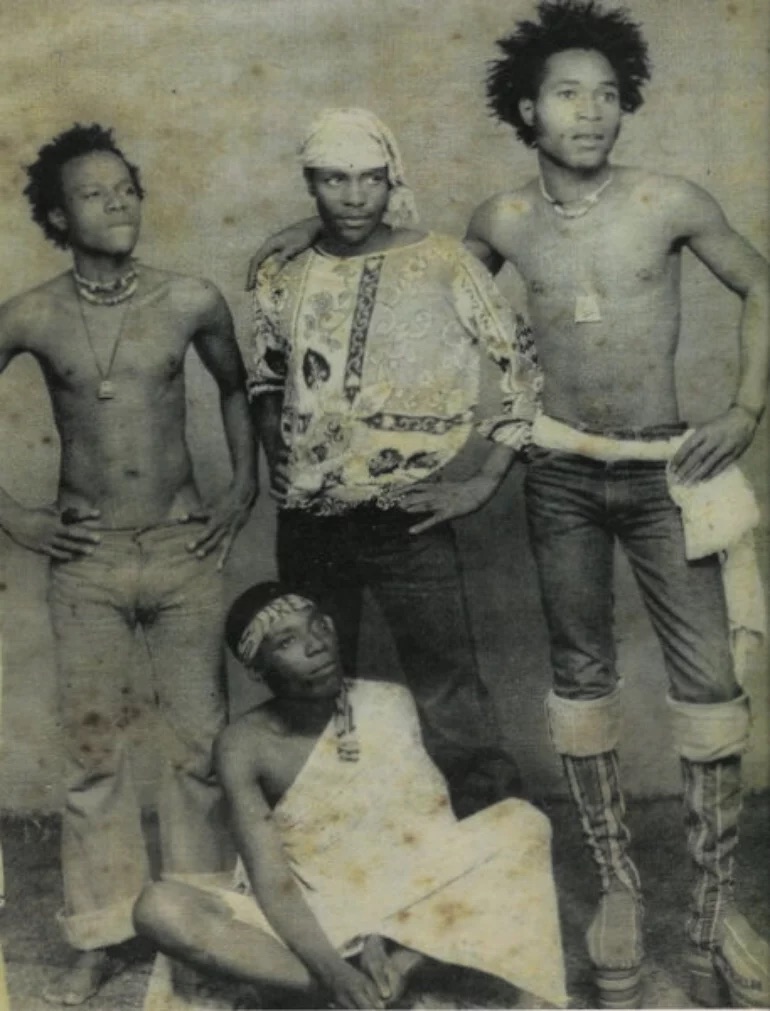
WITCH (an acronym for We Intend To Cause Havoc) was born in 1971 in the mining town of Kitwe. Its leader, Emmanuel Chanda, nicknamed « Jagari » because he reminded people of Mick Jagger on stage11, formed the most popular band on the Zamrock scene. The group produced five albums between 1972 and 1977, including Introduction (1972) — the first Zamrock record — and Lazy Bones (1975), considered a peak12. Their concerts lasted from 7 PM to 2 AM, and the frenzied crowds sometimes tore off the roofs of the halls13. « We had the influence of rock ’n’ roll, but we were Africans, so we couldn’t play rock ’n’ roll as is. We had to incorporate our own things », Jagari would explain14.
Zamrock is a unique blend: fuzz guitars and wah-wah, psychedelia, African rhythms, and English vocals mixed with local languages15. While WITCH embodied heavy psychedelic rock, other groups explored softer variants. Paul Ngozi — whose real name is Paul Dobson Nyirongo, born in 1949 and died in 1989 — led the Ngozi Family, mixing rock, kalindula, and reggae. Known for his spectacular performances, he played guitar with his teeth and sang lyrics that resonated in the streets16.
The kalindula scene, on its part, was fueled by groups like Amayenge Cultural Ensemble (founded by Chris Chali in 1978), who dominated the scene for decades by integrating the 73 ethnic groups of the country17. Other major names: PK Chishala, Emmanuel Mulemena, the Mulemena Boys18. Kalindula was distinguished by a funky bass, catchy rhythms, and deeply social lyricism — the text is always, for the Zambian listener, the most important thing19.
The 1970-1979 period is a golden age. The copper boom offers purchasing power to workers, who can pay to attend concerts. But starting from 1974, the drop in copper prices begins the decline20.
The Epidemic Shock and Digital Revival
Zambian music of the 1970s suffered a double blow: economic collapse due to the fall in copper prices, then the AIDS epidemic. The epidemic hit so hard that an estimated 1.4 million deaths occurred in Zambia between 1985 and 202321. On the Zamrock scene, death practically took out the entire first generation of WITCH. « Giddy King » Mulenga, « Star MacBoyd » Sinkala, Paul « Jones » Mumba, Chris « Kims » Mbewe and John « Music » Muma — each, Jagari recounts, died of AIDS22.
In the 1980s and 1990s, Zambian radios were invaded by imported American, Congolese, and Jamaican music23. A huge void opened up. But music did not disappear: it reinvented itself.
Zed Beats was born at the end of the 1980s, when self-taught producers began using computers and software to fuse African sounds with R&B, reggae, hip-hop, and dancehall24. Daddy Zemus released the album Salaula in 1997 — the Zambian term for second-hand clothing imported from Europe, which became the symbol of an urban generation25. Then came Jordan Katembula, known as JK, whose 2001 album JK is the sonic manifesto of Zed Beats: tracks in Chibemba, such as Balekuzembeleka (« They lie to you »), which became anthems26. Zed Beats does not just copy: it resolves. Deejays become the new vectors of music, and women participate in production more than ever27.
The Legacy: From WITCH to Glastonbury, from Yo Maps to the World
Today, the Zambian music scene is more alive and connected than ever. The beacon of this movement is Yo Maps — whose real name is Elton Mulenga, born in 1994 in Kasama. His first album, Kommando, released in 2021, accumulated 18 million streams in the first month28. He holds the record for the most Kwacha Music Awards won in a single evening, and his collaboration with American R&B icon Omarion on “Superman”29 propelled his name onto the international stage. Four of his tracks surpassed 10 million views on YouTube30. « Our music contributes to the broader African movement, and I am proud to be part of it », he explains31.
Other names dominate the charts: Slap Dee (the « King Dezo »), Macky 2, Chef 187, Abel Chungu32. Zed Beats evolves constantly, absorbing afrobeats, amapiano, Jamaican dancehall33. Young artists even create new hybridizations: Trapundula — a fusion of trap and kalindula — was recently born from the hands of Vichenzo, Akar, SG Man and Eazy34.
And Zamrock? It never really disappeared. Since 2011 and the reissues by Now-Again Records, WITCH’s music has conquered a global audience35. In 2017, the group undertook its first tour outside Africa. In 2023, it released Zango, its first album in 39 years36. In 2025, it becomes the first Zamrock group to perform at Glastonbury37. « Zamrock is our own thing », says Jagari. « Like rhumba for Cuba and the Congo. Like amapiano for South Africa. Like highlife for Nigeria. »38
The sound of the Copperbelt mines’ copper traveled much further than one would have thought.
Sources and references
-
BBC Culture, « ‘It’s hard not to be blown away’: The 70s rock band putting Zamrock back on the map, 50 years on », June 11, 2025. URL: https://bbc.com/culture/article/20250611-the-70s-rock-band-putting-zamrock-on-the-map ↩︎
-
BBC Culture (ibid.); Third Man Records, Jack White’s label. ↩︎ ↩︎
-
Wolfgang Bender, Sweet Mother: Modern African Music, Chicago Studies in Ethnomusicology, U. of Chicago Press, 1991 (chap. 5 « Music of Liberation », pp. 136-150). ↩︎
-
Global Voices, « The death and rebirth of the distinctive sounds of Zambia », November 29, 2023. URL: https://globalvoices.org/2023/11/29/the-death-and-rebirth-of-the-distinctive-sounds-of-zambia/ ↩︎
-
Bender (op. cit.), pp. 146-150. ↩︎
-
Stern’s Guide to Contemporary African Music Vol. 2, Graham (Pluto Press, 1992), ch. 38 « Zambia »; Bender (op. cit.), pp. 138-142. ↩︎
-
Global Voices (op. cit.); Stern’s Guide (op. cit.). ↩︎
-
Bender (op. cit.), pp. 143-145. ↩︎
-
Bender (ibid.). ↩︎
-
The Guardian, « Why Zamrock is back in play », July 22, 2013. URL: https://theguardian.com/music/2021/jul/05/witch-the-glory-and-tragedy-of-zambias-psych-rock-trailblazers ↩︎
-
BBC Culture (op. cit.). ↩︎
-
BBC Culture (ibid.); Stern’s Guide (op. cit.). ↩︎
-
The Guardian (op. cit.). ↩︎
-
BBC Culture (op. cit.). ↩︎
-
Global Voices (op. cit.). ↩︎
-
The Guardian (ibid.); Stern’s Guide (op. cit.). ↩︎
-
Chalo Chatu, « Amayenge ». URL: https://chalochatu.org/Amayenge ↩︎
-
Global Voices (op. cit.). ↩︎
-
Bender (op. cit.), pp. 149. ↩︎
-
BBC Culture (op. cit.). ↩︎
-
Global AIDS Tracker, UNAIDS. URL: https://www.unaids.org/en/regionscountries/countries/zambia ↩︎
-
The Guardian (op. cit.). ↩︎
-
The Conversation, « Zed Beats: how home studios reinvented Zambian pop music », by Dr Mathew Tembo. URL: https://theconversation.com/zed-beats-how-home-studios-reinvented-zambian-pop-music-and-gave-young-people-a-voice-288438 ↩︎
-
The Conversation (ibid.); Global Voices (op. cit.). ↩︎
-
The Conversation (op. cit.). ↩︎
-
The Conversation (ibid.). ↩︎
-
The Conversation (ibid.). ↩︎
-
GQ Afrique, « Yo Maps shines as the global ambassador of Zambian music », December 7, 2024. URL: https://gq.co.za/culture/entertainment/2024-12-07-yo-maps-shines-as-the-global-ambassador-of-zambian-music/ ↩︎
-
Wikipedia, « Yo Maps ». URL: https://en.wikipedia.org/wiki/Yo_Maps ↩︎
-
Zedify Online, « Yo Maps Breaks Records as Confirmation Hits 10 Million YouTube Views », November 3, 2024. URL: https://zedifyonline.com/yo-maps-breaks-records-as-fourth-song-hit/ ↩︎
-
GQ Afrique (op. cit.). ↩︎
-
UkaniManje.org, « Our Artists ». URL: https://ukanimanje.org/our-artists ↩︎
-
The Conversation (op. cit.). ↩︎
-
Lusaka Star, « ZAMBIA BIRTHS MUSIC GENRE ». URL: https://lusakastar.com/entertainment/zambia-births-music-genre ↩︎
-
BBC Culture (op. cit.). ↩︎
-
BBC Culture (ibid.). ↩︎
-
BBC Culture (ibid.). ↩︎
-
BBC Culture (ibid.). ↩︎