Biography
Compay Segundo: the father of Cuban música
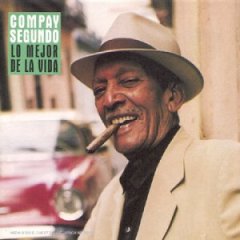
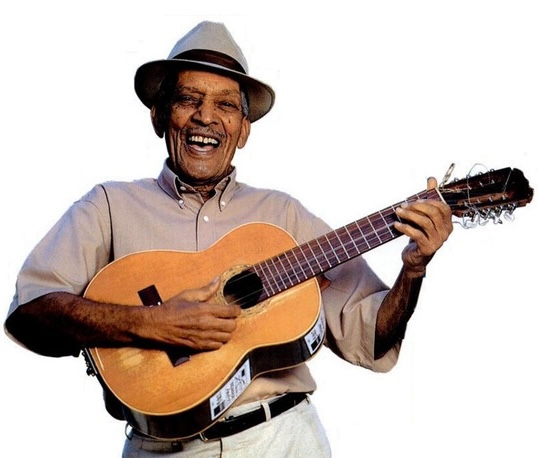
In August 2002, at the Hotel Nacional de La Habana, Compay Segundo straightened his hat and saluted a standing audience. Dressed in his Panama hat, smoking his cigar, and holding the mystery of the armónico in his calloused hands, this old man had just finished “Chan Chan”, the four-chord song that now carries Cuban music into bars all over the world.
In brief
| Full name | Máximo Francisco Repilado Muñoz Telles |
| Birth | November 18, 1907, Siboney (Cuba) |
| Death | July 13, 2003, La Habana (Cuba) |
| Genre(s) | Son cubano, trova |
| Instrument(s) | Tres, guitar, armónico (instrument invented by the artist) |
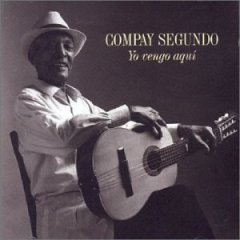
| Notable works | “Chan Chan”, “Macusa”, “Yo vengo aquí” |
| Awards | Grammy Award (1998), Félix Varela (Cuba, 2001) |
Key dates
| Year | Event |
|---|---|
| 1907 | Born in Siboney, near Santiago de Cuba. His father was a mine mechanic. |
| 1922 | At fifteen, composed “Yo vengo aquí”, his first song. |
| 1928-30 | Invented the armónico, a seven-string expanded guitar. |
| 1934 | Settled in La Habana and joined the Cuarteto de Ñico Saquito. |
| 1942-55 | Duo Los Compadres with Lorenzo Hierrezuelo; daily radio broadcasts reached the whole island. |
| 1955 | Breakup; Compay left music and became a tabaquero for sixteen years. |
| 1987-88 | Wrote “Chan Chan”; performed it at the Smithsonian Festival in Washington. |
| 1998 | Buena Vista Social Club: four million copies sold, one Grammy Award. |
| 2003 | Died on July 13 in La Habana; national funeral in Santiago. |
Between invention and Cuban son
Compay Segundo grew up by the water in Siboney. As a teenager, he joined the municipal band of Santiago at sixteen as a clarinetist and learned the tres, that Cuban instrument that pulses at the heart of guajira music. But he was not satisfied with the limits of the tres and invented the armónico at seventeen—a seven-string guitar that bridges the harmonic gap between the tres and the Spanish guitar, a unique instrument in the world. With the armónico, he wrote in 1922 “Yo vengo aquí”, a standard that remains in Cuban memory.
In 1942, Compay founded Los Compadres with Lorenzo Hierrezuelo. The nickname “Segundo” comes from his role in the duo: Hierrezuelo sang the lead vocal, Compay the second, shining on the armónico. Their daily radio show was listened to throughout the island and even in the Dominican Republic. Their style blended proverbs, witty remarks, and bold allusions, gaining immediate popularity among common people. Between 1942 and 1955, the duo recorded a series of 78 rpm records: “Macusa”, inspired by a youthful love; the ironic “Vicenta”; or the melancholic “Huellas del pasado”. During these years, Compay also worked with renowned conjuntos, including that of Miguel Matamoros. Cuban music lived its golden age, and Compay was one of its main gears.
The Castro revolution marked a silence: Compay stopped playing and returned to being a tabaquero, an artisan cigar maker. He returned to the stage sixteen years later, first with the Cuarteto Daiquiri, which he created in Santiago, and then in response to an invitation from Eliades Ochoa to the Cuarteto Patria. In 1987, he wrote “Chan Chan”—four chords, four notes. He performed it at the Smithsonian Festival in Washington in 1988, and the Cuban sound resonated in its purest form. In 1994, he discovered Europe with “Compay Segundo y sus Muchachos” and recorded in the Canary Islands. In 1995, France crowned him with a gold record for “Yo vengo aquí”—at 88, Compay lived a second life. In 1997-98, producer Ry Cooder gathered the old-timers of the Buena Vista Social Club for an album that would become the greatest success of modern Cuban music: four million copies sold, a Grammy Award awarded to the ensemble, with Wim Wenders filming it all for a legendary documentary. “Chan Chan” became the opening track and the signature.
In July 2003, Compay Segundo passed away from kidney failure in La Habana, twenty years before the 115 years he had predicted for himself. The Cuban State honored him with a national funeral in Santiago de Cuba. In his Guardian obituary, Ry Cooder recalled that Castro was still a newcomer to a man who had witnessed dictatorships and revolutions passing by, never ceasing to smoke his cigar.
Major works
| Work | Year | Why it is essential |
|---|---|---|
| “Chan Chan” | 1987 (published 1998) | Four chords, four notes. The opening song of Buena Vista Social Club, becoming the worldwide hymn of son cubano. |
| Los Compadres — Sentimiento guajiro (78 rpm) | 1942-55 | The duo that shaped the Cuban sound of the 1940s: humor, double vocal, and armónico. |
| Buena Vista Social Club (album) | 1998 | The record that revealed Cuban music to the world; four million copies and a Grammy. |
| “Macusa” | c. 1945 | A sentimental melody that remains in Cuban memory thanks to the duo. |
Legacy and influence
Compay Segundo crossed almost the entire 20th-century Cuban landscape carrying the armónico, which remains a unique instrument in the world—a proof that innovation does not require dozens of techniques but simply the will to combine what exists. After his death, Cuban musicians continued to cite “Chan Chan” as the natural gateway to son cubano, and the albums At Carnegie Hall (2008) and Lost and Found (2015) testify that Buena Vista still speaks louder than the generations that followed. He remains, in the eyes of specialists, the last living link to the troubadours of 19th-century Cuba.
Sources and references
- Compay Segundo — Wikipedia, https://fr.wikipedia.org/wiki/Compay_Segundo, accessed November 6, 2025.
- Compay Segundo (en.wikipedia.org/wiki/Compay_Segundo), English Wikipedia, https://en.wikipedia.org/wiki/Compay_Segundo, accessed 6 November 2025.
- Compay Segundo — Biography, AllMusic, https://www.allmusic.com/artist/compay-segundo-mn0000942252, accessed 6 November 2025.
- Compay Interview (by Betty Arcos), PBS — Buena Vista Social Club, https://www.pbs.org/buenavista/musicians/bios/compay_interview_eng.html, accessed 6 November 2025.
- Ry Cooder, “Life begins at ninety”, The Guardian, 17 July 2003, https://www.theguardian.com/music/2003/jul/17/artsfeatures.popandrock, accessed 6 November 2025.
- “Compay Segundo: short biography”, Linternaute, https://www.linternaunte.com/musique/biographie/1777550-compay-segundo-biographie-courte-dates-citations/, accessed 6 November 2025.