The Drums That Have Not Finished Speaking: The Musical History of Burundi
The ritual dance of the royal drum of Burundi — a spectacle of synchronized drums, acrobatic dances and heroic poetry — was inscribed in 2014 on the UNESCO list of intangible heritage. In a country often reduced in international media to cycles of crisis, this recognition conceals a much richer and nuanced musical reality. The Burundian scene, from the royal drums of Gishora to urban artists in Bujumbura, passing through the pioneer Khadja Nin, a trailblazer of world African music 1, offers an overview that deserves to be known beyond the hexagon.
From Sacred Drums to Global Echoes
The origins of Burundian musical tradition date back at least to the 17th century, during the Tutsi monarchy that ruled over the hills. The karyenda drum, carved from the sacred trunk of the umuvugangoma (Cordia africana), served as an emblem of royal power. The sound of this drum, several tens of centimeters tall, announced the days, the sowing, coronation ceremonies and great agricultural festivals such as umuganuro, the celebration of sorghum that rhythmized the kingdom’s calendar 2. The karyenda was itself the symbol of royalty — it was present on the Burundian flag from 1962 to 1966 — and its temple was guarded by Hutu clans, the only ones the king authorized to make and carry the drums 3.
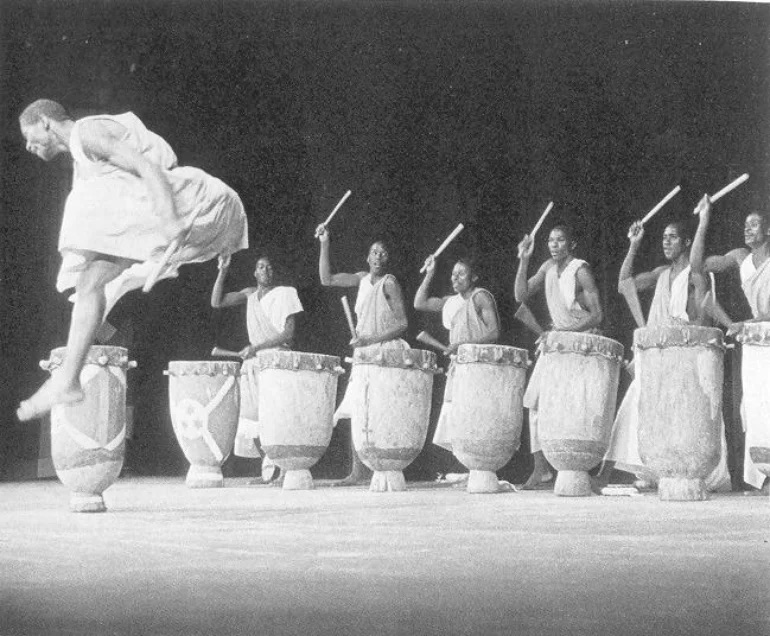
In the 19th century, King Mwezi Gisabo (reign around 1852-1908) founded the sanctuary of Gishora, about seven kilometers from Gitega, to perpetuate the rites of the royal drum. The site, protected by a palisade of wooden posts, comprises three courts: the main royal court, the king’s private court and the court of sacred drums. The two largest drums, Ruciteme (the one for which land is cleared) and Murimirwa (the one for which crops are cultivated), still rest there inviolate, linked to fertility and royalty 4. The drums are played by the Abatimbo, artisan-drummers whose skill is transmitted from father to son. The performance integrates synchronized rhythms, acrobatic dances, heroic poetry and traditional songs: at the center, a central drum inkiranya directs the rhythm followed by peripheral drums amashako and ibishikiso 5.
International recordings arrive in 1967, with Ocora’s collection that captures the whispered voices, zithers inanga and polyrhythms of the drums. The album Musique du Burundi (Ocora, 1968) becomes a reference for Western musicians: saxophonist Don Cherry integrates the Burundian “whispered singing” into his repertoire, while Joni Mitchell draws inspiration from the same sources on her album The Hissing of Summer Lawns 6. The Masters Drummers of Burundi embark on their international tours from the 1960s, participating in the first WOMAD Festival in 1982 and revealing to the whole world these polyrhythms that seduce both concert halls and cinemas, which have abundantly used them as soundtracks for films 7.
Beyond the drums, traditional Burundian music abounds with remarkable instruments. The inanga, a six- or eight-stringed hollow zither stretched over a wooden board, accompanies the chuchotee, whispered singing where low voices blend with the instrument’s resonances to tell stories 8. The idono, a monocord violin originating from Tanzania, is played solo with singing, covering themes of religion, politics and history. The umwirongi, a small shepherd’s flute, and the igihuha, antelope horn, complete this soundscape. Vocal forms are equally rich: the akazehe, interlocked polyphonic singing played exclusively by women during social greetings, alternates two voices — gutera (to lead) and kwakira (to respond) — according to strict musical rules 9.
Post-independence: Rumba and Modernization
Burundi gains independence from Belgium in 1962. The monarchy is abolished in 1966, and the republic gets set up. But music does not follow the political course. Congolese rumba and soukous, which cross Lake Tanganyika to reach Bujumbura, profoundly influence the young urban scene from the 1960s. Congolese musicians fleeing the Katanga secession crisis take refuge in Nairobi and Bujumbura, which have recording studios 10.
The 1980s mark a decisive turning point with the Orchestre Amabano, one of Burundi’s flagship groups, which fuses Congolese rumba, psychedelic funk and traditional Burundian elements to create accessible pop music that is easy to dance to. Their album Amsterdam Ticket (1987) propels them among the country’s best orchestras and earns them an award at the Radio Nederland contest 11. This is the era when Burundian groups begin to record and perform internationally, paving the way for a structured urban scene.
It is also during this period that Khadja Nin (born June 27, 1959) takes her first musical steps. Discovered as a child soloist in a Bujumbura choir at the age of seven, she leaves Burundi for Belgium via Zaire in the early 1980s. She signs with BMG in 1985, and her eponymous album Khadja Nin is released in 1992. Her second album, Ya Pili, is praised by critics in 1994. The third, Sambolera (1996), is a multilingual masterpiece mixing Swahili, Kirundi and French, where the track Sina Mali, Sina Deni reinterprets Stevie Wonder under the title Free 12. Khadja Nin sings in duo with Montserrat Caballé on Sailing in 1997, and performs at Paris-Bercy alongside Sting in 2000. Her legacy continues to inspire contemporary Burundian female artists 13.
Civil war, resilience and digital renaissance
The years 1993 to 2005, marked by an exceptionally violent civil war, caused the exile of many artists and weakened traditional oral transmissions. Learning was disrupted, scenes scattered. Yet, music remained a powerful vector of resilience: Kidum, a Burundian musician based in Kenya, composed peace songs that circulated within the diaspora and in the country itself, attempting to weave bridges between wounded communities 14.
In the digital age, a new generation reconfigured the Burundian scene. Big Fizzo (Mugani Desire), born in Bwiza, a suburb of Bujumbura, began his career in the group Nigga Sound at the end of the 1990s. The group struggled, but Kidum, impressed by his talent, helped him launch a solo career. He became the tutelary figure of Burundian urban pop, with tracks like Mbarira, Bajou, Sitapenda Tena and Urambabaza, sung in Kirundi, Rwandan, Swahili, French and English 15.
Sat-B (Bizimana Aboubakar Karume), born on 7 December 1989 in Bujumbura, may have signed the most accomplished project of the contemporary scene. His name means “Satellite of Buja” — his nickname is self-descriptive. After starting in the hip-hop trio Wanavesi Kikosi, he launched a solo career in 2009. His songs, danceable and triply linguistic (Kirundi, French, English), make him one of the most important artists in East Africa, awarded an East Africa Entertainment prize in 2022 and a nomination for an Afrima 16. He collaborates with Meddy, Sauti Sol and Urban Boyz, and runs the Empire Avenue label 17.
The current scene is young, diverse and resolutely digital. Bernice the Bell, born into a family of musicians during the civil war, found solace in singing amidst displacement; her track Iwacu (2022), dedicated to Burundi and its traditions, received numerous awards 18. Fabelove (Fabelove Kamiligado), nicknamed “Da K.Shan Boy”, is the most “gangsta” rapper on the scene, voted Radio Artist of the Year 2019 19. B-Face On The Flo (Boniface Girukwishaka) performs dense and impactful Kirundi rap, exploring issues of youth, poverty and identity 20. K Muco, born in a refugee camp in Tanzania and raised in the United States, produces English-language trap about cassava culture that circulates globally 21. Sat-B collaborates with Ibraah (Tanzania), and Mt Number One with Mar Mar, showing the porosity of the East African scene 22.
Where is it going?
Initiatives such as the Akiwacu centre in Kigobe, Bujumbura, or the Institut français du Burundi, train the new generation in traditional and modern instruments 23. The Yaga Festival in Bujumbura brings together local and regional artists. The Musicology Institute of Gitega integrates traditional practices into the education of young people 24.
Yet challenges persist. Censorship and pressure on radio stations remain realities. The lack of professional studios hinders independent production. Year 217 marks a turning point: a government decree forbade women from playing drums, on the pretext that drumming is men’s work, whereas women have broken through centuries of tradition 25. Young artists confronted with the economic realities of a scene in reconstruction must cope with piracy, lack of infrastructure and competition from Congolese rumba, which is more structured and accessible 26.
But the drum still speaks. The Abatimbo of Gishora continue to strike the hills, and each generation in Bujumbura reinterprets rhythms in Kirundi, Swahili, French or English. Burundian music does not wait to be given a voice — it already has one, for centuries 27.
Sources and references
-
UNESCO, “Ritual Dance of the Royal Drum in Burundi”, inscribed in 2014, ich.unesco.org. ↩︎
-
Leonard Sinzinkayo, Director General of Culture and Arts at the Burundian Ministry, interview reported by Xinhua, December 23, 2018, xinhuanet.com. ↩︎
-
Grokipedia, article “Karyenda”, en.wikipedia.org/wiki/Karyenda. ↩︎
-
“The Royal Residence of Burundi: The Case of Gishora”, UNESCO Tentative List 2007, whc.unesco.org. ↩︎
-
Britannica, “Burundi - Ethnicity, Music, Dance”, britannica.com. ↩︎
-
In Sheeps Clothing Hi-Fi, album sleeve notes for Musique du Burundi (Ocora OCR 40, 1968), insheepsclothinghifi.com. ↩︎
-
Stern, Ronnie Graham, Stern’s Guide to Contemporary African Music (Zwan Publications, 1988), pp. 230-231. ↩︎
-
Grokipedia, “Music of Burundi”, grokipedia.com. ↩︎
-
BlueTree Audio, “Burundi Music Today”, accessed in 2025, music.bluetreeaudio.com. ↩︎
-
World Music Guide, “Chapter 5: East Africa”, skill world-music-guide. ↩︎
-
Grokipedia, “Music of Burundi”, section Orchestre Amabano, grokipedia.com. ↩︎
-
Spotify, artist profile Khadja Nin, open.spotify.com. ↩︎
-
Wikipedia, “Khadja Nin”, en.wikipedia.org/wiki/Khadja_Nin. ↩︎
-
Grokipedia, “Music of Burundi”, section Cultural and Social Context, grokipedia.com. ↩︎
-
Music in Africa, “Big Fizzo”, musicinafrica.net. ↩︎
-
Wikipedia, “Sat-B”, en.wikipedia.org/wiki/Sat-B. ↩︎
-
ProfileAbility, “SAT-B Biography”, profileability.com. ↩︎
-
Supamodu, “An Anthology of the Best New Music from Burundi, Part II”, January 21, 2020, supamodu.com. ↩︎
-
Supamodu, op. cit. (section Fabelove). ↩︎
-
BlueTree Audio, op. cit. (section Kirundi in rap). ↩︎
-
Supamodu, op. cit. (section K Muco). ↩︎
-
BlueTree Audio, op. cit. (section East African exchange). ↩︎
-
BlueTree Audio, op. cit. (section Where creation happens now). ↩︎
-
Grokipedia, section Preservation and Challenges, grokipedia.com. ↩︎
-
Africanews, “Burundian drummers keeping the old vibe alive”, June 22, 2022, africanews.com. ↩︎
-
Bujumbura.org, “Music & Dance in Burundi — Traditional to Modern”, bujumbura.org. ↩︎
-
CountrySpec, “The Royal Drum, Kirundi, Food and Belief”, countryspec.com. ↩︎