Biography
Tao Ravao
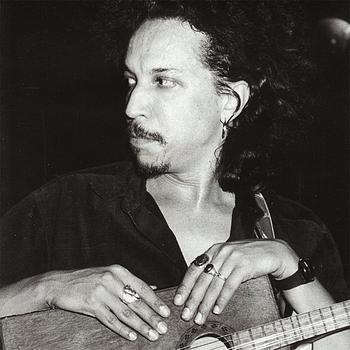
The Malagasy guitarist Tao Ravao spent seven years crossing Europe as a street musician, with a suitcase on his back and blues in his strings. Years later, this same man, born to a Betsileo mother and a French father in Antananarivo in 1956, returned to the island to discover sounds he had never heard before: those of the valiha, a bamboo tube zither that vibrates like an ancestral breath above the Indian Ocean. He carried with him the chords of Chicago blues, learned under the guidance of Homesick James. Thus, Malagasy afro-blues was born — a musical bridge between the Mississippi delta and the great island.
In brief
| Stage name | Tao Ravao (chosen name, that of his mother) |
| Birth | August 8, 1956, Antananarivo (Madagascar) |
| Field | Multi-instrumentalist — kabosy, valiha, guitar, mandolin; afro-blues and Malagasy music |
| Signature works | Vazo (2013), Piment Bleu (2021) |
| Regular collaborations | Vincent Bucher (harmonica), Thomas Laurent (harmonica) |
Key dates
| Year | Event |
|---|---|
| 1956 | Birth in Antananarivo, to a Betsileo mother and a French father |
| 1968 | Departure for France (Montluçon); first instruments: mandolin, banjo |
| 1969-1970 | Meeting with Homesick James, Chicago bluesman; trip to Chicago to study |
| 1980 | First appearance at the New Orleans jazz festival; accompanied Big Walter Horton, Louisiana Red |
| 1988 | Return to Madagascar: fascination with traditional music, trio with Justin Vali |
| 1989 | Recording of Live – From Madagascar To Chicago with The All Out Blues Band |
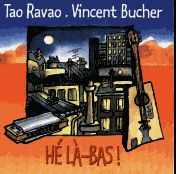
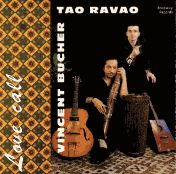
| 1993-2004 | Intense collaboration period with Vincent Bucher (Love Call, Tany Manga, Hé Là-Bas) |
| 2013 | Release of Vazo, album dedicated to the 1947 Malagasy insurrection |
| 2016 | Au bout du petit matin…, in duo with Thomas Laurent, on Buda Musique |
| 2021 | Piment Bleu, with Vincent Bucher, World Music Award of the Charles Cros Academy |
From Chicago blues to the sound of the great island
Tao Ravao grew up on the island he would leave at age twelve, surrounded by the ambient sounds of Malagasy music: mandolin and banjo first served him to reproduce the traditional string instruments he heard around him. In Montluçon, in 1968, a record by Homesick James — nicknamed “Mr Bottle Neck” for his bottleneck playing — changed everything. The Malagasy-origin French teenager discovered electric blues, and the following year, he knocked on his idol’s door in Chicago. Homesick James accepted him as a student; he followed him on tour in Italy, and gradually built a reputation as a sideman on the American blues scene: from 1980, he played at the New Orleans festival and accompanied veterans such as Big Walter Horton, Louisiana Red, and Eddie C. Campbell on a journey that extended until 1993.
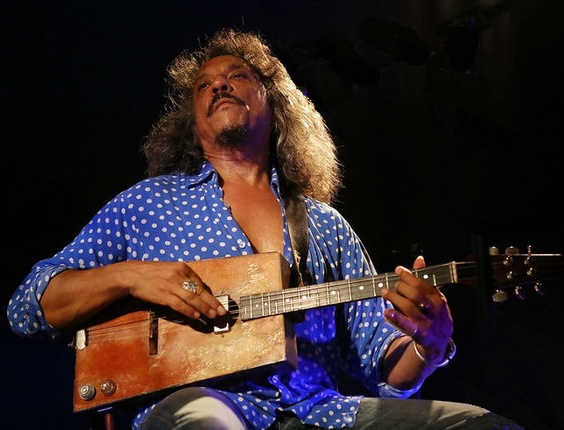
This emerging bluesman was also a street musician on the streets of France — seven years in Europe with a guitar, from stages to open-air markets. “I always saw the vision of blues in everything I played,” he would later explain. But in 1988, a trip to the island of his childhood caused this second creative shock: Tao Ravao discovered traditional Malagasy music and began learning the kabosy (rustic small guitar from southern Madagascar) and the valiha. By introducing the slide to the kabosy — a technique unknown to amateur Malagasy guitarists of the time — he forged an unprecedented hybrid style: Malagasy afro-blues.
Memory and trances: music as duty
The album Vazo, released in 2013, marks a decisive turning point in Tao Ravao’s journey. With his constant accomplice, harmonica player Vincent Bucher, bassist Axel Rasoanaivo, and percussionist Jean-Noël Godard, he dedicates four tracks to the Malagasy insurrection of March 1947, a French colonial repression that caused thousands of deaths. “95% of Malagasy people do not know what happened to us in 1947,” declares Tao Ravao in Le Monde. “It is a part of our history completely obscured — one of the greatest massacres of French colonialism.”
This work of memory, he also undertook through the show Rano Rano, alongside photographer Pierrot Men and writer Jean-Luc Raharimanana: together, they went to Madagascar to collect testimonies from the last survivors of the insurrection. “I then began a work of memory,” he confesses, after reading the writings of Franciscan brother Jacques Tronchon.
With Vincent Bucher, Tao Ravao has formed since the 1980s the duo Tany Manga (which translates approximately from Malagasy as “sacred land” or “blue land”), crossing festivals from Vancouver to Tokyo, from Montreal to East Africa. Their music — a crossbreed where blues, jazz, Malagasy, West Indian, and Cajun mix — was praised by RootsWorld as “a mastered compromise between harmonica and kabosy rather than the noisy individualism of their playing.” In 2016, he renewed the experience with Thomas Laurent on Au bout du petit matin…, an album tribute to Aimé Césaire and mosaic of blues, Cape Verdean morna, Brazilian forro, and Creole themes. Piment Bleu (2021), their latest common opus, received the World Music Award of the Charles Cros Academy.
Major works
| Work | Year | Why it is essential |
|---|---|---|
| Live – From Madagascar To Chicago | 1989 | First live recordings of Tao Ravao, pure Chicago blues |
| Tany Manga (with V. Bucher) | 1996 | Starting point of the founding duo, affirmed Malagasy afro-blues |
| Vazo (with V. Bucher) | 2013 | Memorial commitment on the 1947 insurrection, biographical turning point |
| Piment Bleu (with V. Bucher) | 2021 | Concluded afro-blues synthesis, Charles Cros Academy World Music Award |
Heritage and Influence
Tao Ravao embodies a rare intercultural bridge: the Malagasy bluesman who reintegrated the traditional sounds of his homeland with the technique of an American street musician. His discipline as an artist-director is as notable as his instrumental virtuosity — he directed the production of albums by D’Gary, Jean Émilien, Rajery, and the Malians Ba Cissoko and Sékou Diabaté of Bembeya Jazz. By rediscovering the kabosy and valiha with the attitude of a bluesman, he opened a path that many young Malagasy musicians follow today.
Sources and References
- « Tao Ravao — BIO », taoravao.com, https://taoravao.com/index.php/bio/, accessed 5 November 2026.
- « Tao Ravao, the Blues of Madagascar », Le Monde, https://www.lemonde.fr/culture/article/2013/05/29/tao-ravao-le-blues-de-madagascar_3420060_3246.html, accessed 5 November 2026.
- « Tao Ravao », Afrisson, https://www.afrisson.com/tao-ravao-390/, accessed 5 November 2026.
- « Tao Ravao and Vincent Bucher with Jean-Noel Godard », Gary Cristall, https://www.garycristall.com/tao.shtml, accessed 5 November 2026.
- « Tao Ravao — Discography », Discogs, https://www.discogs.com/artist/3541649-Tao-Ravao, accessed 5 November 2026.
- « Tao Ravao and Thomas Laurent — Au bout du petit matin », RootsWorld, https://www.rootsworld.com/reviews/ravao-17.shtml, accessed 5 November 2026.
- « INTERMEDIAL INDIAN OCEAN — In Conversation with Tao Ravao », Africa Multiple AMIRA, https://data.africamultiple.uni-bayreuth.de/s/amira/item/39358, accessed 5 November 2026.
- « Tao Ravao et Vincent Bucher — De Madagascar aux rives du Mississipi », 5planètes, https://www.5planetes.com/fr/actualites/tao-ravao-et-vincent-bucher, accessed 5 November 2026.