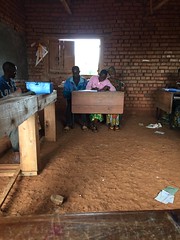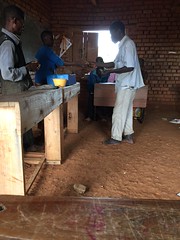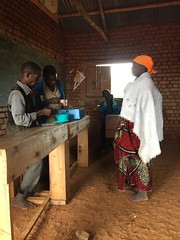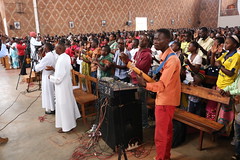
Burundi : Photos

Discover every day Photographs of the various countries of Africa and the Caribbean

All the photos are from the photo sharing website flickr

Use the left menu to choose a country.


Epilobium hirsutum - stolon tip Calandstraat, Leiden, NL 10 Aug 2008 07 Leo

This plant is a hemicryptophyte and a helophyte. Although every winter the above-ground portions of the plant die off, it is still a perennial. in the autumn lateral buds near the base of the main stem produce fleshy stolons, such as the one pictured above, which grow along the ground just below the surface of the soil. It is a helophyte because it can stand frequently waterlogged soils.
The roots you see here are adventitious, because this is actually a stem. Those thingys sticking off it are apparently called 'cataphylls'.


Epilobium hirsutum - base leaf + stem Calandstraat, Leiden, NL 10 Aug 2008 Leo

See. No petioles, hairy stem.


Epilobium hirsutum - lvs Calandstraat, Leiden, NL 10 Aug 2008 05 Leo

On distribution: This plant is native throughout Eurasia and much of northern, eastern and southern Africa, and has been introduced to eastern Australia and northeastern and the northern west coastal regions of North America.

This is the list of countries it is seen as native in: Iceland, Ireland, UK, Portugal, Spain, France, Belgium, Netherlands, Luxembourg, Germany, Denmark, Poland, Belarus, Czech Republic, Slovakia, Norway, Sweden, Finland, Latvia, Lithuania, Estonia, Switzerland, Austria, Hungary, Italy, Slovenia, Croatia, Bosnia, Serbia, Kosovo, Macedonia, Albania, Greece, Turkey, Bulgaria, Romania, Moldova, Ukraine, India, Russia, Iran, Pakistan, Afghanistan, Japan, North Korea, South Korea, Mongolia, Nepal, Myanmar, Bhutan, Morocco, Algeria, Tunisia, Libya, Egypt, Israel, Lebanon, Sudan, Chad, Niger, Eritrea, Ethiopia, Kenya, Tanzania, Uganda, Burundi, Rwanda, DRC, Zimbabwe, South Africa, Lesotho, Swaziland, and Namibia.
It is found in the Canary Islands and Cape Verde, but nativity seems questionable.

It is apparently not found in Somalia, Djibouti, Sri Lanka or Taiwan.

I still must check the distribution in these areas: Malta? Middle East? Taiwan? Caucasus? Central Asia? Mozambique? Madagascar? SE Asia?

Here's some notes:
North America:
I was first inclined to think that the distribution in North America was again injudiciously seen as non-native, but I have since revised my opinion. There are three main reasons why this plant is probably not native to the USA and Canada:
1. Someone actually wrote a report explaining a timeline for its introduction; 'Distributional History of Epilobium hirsutum (great hairy willow-herb) in North America' by R. L. Stuckey, written 1970.
2. Looking at the proven distribution as provided by Den Virtuella Floran
(http://linnaeus.nrm.se/flora/di/onagra/epilo/epilhir.html) shows that it is not so adapted to northern conditions that a Bering Strait crossing during the Ice Age is likely.
3. Deilephila elpenor, a moth which uses this plant as a host plant does not share a North American distribution with E. hirsutum (well actually, it seems to have been introduced recently in southwest Canada).

Scandinavia: Some publications say it does not occur in Scandinavia. This is not true, it occurs throughout along the southern Baltic and North Sea coasts.


Epilobium hirsutum (Harige Wilgeroosje) - Calandstraat, Leiden, NL 10 Aug 2008 Leo

English: Hairy Willow-herb, Great Willowherb, Great Hairy Willowherb, Codlins-and-cream (UK), Apple-pie (UK), Cherry-pie (UK), Kaporie Tea (UK?)*, Salt of the Shepherds (SA)
Arabic: ذنب القطة ,علفة ,شيخ ,فرفور
Catalan: Epilobi Hirsut, Matajaia
Chinese: 柳叶菜, pronounced 'liu ye cai'
Czech: Vrbovka Chlupatá
Danish: Danish: Lådden Dueurt
Dutch: Harig Wilgenroosje
Estonian: Karvane Pajulill
Farsi: علف بید
Finnish: Karvahorsma
French: Épilobe à grandes fleurs, Épilobe hirsute, Nériette amplexicaule, Épilobe hérissé, Épilobe velu
Frisian: Stokroastieneblom
German: Zottige Weidenröschen, Zottiges Weidenröschen, Zottigesweidenröschen, Zottiges-Weidenröschen, Rauhes Weidenröschen, Rauhhaariges Weidenröschen, Kleinblaettriges Weidenroeschen (?)**
Greek: Παραχνούδι, pronounced 'parachnouthi'
Hebrew: ערברבה שעירה, with vowels written עֲרַבְרַבָּה שְׂעִירָה
Hungarian: Borzas Füzike, Gyapjas Füzike
Italian: Garofanino d'acqua, Viole di palude
Japanese: オオアカバナ
Korean: 큰바늘꽃
Latvian: Pūkainā Kazroze
Lithuanian: Plaukuotoji Ožkarožė
Norwegian: Stormjølke
Polish: Wierzbownica Kosmata
Portuguese: Erva-dos-estolhos
Romanian: Limbricas, Rascoage, Pufulita, Sburatoare***
Russian: Кипрей Волосистый
Sami: Horbmášattut for the entire genus Epilobium
Samogitian: Plaukoutuojė Uožkaruožė
Spanish: Epilobio Velludo, Hierba de San Antonio, Adelfilla Pelosa
Swazi: iciKiciki, itSwayi Lentaba
Swedish: Rosendunört
Turkish: Yakı Otu, Yakıotu (tüylü), Meragülü
Ukrainian: Знітом Шорстким
Upper Sorbian: Kosmičkata Wjerbinka

*Weak source = According to Mrs C.F Leyel in her 1937 book Herbal Delights "Willow Herb went by the name Kaporie Tea in Russia". PFAF has quoted that fact, and Jean-François Leger from Tela Botanica probably got it from them. Tea in Russian is Чай, which is pronounced something like 'chaí', for one.
**From Israeli source
***Also used for E. angustifolium


Men in Banana field

PWRDF posted a photo:

Men in Banana field


Training

PWRDF posted a photo:

Training


Rumongue clinic

PWRDF posted a photo:

Rumongue clinic


Terraces

PWRDF posted a photo:

Terraces


Rumongue clinic - 2

PWRDF posted a photo:

Rumongue clinic - 2


Field with terraces

PWRDF posted a photo:

Field with terraces


Men standing in experimental farm

PWRDF posted a photo:

Men standing in experimental farm


Experimental farm

PWRDF posted a photo:

Experimental farm


Field showing erosion

PWRDF posted a photo:

Field showing erosion


Rumongue clinic - 4

PWRDF posted a photo:

Rumongue clinic - 4


Cows

PWRDF posted a photo:

Cows


Nestor in the field

PWRDF posted a photo:

Nestor in the field


Cows-2

PWRDF posted a photo:

Cows-2


Training - 2

PWRDF posted a photo:

Training - 2


Farmers' training

PWRDF posted a photo:

Farmers' training


Terraces training

PWRDF posted a photo:

Terraces training


Images automaticaly loaded from flickr with tags : (burundi)